Time: Popularity:0times
A Heat Deflection Vicat Softening Point Tester is an instrument designed to measure the temperature at which thermoplastic materials or resins start to soften under a specified load. By applying a standard force while heating the sample, you can determine the Vicat softening point, which reflects the material’s heat resistance and deformation behavior under high temperatures. This information is essential for assessing material performance in processing and in high-temperature applications.
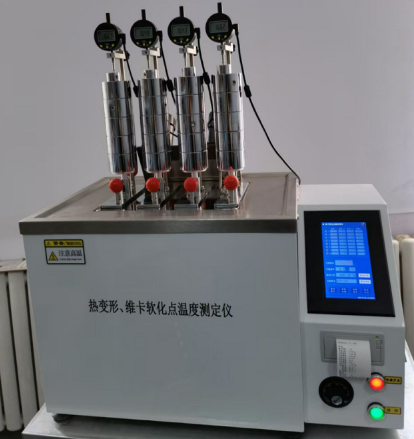
You can use this tester to:
(1) Determine the Vicat softening point of various thermoplastic materials and resins;
(2) Evaluate how materials behave under heat and mechanical stress;
(3) Compare different batches or types of materials for consistency;
(4) Support product development, quality control, and performance verification.
The instrument helps you understand how a material will perform in manufacturing, during long-term use, or in high-temperature environments.
When using this tester, follow established standards to ensure accuracy and repeatability:
GB/T 1633 “Plastics — Determination of Vicat Softening Temperature”
ISO 306 “Plastics — Thermoplastic Materials — Determination of Vicat Softening Temperature”
These standards define sample size, load, heating rate, and measurement procedure, allowing you to obtain reliable and comparable results.
To perform a test, follow these steps:
(1) Prepare and place the sample in the tester’s fixture;
(2) Apply the standard load according to the relevant standard;
(3) Heat the sample at the controlled rate specified in the standard;
(4) Observe the probe until it penetrates the sample to a set depth; the temperature at this point is the Vicat softening point;
(5) Repeat the test if needed and take the average for more precise results.
Strict adherence to the standard ensures the measurement is valid and reproducible.
No. The Heat Deflection Vicat Softening Point Tester is specifically designed for polymers and thermoplastics. Metals, such as iron or steel, have much higher melting points and deform differently, so this instrument cannot be used for metal testing. For metals, high-temperature mechanical testing machines or thermal expansion instruments are required.
When selecting an instrument, consider:
(1) Material compatibility – ensure it is suitable for the types of plastics or resins you work with;
(2) Heating method – electric heating or oil bath heating affects temperature uniformity;
(3) Load range – verify it meets the standard-specified load requirements;
(4) Temperature precision – high-precision control ensures consistent and accurate results;
(5) Ease of operation – digital display, automatic testing, and data recording features improve efficiency and reduce user error.

Company Phone
+86-21-6420 0566
Working hours
Monday to Friday
Mobile phone:
13816217984
Email:
info@qinsun-lab.com