Time: Popularity:0times
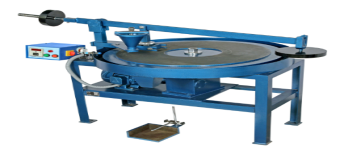
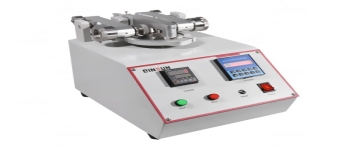
The Taber Abrasion Resistance Tester, also known as the Taber Abraser, is a professional instrument used to evaluate the wear resistance and surface durability of materials. By applying controlled friction through rotating abrasive wheels, the tester accurately simulates real-world abrasion such as rubbing, scuffing, and mechanical wear.
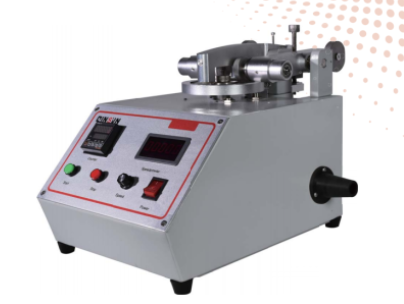
This device is essential for product development, quality inspection, and material performance comparison, helping manufacturers assess lifespan, optimize formulations, and ensure compliance with global standards.
The Taber Abrasion Tester is widely used across multiple industries and material categories, including:
Automotive: interior panels, coatings, trims, leather
Plastics & Polymers: sheets, films, molded components
Textiles: upholstery fabrics, industrial fabrics, protective fabrics
Coatings & Paints: wood coatings, metal coatings, decorative finishes
Flooring: laminate flooring, vinyl flooring, composite materials
Paper & Packaging: printed surfaces, laminated cartons
Electronics: device housings, keypads, controllers
Its versatility makes it suitable for factories, testing laboratories, R&D centers, and certification agencies.
The Taber Abrasion Resistance Tester meets major international abrasion test standards, including:
ASTM D4060 – Abrasion Resistance of Organic Coatings (Taber Abraser Method)
ASTM D1044 – Abrasion Resistance of Transparent Plastics
ASTM D3884 – Abrasion Resistance of Textile Fabrics (Rotary Platform, Double-Head Method)
ISO 5470-1 – Rubber- or Plastics-Coated Fabrics — Abrasion Resistance (Taber Abraser)
ISO 9352 – Plastics — Determination of Resistance to Wear by Abrasion (Taber Abraser Method)
DIN 53109 – Abrasion Resistance of Paper and Board (Taber Method)
JIS K 7204 – Plastic Abrasion Resistance Test (Taber Method)
GB/T 1768 – Paints and Varnishes — Determination of Abrasion Resistance (Taber Abraser Method)
Complying with these standards ensures reliable, repeatable results recognized worldwide.
| Parameter | Specification |
|---|---|
| Rotational Speed | Adjustable: 30–75 RPM (digital control) |
| Sample Diameter | 100 mm |
| Test Platform Diameter | 113 mm |
| Cycle Range | 1–999,999 revolutions (presettable) |
| Air Pressure | 250 g (standard) |
| Weight Options | 250 g, 500 g, 750 g, 1000 g (included); 125 g (optional) |
| Wheel Pressure Range | 125 g, 250 g, 500 g, 750 g, 1000 g, 1250 g |
| Vacuum Arm Adjustment | Height-adjustable |
| Power Supply | 220 V, 50 Hz |
| Dimensions | 220 (W) × 380 (D) × 300 (H) mm |
| Net Weight | 20 kg |
1. Single-Head Taber Abraser
Standard configuration suitable for daily QC and basic material evaluation.
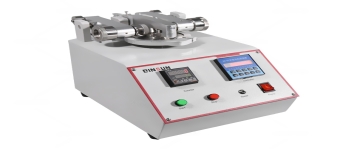
2. Double-Head Taber Abraser
Allows simultaneous testing with two abrasive wheels, improving efficiency and stability.
3. Digital/Touchscreen Taber Abraser
Equipped with programmable settings, cycle presets, and digital control for higher accuracy.
4. Industrial Heavy-Duty Taber Abraser
Designed for high-load, aggressive abrasion testing on flooring, coatings, and industrial materials.
The Taber Abrasion Tester operates using a rotating platform abrasion mechanism:
The specimen is mounted on a circular rotating turntable.
Two abrasive wheels are pressed against the surface under a specified load.
As the platform rotates, the wheels create a circular wear path.
Wear is measured through:
weight loss
thickness reduction
haze or gloss changes
visual observation
cycles required to reach failure
This principle accurately replicates surface wear caused by handling, walking, rubbing, and long-term usage.
1. What materials can be tested with a Taber Abrasion Resistance Tester?
It can test plastics, coatings, textiles, leather, paper, flooring, automotive materials, and electronic housings.
2. How do I select the correct abrasive wheel?
Choose based on your material and test standard:
CS-10: mild abrasion (coatings, plastics)
H-18: moderate–heavy abrasion
H-10: aggressive abrasion
CS-17: general-purpose abrasion
3. How are abrasion test results evaluated?
Evaluation may include weight loss, visual grading, haze increase, gloss decrease, or the number of cycles required to produce wear failure.
4. Do I need a vacuum system during testing?
Yes. Vacuum suction removes debris and ensures consistent friction on the specimen surface.
5. What is the typical number of cycles for a Taber abrasion test?
Common ranges include:
100–1,000 cycles for coatings
1,000–10,000 cycles for plastics, flooring, and composite materials
6. How often should I replace or resurface the abrasive wheels?
Wheels should be resurfaced or replaced when they become glazed, worn unevenly, or reach the minimum allowable diameter specified by the standards.

Company Phone
+86-21-6420 0566
Working hours
Monday to Friday
Mobile phone:
13816217984
Email:
info@qinsun-lab.com