Time: Popularity:0times
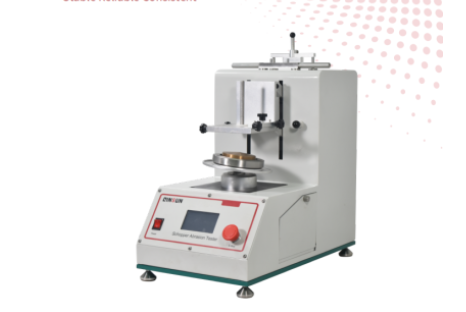
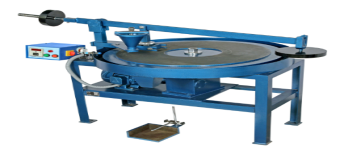
The Schopper Abrasion Tester is used to measure the abrasion resistance, surface durability, and wear performance of flexible materials. It simulates rotary friction under controlled force, enabling accurate evaluation of how materials perform under repeated rubbing or contact stress.
Automotive interior materials (fabric, leather, coated textiles, decorative films)
Paper, cardboard, and printed packaging surfaces
Synthetic leather and coated materials
Nonwoven fabrics and technical textiles
Soft-touch surfaces and interior trim components
This instrument is widely used in automotive OEM labs, material manufacturers, textile factories, and R&D institutions.
The Schopper Abrasion Tester meets major global and automotive abrasion testing standards:
DIN 53863 Part 2 – Rotary abrasion test for textile fabrics
GME 60345 / GMW 3283 – GM automotive abrasion protocols
VW/Audi PV 3908 – Volkswagen/Audi surface durability standard
QC/T 216 – Chinese automotive interior material abrasion standard
Its broad compliance ensures reliable qualification testing across multiple industries.
Standard Schopper Abrasion Tester
Applications: Paper, textiles, packaging, and general materials
Standards: DIN 53863, QC/T 216
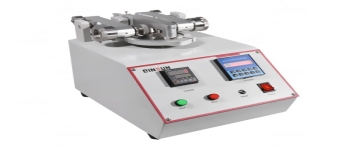
Automotive-Grade Digital Schopper Abrasion Tester
Applications: Automotive fabrics, leather, coated textiles
Features: Touchscreen, programmable cycles, load control
Standards: GMW 3283, PV 3908, GME 60345
High-Load Schopper Abrasion Tester
Applications: Heavy-duty materials, industrial fabrics, reinforced coatings
Features: Higher load capacity up to 25 N
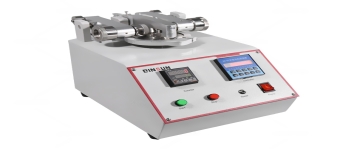
Custom Multi-Station Schopper Abrasion Tester
Applications: High-throughput QC labs
Features: Multi-head design for parallel testing
Precision Compliance
Designed to meet multiple global automotive standards, ensuring universal testing capability.
Versatile Applications
Suitable for fabrics, leather, coated textiles, soft-touch materials, and other flexible substrates.
User-Friendly Interface
Touchscreen operation with manual or automatic mode selection.
High Measurement Accuracy
Adjustable arc height (0–10 mm) and load range 0.5–25 N provide precise test control.
Durable Construction
Stainless-steel test head and corrosion-resistant components ensure long-term reliability.
High Testing Efficiency
The test head automatically reverses rotation every 100 cycles, reducing test bias and improving result repeatability.
Rotary Abrasion Mechanism
The test head rotates at 75 rpm, maintaining line contact with the abrasion block at a 166° taper angle, accurately simulating tangential wear.
Stable Clamping System
An obtuse-angle cone chuck secures samples firmly, even under high-speed rotation.
Touchscreen Control Panel
Allows users to set cycles, load, direction reversal, and monitor test progress in real time.
Arc Height Measurement
Built-in gauge measures deformation or wear depth after testing.
Load Customization
Includes interchangeable weights — 50 g to 1500 g — to match different material requirements.
Compact and Space-Saving
With dimensions 325 × 565 × 560 mm, it fits easily into most laboratory environments.
| Parameter | Specification |
|---|---|
| Revolutions per Minute | 75 rpm |
| Taper Angle | 166° |
| Mounting Head Declination | 7° |
| Specimen Size | 100 cm² |
| Test Area | 50 cm² |
| Arc Height Adjustment | 0–10 mm |
| Load Range | 0.5–25 N |
| Standard Weights | 50g, 100g, 250g, 500g, 1000g, 1500g |
| Dimensions | 325 × 565 × 560 mm |
| Net Weight | 35 kg |
| Power Supply | 115/240V, 50/60Hz |
| Power Consumption | 130W |
1. What is a Schopper Abrasion Tester?
The Schopper Abrasion Tester is a precision instrument used to evaluate the abrasion resistance of textiles, leather, automotive interior materials, and coated fabrics. It simulates real-world wear through a controlled rotary abrasion mechanism to determine material durability and performance.
2. What materials can be tested with the Schopper Abrasion Tester?
It is widely used for:
Automotive interior fabrics
Leather and synthetic leather
Coated textile materials
Industrial fabrics
Upholstery materials
Technical textiles
The tester supports both soft and reinforced materials by using adjustable loads.
3. What standards does the Schopper Abrasion Tester comply with?
This tester meets several international and automotive standards, including:
DIN 53863 Part 2
GME 60345 & GMW 3283
VW/Audi PV 3908
QC/T 216
Compliance ensures reliable results for global automotive suppliers and textile manufacturers.
4. How does the Schopper Abrasion Tester work?
The instrument clamps a material sample onto a rotating test head. As the head spins, it creates line contact against an abrasion block under a specified load. The friction simulates long-term wear, helping assess surface damage, fiber breakage, and deformation.
5. How is abrasion resistance measured in this test?
Abrasion resistance is determined by:
The number of cycles completed before visible wear
Change in appearance or surface texture
Arc height deformation (measured 0–10 mm)
Material loss or structural damage
These results help evaluate long-term durability.

Company Phone
+86-21-6420 0566
Working hours
Monday to Friday
Mobile phone:
13816217984
Email:
info@qinsun-lab.com