Time: Popularity:0times
A UV Aging Test Chamber is a laboratory instrument designed to simulate material aging under sunlight. It uses artificial ultraviolet (UV) light sources—typically UV lamps—combined with controllable temperature and humidity, allowing you to replicate long-term outdoor exposure in a short period.
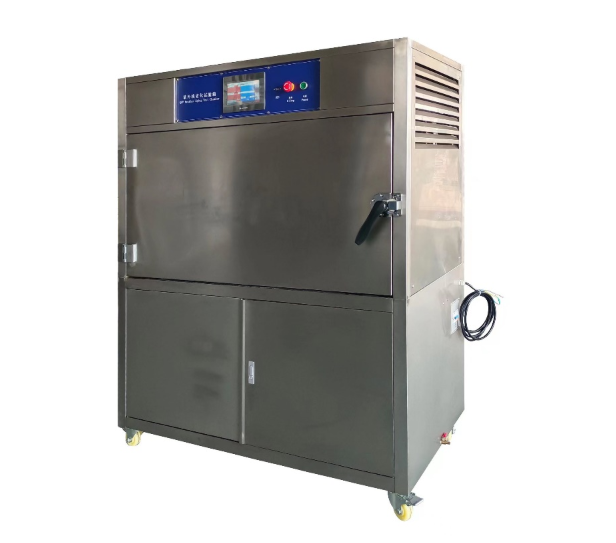
With a UV Aging Test Chamber, you can:
Test the weather resistance of plastics, rubber, coatings, textiles, paints, and other materials;
Observe changes such as color fading, cracking, chalking, or embrittlement;
Assess product lifespan and reliability in outdoor conditions;
Provide data to support material development and quality control.
The chamber is usually designed and operated according to standards such as:
GB/T 16422 “Methods of Exposure of Plastics to UV Light”;
ISO 4892 “Plastics — Methods of Exposure to Laboratory Light Sources”;
ensuring that your test results are repeatable and comparable.
The main purpose of a UV Aging Test Chamber is to simulate and accelerate sunlight-induced aging. Specifically, it allows you to:
Evaluate light resistance: Test how plastics, rubber, coatings, paints, and textiles respond to UV exposure, including color changes, chalking, cracking, or embrittlement.
Predict service life: Accelerated aging experiments can help you estimate long-term performance in outdoor environments.
Support material development: Quickly screen new materials or formulations for improved weather resistance.
Quality control: Standardized tests ensure consistent UV aging performance across production batches.
Performance comparison: Compare different materials or treatments under the same UV exposure conditions.
Although both simulate light-induced aging, they differ in light source, environmental simulation, and application:
Light Source
UV Aging Chamber: Uses UV lamps (e.g., UVA-340 or UVB-313), primarily targeting ultraviolet light to simulate sunlight UV effects.
Xenon Lamp Chamber: Uses xenon lamps that closely mimic full-spectrum sunlight, including UV, visible light, and some infrared radiation.
Environmental Simulation
UV Aging Chamber: Focuses on UV exposure and often combines heat and humidity, but the spectrum is limited.
Xenon Lamp Chamber: Provides full-spectrum sunlight simulation, with controlled temperature, humidity, and optional water spray or condensation cycles, closely replicating real outdoor conditions.
Applicable Materials and Uses
UV Aging Chamber: Suitable for testing plastics, rubber, coatings, paints, and similar materials for UV-specific aging.
Xenon Lamp Chamber: Suitable for coatings, plastics, rubber, textiles, building materials, and more, simulating combined effects of light, heat, and moisture.
Result Relevance
UV Aging Chamber: Reflects performance changes mainly due to UV exposure; results are reliable but limited to UV effects.
Xenon Lamp Chamber: Results are closer to actual outdoor conditions, providing a more comprehensive prediction of natural aging.
1. Preparation Before Testing
Check sample condition: Ensure the surface is clean, dimensions fit the fixture, and samples do not shade each other.
Check lamp type: UVA-340 (295–400 nm) simulates sunlight cutoff for most outdoor materials; UVB-313 (280–315 nm) provides stronger energy for rapid screening but may cause non-natural aging.
Check test standards: Set irradiance, temperature, and cycle programs according to ASTM G154, ISO 4892-3, or GB/T 16422.3.
2. Operation Procedure
Sample installation: Secure samples on the rack, facing the lamps with even spacing; install black panel temperature (BPT/BST) sensors to monitor surface temperature.
Parameter setting: Set UV irradiance (typically 0.35–0.85 W/m² @ 340 nm), light/condensation cycle (e.g., 8 h UV + 4 h condensation); set chamber and condensation water temperatures (chamber 50–70 °C, water 10–15 °C higher).
Running and monitoring: Ensure uniform condensation coverage; check lamps regularly for blackening, flickering, or damage; avoid frequent door opening.
3. After Testing & Maintenance
Turn off lamps and ventilate to cool the chamber;
Remove samples and clean condensation water and debris;
Empty water tank to prevent algae or scale formation.

Company Phone
+86-21-6420 0566
Working hours
Monday to Friday
Mobile phone:
13816217984
Email:
info@qinsun-lab.com