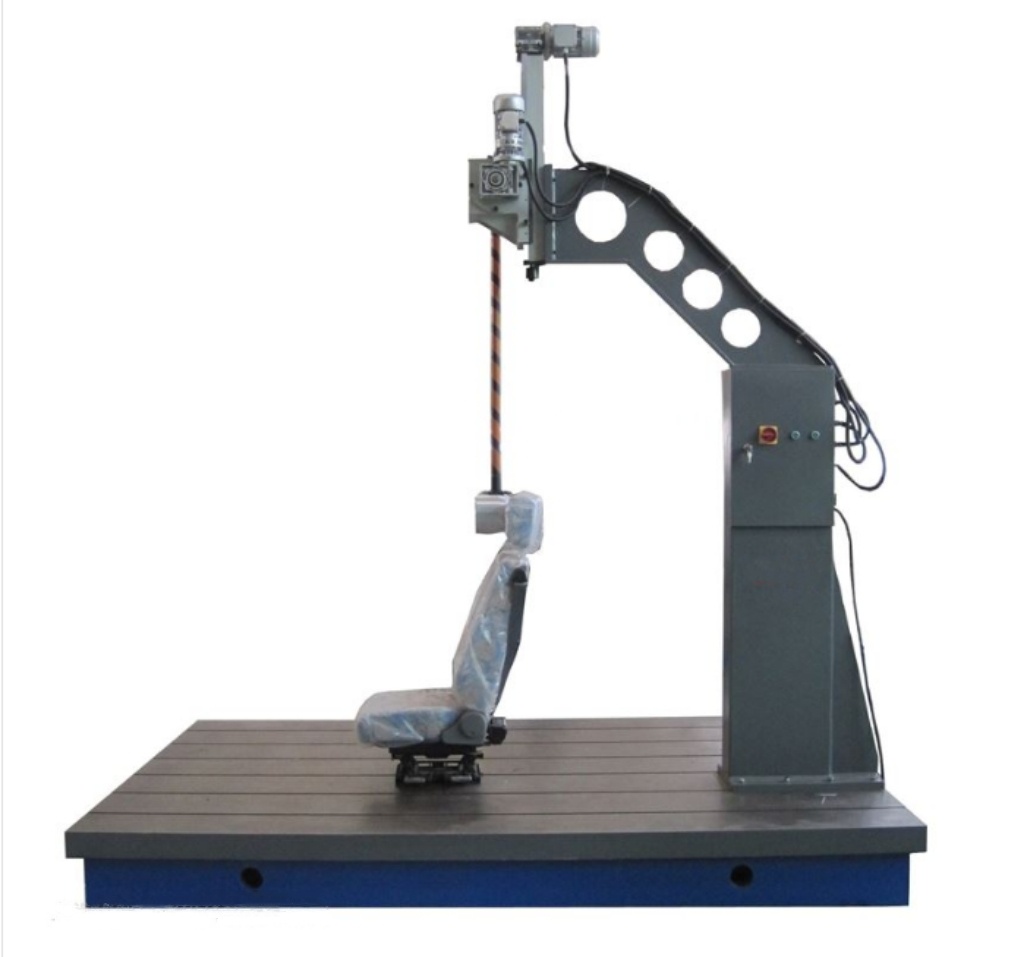
Racing Seat Headrest Restraint and Front-Rear Impact Testing Machine is designed to evaluate the str
WhatsApp : +86 15601902607
Email : info@qinsun-lab.com

The Racing Seat Headrest Restraint and Front-Rear Impact Testing Machine is designed to evaluate the strength and impact performance of racing seat headrest restraint systems. It enables you to perform controlled front and rear impact tests to ensure occupant safety under various conditions. The machine features a user-friendly Windows-based interface with virtual instrument technology, allowing precise operation, real-time monitoring, and efficient data management.
You can use this machine to assess the structural integrity and performance of racing seat headrests and restraint systems in a range of scenarios:
Evaluating headrest strength for new seat designs.
Testing after process modifications or material changes.
Quality verification of incoming seat components.
Random sampling for production quality control.
Reproducing real-world impact conditions to ensure occupant safety.
Commonly tested components with this machine:
Racing seat headrests
Seat restraint assemblies
Front and rear seat structural components
Occupant protection system components
The machine complies with international and national standards for automotive seat and occupant protection testing, including:
GB 15083‑2019 – Automotive seats, seat anchors, and headrest strength requirements and test methods
ISO/TS 16925:2014‑06 – General testing technical specification for seats and occupant restraint devices
FMVSS 202a – U.S. motor vehicle safety standard for head restraint performance
FMVSS 201 – U.S. motor vehicle safety standard for occupant impact protection
FMVSS 208 – U.S. motor vehicle safety standard for occupant protection performance
| Parameter | Details |
|---|---|
| Impact Acceleration Range | 200 g |
| Impact Velocity | 24.1 km/h |
| Velocity Accuracy | ±2.5% (or ±0.5 km/h) |
| Sampling Frequency | 250 kSP/s |
| Pendulum Length | 1250 mm |
| Pendulum Elevation Resolution | 0.1° |
| Acceleration Accuracy | ±5% |
| Impact Hammer Effective Mass | 6.8 kg ±0.05 kg |
| Main Test Bench Dimensions | 3000 × 2000 × 4100 mm |
| Computer Console Dimensions | 600 × 600 × 1500 mm |
| Power Supply | Single-phase AC 220V, 50Hz, 1 kW; Three-phase AC 380V, 50Hz, 3 kW |
Pendulum-based impact testing for precise simulation of front and rear collisions.
Computer interface uses virtual instrument panel technology for intuitive operation.
Test data is reproducible with highlighted key points for easy analysis.
Data is stored in a database, allowing efficient retrieval and review.
Pendulum swing angle adjustable from 0° to 172° for versatile impact testing.
Equipped with safety protective net to ensure operator safety during testing.
Data acquisition modules
Pendulum calibration tools
Protective net and support frame
Clamping and fixture devices for headrests and seats
Computer console with software license
Secure the racing seat and headrest assembly onto the test bench.
Configure impact parameters including velocity, pendulum angle, and sampling frequency via the computer console.
Verify all safety measures, including protective nets, are in place.
Initiate the impact test; pendulum strikes the headrest or restraint system.
Monitor real-time data on acceleration, velocity, and force.
After testing, retrieve the data from the database for analysis.
Inspect the tested component for deformation or failure.
Periodically inspect pendulum and pivot points for wear or alignment issues.
Verify and calibrate the impact hammer and data acquisition system regularly.
Ensure the safety protective net and support frame are intact.
Check computer software and database for integrity and proper operation.
Keep the test area clean and free of debris that may affect pendulum movement.
1. What is this product?
It is a testing machine designed to evaluate the strength and impact performance of racing seat headrest restraint systems under controlled front and rear collision conditions.
2. What is it used for?
You use it to verify headrest and seat restraint strength, assess occupant protection performance, and ensure compliance with automotive safety standards.
3. How does it work?
The machine uses a pendulum to apply a controlled impact to the headrest or restraint system while recording acceleration, velocity, and other data through a high-speed data acquisition system.
4. Why is it important?
It ensures that racing seats and headrests provide effective protection during collisions, reducing the risk of injury to occupants and confirming compliance with safety regulations.
5. Which industries is it suitable for?
Automotive and motorsport seat manufacturing
Safety testing laboratories
Automotive R&D centers
Quality control for seat and restraint system production
Qinsun Instruments Co., LTD is a professional laboratory testing instrument manufacturer in China,Have been focusing on laboratory instrument R&D more than 30 years and have rich industry experience,Based on international testing standards,We are also the instrument supplier for BV SGS laboratory,We provide one-stop solutions for lab instruments,Free Training and Turn-Key Service,Products exported all over the world,Offer 36 month warranty and are a trustworthy partner.

Company Phone
+86-21-6420 0566
Working hours
Monday to Friday
Mobile phone:
13816217984
Email:
info@qinsun-lab.com