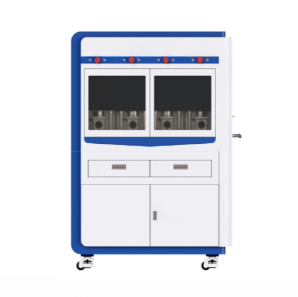
System overview:By in-situ monitoring the expansion behavior of silicon anode in charge and discharg
WhatsApp : +86 15601902607
Email : info@qinsun-lab.com

The Silicon-based Negative Electrode Expansion In-situ Fast Screening System is designed for rapid and accurate evaluation of expansion behavior of silicon-based anode materials during charge and discharge processes. By adopting a coin-cell–referenced assembly concept, the system enables direct in-situ measurement of anode thickness expansion without the need for full cell fabrication. This significantly reduces sample preparation time, material consumption, and labor cost, providing an efficient screening tool for silicon-based anode R&D and material optimization.
(1) In-situ expansion screening of silicon-based and silicon–carbon anode materials during electrochemical cycling.
(2) Comparative evaluation of expansion behavior under different compaction pressures.
(3) Fast performance screening of modified silicon–carbon materials in early-stage R&D.
(4) Expansion characterization of anode materials assembled in coin-cell–type, laminated, or pouch-type structures.
(5) Correlation analysis between anode swelling, structural stability, and electrochemical performance.
(6) Material selection and optimization for high-capacity lithium-ion battery anodes.
(1) RSS1100 – Internal standard for spring-loaded in-situ expansion screening system.
(2) RSS1200 – Internal standard for servo-controlled pressure in-situ expansion screening system.
(3) RSS1300 – Internal standard for multi-structure anode expansion evaluation.
(4) RSS1400 – Internal standard for high-pressure precision in-situ expansion measurement.
(1) In-situ real-time characterization of silicon anode thickness expansion during charge and discharge.
(2) Four-channel synchronous testing to improve screening efficiency and data comparability.
(3) High-precision thickness measurement with sub-micron resolution.
(4) Multiple pressure control modes including spring loading and servo motor control.
(5) Compatibility with multiple cell structures including coin-type, laminated cells, and pouch cells.
(6) Visual operation interface with intuitive parameter setting and one-click data export.
(7) Direct anode-end expansion measurement without full cell assembly.
(8) Stable mechanical structure ensuring repeatable and reliable test results.
| Model | RSS1100 | RSS1200 | RSS1300 | RSS1400 |
|---|---|---|---|---|
| Number of Channels | 4 | 4 | 4 | 4 |
| Pressure Control Mode | Spring loading | Servo motor | Servo motor | Servo motor |
| Pressure Range | Up to 5 kg | 1–100 kg | 1–100 kg | 1–100 kg |
| Pressure Accuracy / Resolution | ±0.1 kg | 0.1 kg / ±0.3% FS | 0.1 kg / ±0.3% FS | 0.1 kg / ±0.3% FS |
| Thickness Measurement Range | ±5 mm | ±5 mm | ±5 mm | ±5 mm |
| Thickness Resolution / Accuracy | 0.1 μm / ±1 μm | 0.1 μm / ±1 μm | 0.1 μm / ±1 μm | 0.1 μm / ±1 μm |
| System Error | ≤3% | ≤3% | ≤3% | ≤3% |
| Applicable Samples | Horizontal coin cells | Coin-type, laminated cells, pouch cells | ||
| Max Sample Size | — | — | — | ≤ 60 × 90 × 4 mm (customizable) |
(1) In-situ expansion test fixtures for coin-type, laminated, and pouch cells.
(2) High-precision displacement sensors.
(3) Pressure loading modules (spring or servo-controlled).
(4) Data acquisition and analysis software.
(5) Visual operation interface and control unit.
(6) Calibration blocks for thickness and pressure verification.
(1) Install the anode sample or test cell into the corresponding in-situ fixture.
(2) Select pressure mode and set target pressure according to test requirements.
(3) Configure thickness measurement parameters and channel allocation.
(4) Connect the system to the external electrochemical tester.
(5) Start the charge/discharge process; the system records expansion thickness changes in real time.
(6) Export and analyze expansion data for material screening and comparison.
(1) Regularly inspect displacement sensors and pressure components for accuracy and stability.
(2) Perform periodic calibration of thickness and pressure measurement modules.
(3) Keep mechanical fixtures clean to ensure stable sample positioning.
(4) Check electrical connections and data acquisition modules before operation.
(5) Update software and back up test data according to laboratory management procedures.
1. What is a Silicon-Based Negative Expansion In Situ Fast Screening System used for?
It evaluates and screens silicon-based materials for negative thermal expansion properties directly under operating conditions.
2. How does the system operate?
The system monitors dimensional changes of samples in real time under controlled temperature or environmental conditions to identify negative expansion behavior.
3. What types of materials can be tested?
Silicon-based composites, ceramics, alloys, and other materials designed for low or negative thermal expansion applications.
4. How is test data recorded and analyzed?
Dimensional changes, expansion coefficients, and thermal response data are captured digitally, displayed on the interface, and can be exported for analysis.
5. What maintenance is required for the system?
Regular cleaning of sample holders and sensors, inspection of mechanical and electronic components, calibration of measurement devices, and software updates.
Qinsun Instruments Co., LTD is a professional laboratory testing instrument manufacturer in China,Have been focusing on laboratory instrument R&D more than 30 years and have rich industry experience,Based on international testing standards,We are also the instrument supplier for BV SGS laboratory,We provide one-stop solutions for lab instruments,Free Training and Turn-Key Service,Products exported all over the world,Offer 36 month warranty and are a trustworthy partner.

Company Phone
+86-21-6420 0566
Working hours
Monday to Friday
Mobile phone:
13816217984
Email:
info@qinsun-lab.com