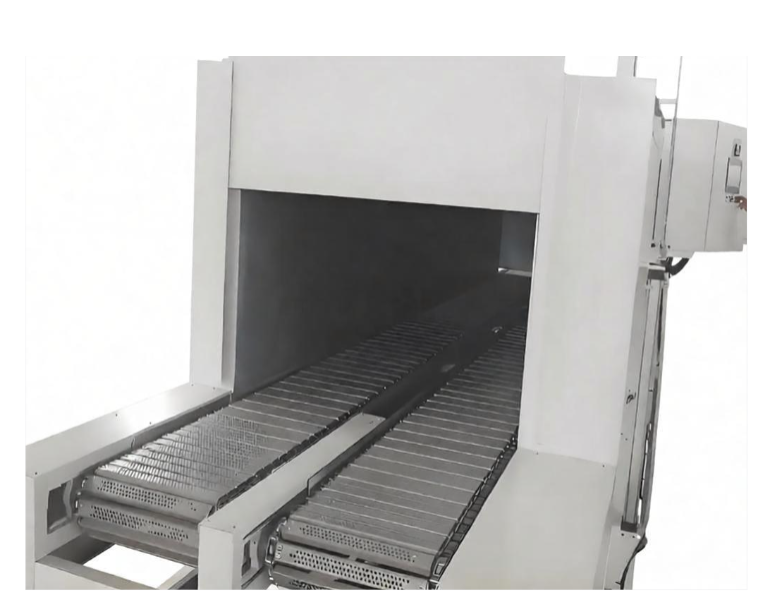
The Flange Preheating Tunnel Oven is an industrial furnace system specially designed for continuous
WhatsApp : +86 15601902607
Email : info@qinsun-lab.com

The Flange Preheating Tunnel Oven is an industrial furnace system specially designed for continuous heating or preheating of metal flanges. It adopts a tunnel-type structure and uses conveying systems such as conveyor belts, roller conveyors, or push-rod mechanisms to continuously transport flange components through the heating zones, achieving the required process temperatures for welding, forging, thermal assembly, or coating preparation.
1. Preheating Before Welding
Used to preheat high-carbon steel and alloy steel flanges before welding.
Reduces the cooling rate during welding and helps prevent:
Welding cracks
Thermal stress concentration
Structural defects
2. Thermal Assembly Process
Utilizes the principle of thermal expansion.
The flange is heated to expand its inner diameter, making it easier to achieve interference fitting and secure assembly with:
Pipes
Shafts
Other mechanical components
3. Forging and Rolling Processes
Used for overall controlled heating before:
Flange forming
Forging
Precision machining processes
to improve material forming performance and processing quality.
4. Pre-Coating Heating and Drying
Used before:
Surface coating
Anti-corrosion treatment
to preheat flange surfaces and improve coating adhesion and durability.
GB/T 10067.1
Basic Technical Requirements for Industrial Electroheat Equipment
Specifies general technical requirements for industrial electric heating equipment design and manufacturing.
GB/T 10066.1
Test Methods for Electroheat Equipment
Provides testing and performance verification methods for industrial heating equipment.
JB/T 4311
Performance Evaluation of Batch and Continuous Resistance Furnaces
Defines performance evaluation requirements for resistance heating furnaces.
TSG 11
Safety Technical Regulations for Boilers
Applicable when the equipment involves related gas-fired or steam heating systems.
1. Continuous Production Operation
The tunnel structure enables continuous flange feeding and heating, providing:
High production efficiency
Stable heating cycles
Compatibility with automated flange manufacturing lines
It is suitable for large-volume industrial production.
2. Precise Temperature Control
The equipment adopts:
Multi-zone independent temperature control
Optimized internal thermal circulation system
to ensure uniform heating of flange components and minimize temperature differences throughout the heating process.
3. Energy Saving and Environmental Protection
The furnace features:
Good sealing performance
Thick thermal insulation layers
Reduced heat loss compared with traditional batch box furnaces
Continuous operation also improves thermal utilization efficiency and reduces energy consumption per unit product.
4. Intelligent Operation Control
The system is usually equipped with:
PLC control system
Touchscreen interface
Temperature curve recording function
Production data export capability
allowing accurate process monitoring and traceability.
Q1: What heating methods are commonly used in flange preheating tunnel ovens?
A:The main heating methods include:
Electric heating (resistance heating wires or infrared radiation tubes)
Natural gas/LPG combustion heating
Electric heating provides more precise temperature control and is suitable for applications requiring strict temperature accuracy. Gas heating is generally more economical for large-size flange preheating applications with high heat demand.
Q2: What is the typical preheating temperature range?
A:The preheating temperature depends on the specific process requirements.
For welding preheating applications, the temperature is generally around 150°C–400°C.
For forging processes, the heating temperature may exceed 1000°C.
The equipment can be customized according to flange material, size, and production process requirements.
Q3: How does the equipment prevent flange surfaces from being scratched during transportation?
A:The conveying system usually adopts:
High-temperature-resistant stainless steel mesh belts
Chain conveyors
Special ceramic roller conveyors
For precision flanges, customized tooling fixtures can be designed on the contact surfaces to minimize mechanical damage and ensure product quality.
Q4: Is the energy consumption of this type of furnace high?
A:The tunnel oven has high thermal utilization efficiency due to continuous operation.
Compared with traditional box furnaces that frequently open doors for loading and unloading, continuous tunnel operation can reduce energy consumption per unit output by approximately 20%–30%, especially in large-scale production environments.
Q5: Does the equipment require a large installation area? What are the factory requirements?
A:Because of its longitudinal tunnel structure, the equipment is usually relatively long, typically ranging from 5 meters to 20 meters depending on production capacity and heating requirements.
The installation site should provide:
Sufficient longitudinal space
Proper exhaust ventilation systems
Stable electrical power supply or gas supply
Suitable foundation and equipment layout conditions
Qinsun Instruments Co., LTD is a professional laboratory testing instrument manufacturer in China,Have been focusing on laboratory instrument R&D more than 30 years and have rich industry experience,Based on international testing standards,We are also the instrument supplier for BV SGS laboratory,We provide one-stop solutions for lab instruments,Free Training and Turn-Key Service,Products exported all over the world,Offer 36 month warranty and are a trustworthy partner.

Company Phone
+86-21-6420 0566
Working hours
Monday to Friday
Mobile phone:
13816217984
Email:
info@qinsun-lab.com