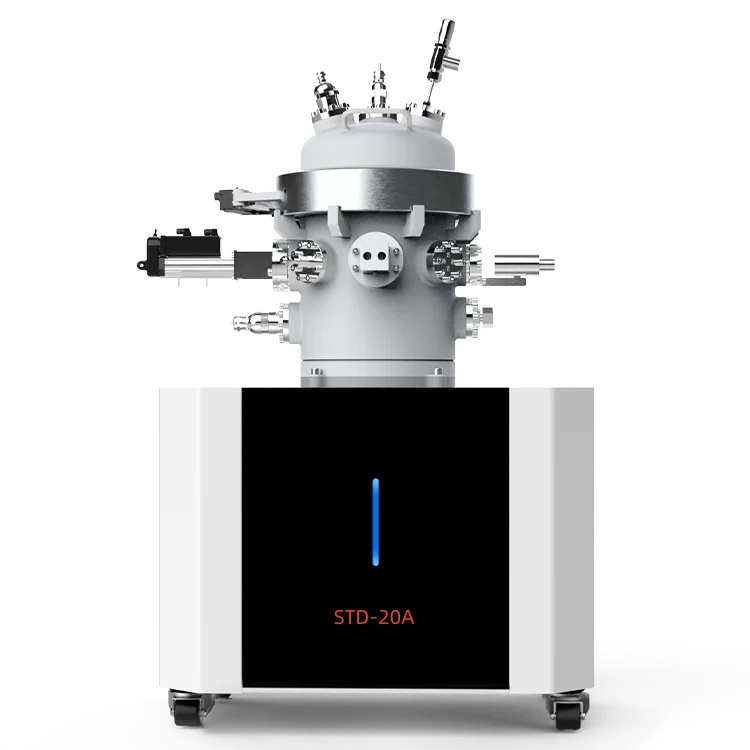
The Small Battery Adiabatic Calorimeter is used to test Thermal runaway onset temperature,Maximum th
WhatsApp : +86 15601902607
Email : info@qinsun-lab.com

The Small Battery Adiabatic Calorimeter is used to test Thermal runaway onset temperature,Maximum thermal runaway rate,Adiabatic temperature rise,it is developed based on adiabatic accelerating calorimetry for battery safety testing of small lithium-ion cells. By synchronously acquiring voltage, current, capacity, temperature, pressure, and time data under various abuse conditions, it enables battery and battery-pack R&D and testing teams to perform comprehensive safety performance evaluation.
》》》Recommend:Large Battery Adiabatic Calorimeters
Lithium-ion batteries
1.Simulates an ideal adiabatic environment, enabling direct and more accurate measurement of battery thermal behavior parameters, including thermal runaway onset temperature, maximum thermal runaway rate, and adiabatic temperature rise.
2.Synchronous acquisition of battery voltage, current, temperature, and pressure data for analysis of current/voltage changes during the thermal runaway process.
3.Includes a heat release mode during charge and discharge, accurately reflecting heat generation and heat release rate during battery operation.
4.Overpressure and overtemperature alarms with automatic furnace lid lifting for safer and more convenient operation.
5.Integrated battery charge–discharge module supports mode switching, constant-current/constant-voltage (CC/CV) charging configuration, charge/discharge current settings, and real-time battery capacity calculation.
6.Compatible with classic adiabatic accelerating calorimeter functions, enabling thermal stability evaluation of battery materials such as electrolyte.
7.Provides two specific heat test modes, constant power and constant rate. A dedicated specific heat test workflow improves specific heat measurement accuracy.
UL 9540A: Battery ESS Thermal Runaway & Fire Propagation
UL 1973: Stationary & Motive Battery Safety
ASTM E1981: ARC Thermal Stability Assessment
SAE J2464 (R2009): Thermal Stability Tests (SAE)
USABC SAND99-0497: Thermal Stability Tests (USABC)
FreedomCAR SAND 2005-3123: Thermal Stability Tests (FreedomCAR)
GB 38031: EV Traction Battery Safety
SN/T 3078.1: Chemical Thermal Stability — ARC
| Model | STD-9A |
| Operating Environment | 5–40℃, <85% RH |
| Temperature Control Range | Ambient to 500℃ |
| Temperature Control Modes | Isothermal mode; Scanning mode; HWS mode; Specific heat constant power mode; Specific heat constant rate mode; Charge–discharge heat release mode. |
| Temperature Detection Threshold | 0.005–0.02℃/min |
| Temperature Tracking Rate | 0.005–40℃/min |
| Temperature Display Resolution | 0.001℃ |
| Furnace Chamber Size | Diameter 90mm, depth 110mm |
| Interface | USB or RJ45 |
| Power Supply | 220V/50Hz |
| Power Consumption | ≤ 3000W |
| Model | STD-20A |
| Adiabatic Furnace Dimensions | 200 (Diameter) × 250 mm (Depth) |
| Temperature Control Range | RT–450℃, optional low-temperature module to –40℃ |
| Self-Heating Detection Sensitivity | 0.01–0.02 ℃/min, adjustable via software |
| Adiabatic Tracking Rate | 0.02–25℃/min |
| Temperature Difference between Furnace and Sample in Constant Temperature | ≤0.5℃ |
| Working Pressure | 0–3 MPa |
| Calorimetric Chamber Pressure Relief Vent | Included |
| Rupture Disc | Included |
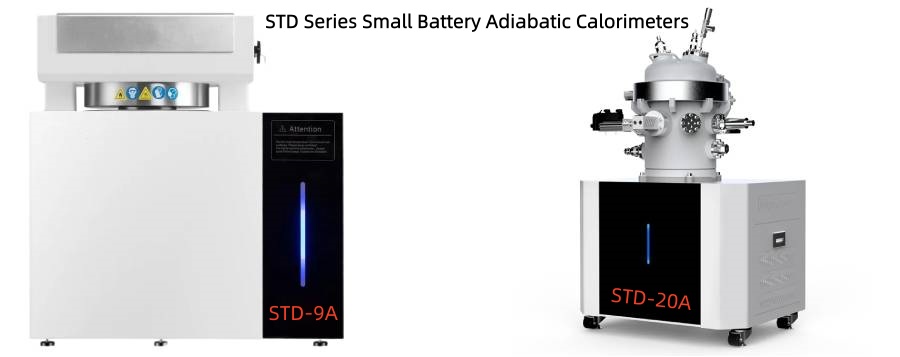
The STD Series Small-Scale Battery Adiabatic Calorimeter is used to test Thermal runaway onset temperature,Maximum thermal runaway rate,Adiabatic temperature rise,it is developed based on adiabatic accelerating calorimetry for battery safety testing of small lithium-ion cells. By synchronously acquiring voltage, current, capacity, temperature, pressure, and time data under various abuse conditions, it enables battery and battery-pack R&D and testing teams to perform comprehensive safety performance evaluation.
【Q】What is the working principle of a battery adiabatic calorimeter?
【A】The BAC series employs adiabatic tracking technology to monitor cell temperature in real time while dynamically adjusting the chamber environment temperature, driving the temperature differential between cell and chamber toward zero. This effectively eliminates heat exchange, ensuring that all observed temperature changes originate solely from the cell's own heat generation or absorption. The system can therefore induce and record the complete thermal runaway process, yielding accurate characterization of key thermal runaway parameters.
【Q】What tests can a battery adiabatic calorimeter perform?
【A】The BAC series supports thermal abuse testing, electrical abuse testing, mechanical abuse testing, specific heat capacity testing, visual monitoring, gas evolution analysis, and charge/discharge calorimetry. These capabilities cover the full spectrum of battery thermal safety evaluation, from abuse triggering to gas analysis and heat generation measurement.
【Q】What key parameters does adiabatic calorimetry provide?
【A】Thermal runaway characteristic temperatures (T₁, T₂, T₃), adiabatic temperature rise, specific heat capacity, charge/discharge heat-generation power and total heat generation, pressure-rise rate, and maximum gas-generation pressure.
【Q】How is adiabatic calorimetry used in battery thermal safety evaluation?
【A】The system enables thermal runaway testing of large-format single cells or small modules under adiabatic conditions to obtain thermal stability characteristic parameters. It also supports cell-level gas-evolution assessment within the UL 9540A standard framework, providing gas volume and generation-rate data to inform module and pack-level venting and burst-protection design. Gas sampling and analysis further enable evaluation of cell-level gas hazards.
【Q】How does adiabatic calorimetry support battery thermal management?
【A】The system measures heat generation, heat-generation rate, and temperature-dependent specific heat capacity across a wide temperature range, including low-temperature conditions. These data provide the quantitative basis for battery thermal management system design and validation.
【Q】Can adiabatic calorimetry be used for battery material testing?
【A】The system enables thermal stability testing of electrolytes, cathode and anode materials, and separators to obtain thermal decomposition characteristic parameters, supporting the improvement of cell and system safety design.
Qinsun Instruments Co., LTD is a professional laboratory testing instrument manufacturer in China,Have been focusing on laboratory instrument R&D more than 30 years and have rich industry experience,Based on international testing standards,We are also the instrument supplier for BV SGS laboratory,We provide one-stop solutions for lab instruments,Free Training and Turn-Key Service,Products exported all over the world,Offer 36 month warranty and are a trustworthy partner.

Company Phone
+86-21-6420 0566
Working hours
Monday to Friday
Mobile phone:
13816217984
Email:
info@qinsun-lab.com