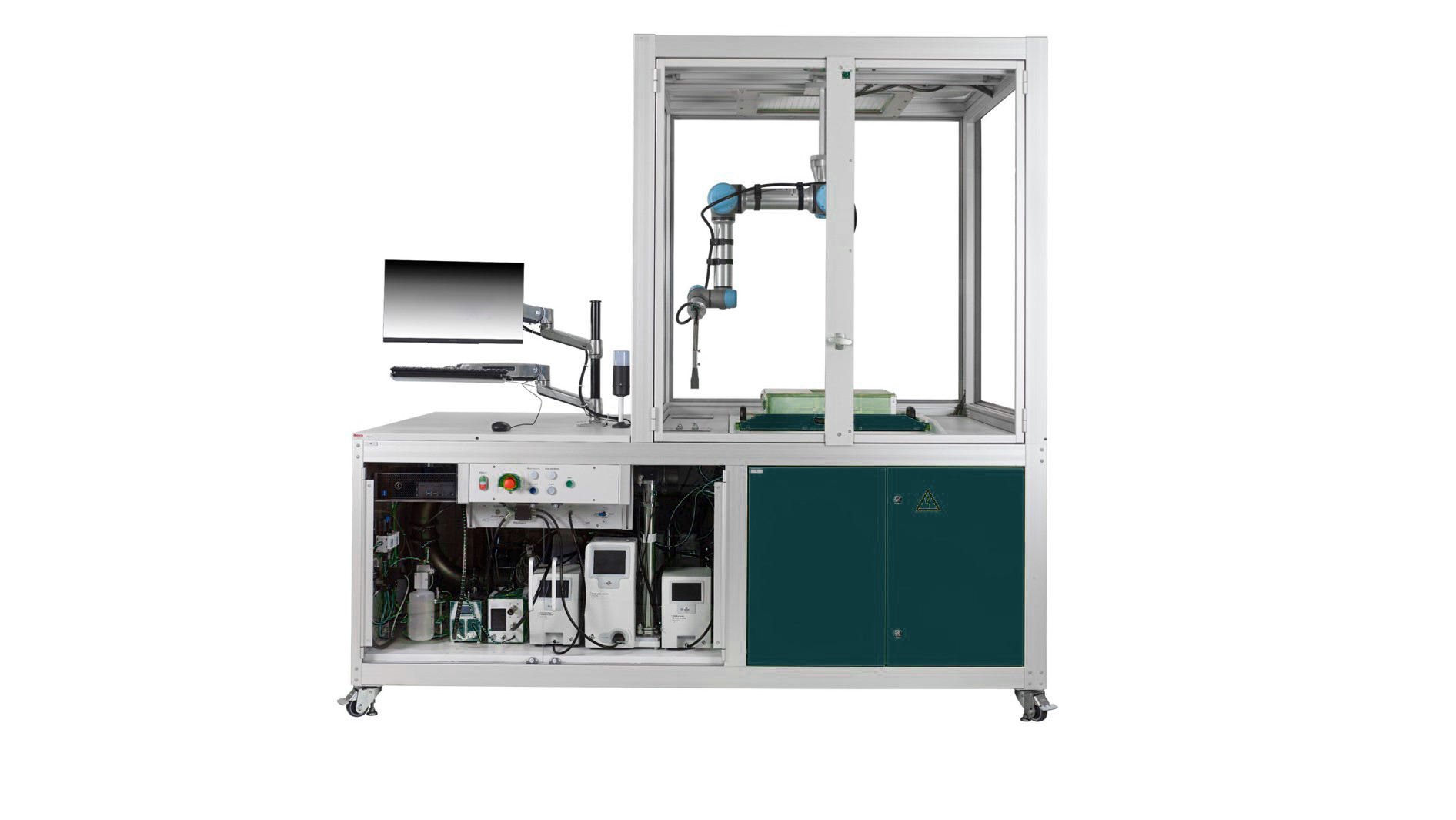
Robot HEPA/ULPA Filter Scanning System. The filter scanning test system is used to determine the int
WhatsApp : +86 15601902607
Email : info@qinsun-lab.com

The Robot HEPA/ULPA Filter Scanning Detection System is designed to evaluate both overall and local particle filtration efficiency of 2D and 3D filter elements, including leakage detection. You can perform efficiency testing using multiple aerosol types, including DEHS, paraffin oil, and PSL. The system integrates optical particle counters (OPC) by default and can optionally use condensation particle counters (CPC) or scanning mobility particle sizers (SMPS) for size-classified aerosol measurements. Initially designed for moderate-flow panel filters and cartridges, the system can be expanded for higher-flow applications.
You can apply this system for:
Product Development & Quality Control: Evaluate and ensure HEPA/ULPA filters meet high-efficiency particle removal requirements.
Filter Scanning: Scan both panel filters and cartridges for comprehensive inspection.
3D Scanning: Support V-shaped or other 3D filters for detailed local efficiency mapping.
High-Flow Filter Testing: Expand the system to test higher-flow filters as needed.
Innovative Testing: Automated 3D scanning increases flexibility and precision compared to conventional methods.
The system is compliant with, but not limited to:
(1) GB 4706.1 – Safety of household and similar electrical appliances, Part 1: General requirements.
(2) EN 1822 – High-efficiency air filters (HEPA and ULPA) – Design and test methods.
(3) JIS B 9900 – Japanese industrial standard for air filtration devices.
(4) IEST-RP-CC001 – Performance and testing of cleanroom air filters for HEPA/ULPA.
(5) ASTM F1471 – Standard test for particle contamination in air and HEPA filter evaluation.
(6) ISO 29463-5 – HEPA/ULPA filter performance evaluation, Part 5: Filter efficiency and leakage detection.
(7) ISO 29463-4 – HEPA/ULPA filter performance evaluation, Part 4: Aerosol testing requirements.
| Parameter | Specification |
|---|---|
| Test Flow Rate | 1 … 300 m³/h |
| Differential Pressure Range | 50 … 5000 Pa |
| Scanning Speed | 5 … 100 mm/s |
| Sample Dimensions (W × H × D) | Panel: 50–500 × 30–500 × 7–280 mm; Cartridge: 40–350 × 40–350 × 45–600 mm |
| Aerosol Media | DEHS, Paraffin Oil, PSL |
| Compressed Air Supply | Max 6.0 bar |
| Power Supply | 3 × 400 VAC, 32 A |
| Aerosol Generation | DEHS, Paraffin Oil, PSL |
| Aerosol Measurement | OPC, CPC, SMPS |
| System Dimensions (W × H × D) | 4000 × 4000 × 3000 mm |
Automated 3D Scanning: First commercial solution for fully automated 3D filter scanning.
Flexible Sample Sizing: You can adjust sample dimensions to accommodate different filter types.
Rapid Implementation: Robot programming allows quick adaptation to new scanning protocols.
Multiple Aerosol Options: Supports DEHS, paraffin oil, and PSL for precise efficiency and leakage testing.
Advanced Measurement Technology: OPC, CPC, and SMPS integration for comprehensive particle size and efficiency evaluation.
(1) DEHS aerosol generator – for DEHS aerosol production.
(2) Paraffin oil aerosol generator – for paraffin oil aerosol production.
(3) PSL aerosol generator – for PSL aerosol production.
Preparation:
Select the filter type and ensure it fits within the system’s sample range.
Set up the aerosol generator, select the appropriate aerosol type, and preheat the system.
Testing:
Install the filter securely on the robot work platform.
Start the scanning system; the robot will automatically perform the scanning operation according to set parameters.
Data Analysis:
Collect efficiency and leakage data via OPC, CPC, or SMPS.
Generate detailed filter performance reports, including overall efficiency, local leakage points, and MPPS curves.
Wear appropriate PPE, including gloves and protective eyewear.
Ensure proper ventilation when handling aerosols.
Regularly inspect aerosol generators, particle counters, and robot components.
Keep the system clean and calibrated to maintain accurate performance.
1.What is this product?
It is a robotic HEPA/ULPA filter scanning detection system for evaluating filtration efficiency and leakage.
2.What is this product used for?
You use it to assess overall and local particle filtration performance for 2D and 3D filters.
3.What is the working principle of this product?
The system uses aerosol generators to introduce particles and particle counters to detect overall and local filtration efficiency, including leakage points, while automatically scanning the filter surface.
4.Why is this product important?
It ensures filters meet stringent performance standards, provides accurate MPPS data, and supports R&D and quality control.
5.What industries is this product suitable for?
HEPA/ULPA filter manufacturing, cleanroom technology, air purification, R&D laboratories, and quality control facilities.
Qinsun Instruments Co., LTD is a professional laboratory testing instrument manufacturer in China,Have been focusing on laboratory instrument R&D more than 30 years and have rich industry experience,Based on international testing standards,We are also the instrument supplier for BV SGS laboratory,We provide one-stop solutions for lab instruments,Free Training and Turn-Key Service,Products exported all over the world,Offer 36 month warranty and are a trustworthy partner.

Company Phone
+86-21-6420 0566
Working hours
Monday to Friday
Mobile phone:
13816217984
Email:
info@qinsun-lab.com