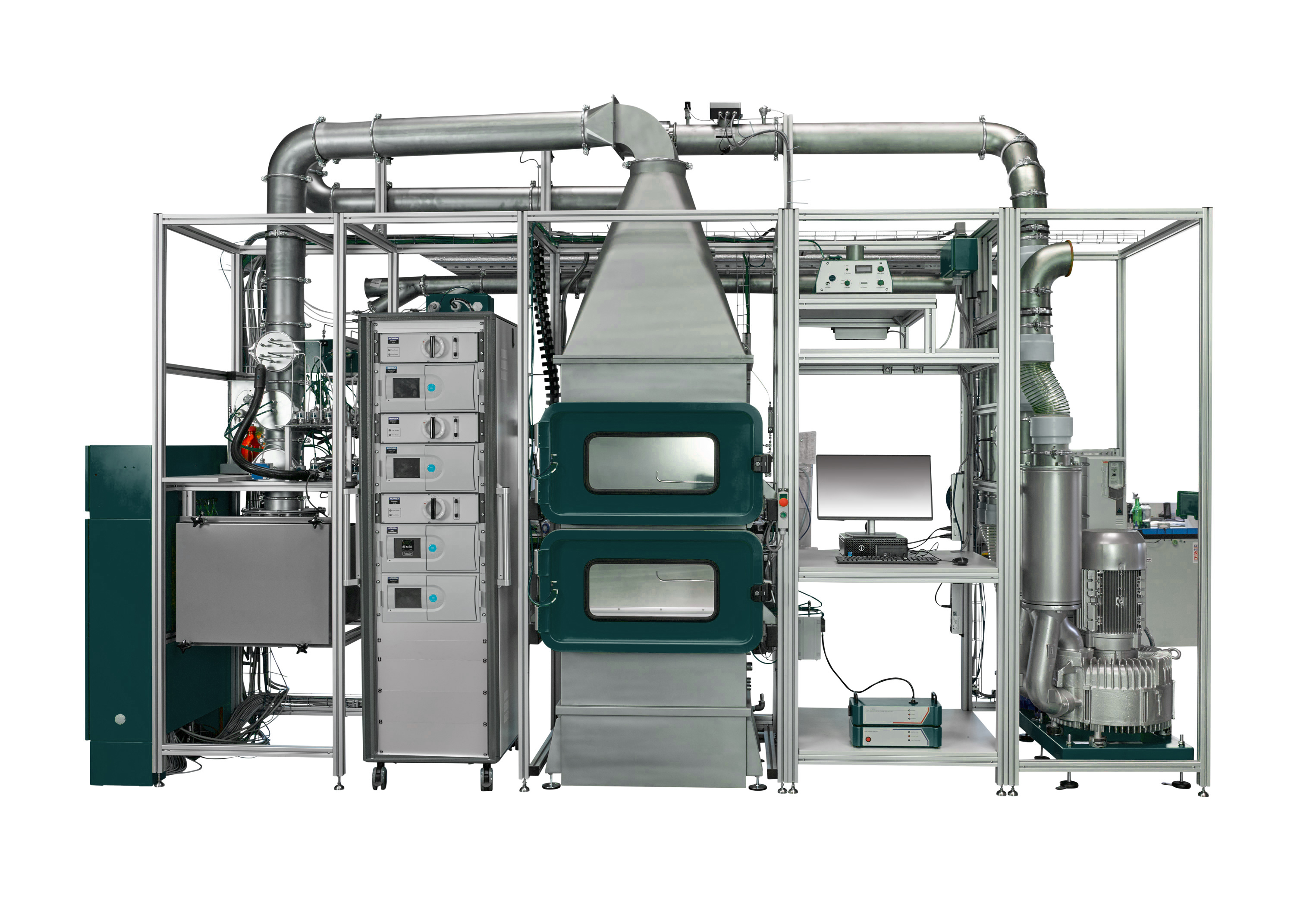
The Fuel Cell Air Intake Filter Test System serves for testing the inlet filters of fuel cells by pa
WhatsApp : +86 15601902607
Email : info@qinsun-lab.com

The Fuel Cell Air Intake Filter Test System is designed to evaluate air intake filters for fuel cells, using both particle-based aerosols and test gases. You can test filter elements of various designs and media, determining differential pressure curves, dust loading, fractional efficiency, and adsorption/desorption performance. The system is scaled to handle larger filter dimensions and higher flow rates than ISO 11155 requirements, making it suitable for advanced R&D and quality control.
You can use this system for:
Quality Control: Verify the performance of fuel cell air intake filters during production.
Research & Development: Evaluate new filter materials and element configurations.
Benchmarking: Compare performance of different filter elements under standardized conditions.
The system complies with:
(1) ISO 11155-1 – Test method for particulate filtration performance of fuel cell air filters.
(2) ISO 11155-2 – Test method for adsorption performance of fuel cell air filters.
(3) DIN 71460-1 – German standard for particulate filtration of fuel cell air filters.
(4) DIN 71460-2 – German standard for adsorption performance testing of fuel cell air filters.
| Parameter | Unit | Value |
|---|---|---|
| Test Flow Rate | m³/h | 70 … 1400 |
| Differential Pressure Measuring Range | Pa | ≤1000 |
| Test Specimen Dimensions | mm | ≤500 × 700 (bypass option: 100 cm²) |
| Operating Medium (Aerosol) | – | ISO 12103-1 A2 fine test dust, DEHS, NaCl, KCl |
| Operating Medium (Gas) | – | Nitrogen dioxide, Hydrogen (others on request) |
| Operating Medium (Standard/ Pollutant Gas) | – | n-Butane (80 ppm), Toluene (80 ppm), Sulphur dioxide (30 ppm) |
| Operating Medium (Other Gas) | – | Nitrogen dioxide (30 ppm), Ammonia (30 ppm), Hydrogen sulphide (0.4 ppm), Acetaldehyde (30 ppm) |
| Power Supply | – | 3 × 400 VAC; 32 A; 50 Hz |
| Gas Sensors | – | FID (organic substances), UV-fluorescence (SO₂), CLD (NOx) |
| Other Sensors | – | Temperature, Relative Humidity, Barometric Pressure |
| System Dimensions | mm | 5000 × 2750 × 3400 |
Gas-tight Test Channels: Ensure no leakage during aerosol or gas testing.
Modular Structure: Adaptable to different filter sizes and test requirements.
High Degree of Automation: Software-based test sequences minimize manual intervention.
Standardized Reporting: Automatic generation of test reports for efficiency and adsorption results.
Versatile Testing Mediums: Support for aerosols (salt, oil, dust) and gases (NO₂, H₂, n-butane, toluene, SO₂, NH₃).
(1) Filter adapters – enable secure mounting of different filter types.
(2) Aerosol generators – for fine dust, DEHS, NaCl, KCl.
(3) Gas dosing units – for standard and pollutant gases including NO₂, H₂, n-butane, SO₂.
(4) Gas sensors – FID, UV-fluorescence, CLD for real-time detection.
Preparation:
Select the filter type and confirm its dimensions fit the test duct.
Set up the appropriate aerosol or gas medium according to the test standard.
Testing:
Insert the test filter into the filter adapter and mount it in the test duct.
Define test flow rate and start the automated sequence.
The system measures differential pressure, dust loading, fractional efficiency, and adsorption/desorption curves.
Data Analysis:
Collect data via software and analyze filter performance.
Generate standardized reports for quality assurance or R&D documentation.
Ensure all gas and aerosol lines are properly sealed to prevent leaks.
Periodically calibrate sensors and aerosol generators to maintain measurement accuracy.
Keep the system clean and check mechanical components for wear.
Ensure ventilation and follow safety guidelines when working with gases.
1.What is this product?
It is a test system for fuel cell air intake filters, capable of evaluating particulate and gas filtration performance.
2.What is this product used for?
You use it for quality control, research, development, and benchmarking of fuel cell air intake filters.
3.What is the working principle of this product?
A defined flow of aerosol or gas passes through the test filter; the system measures differential pressure, efficiency, dust loading, and adsorption/desorption behavior.
4.Why is this product important?
It ensures filters meet performance standards for fuel cells, contributing to safe and efficient operation of fuel cell systems.
5.What industries is this product suitable for?
Fuel cell manufacturing, automotive, clean energy R&D, and filter quality control laboratories.
Qinsun Instruments Co., LTD is a professional laboratory testing instrument manufacturer in China,Have been focusing on laboratory instrument R&D more than 30 years and have rich industry experience,Based on international testing standards,We are also the instrument supplier for BV SGS laboratory,We provide one-stop solutions for lab instruments,Free Training and Turn-Key Service,Products exported all over the world,Offer 36 month warranty and are a trustworthy partner.

Company Phone
+86-21-6420 0566
Working hours
Monday to Friday
Mobile phone:
13816217984
Email:
info@qinsun-lab.com