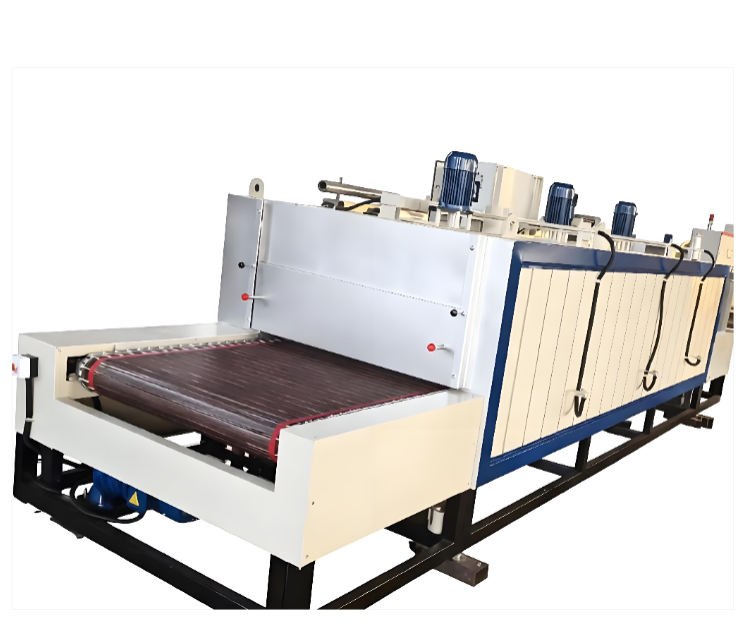
The Busbar Heat Shrink Tube Heating Tunnel Oven is a continuous, high-efficiency automated heating a
WhatsApp : +86 15601902607
Email : info@qinsun-lab.com

The Busbar Heat Shrink Tube Heating Tunnel Oven is a continuous, high-efficiency automated heating and forming equipment specially designed for the heat shrinkable insulation sleeves applied to copper or aluminum busbars in high and low voltage electrical cabinets and substations.The equipment uses a conveyor system to transport busbars fitted with heat shrink tubes at a constant speed into a closed heating tunnel. Through far-infrared radiation heating or hot air circulation, the heat shrink tube is uniformly heated and tightly shrunk around the surface of the busbar, achieving reliable insulation protection.
High and Low Voltage Switchgear Industry
Used for long-distance insulation covering of copper and aluminum busbars with various specifications inside distribution cabinets and switch cabinets.
New Energy Vehicle Industry
Used for insulation heating of battery pack (PACK) internal cell connection busbars and electric drive busbars.
Rail Transit and Transformer Industry
Used for protection of busbars in locomotive traction power supply systems and large-scale transformer outlet copper bars.
The design and production of the equipment generally need to strictly comply with the following industrial standards:
GB/T 10067.1 / GB/T 10067.4
Basic technical requirements for electric heating equipment in China, including general requirements and indirect resistance furnace specifications.
GB 5226.1 / IEC 60204-1
Safety of machinery — Electrical equipment of machines — General technical requirements.
CE Certification
For export applications, the equipment should comply with European safety and electromagnetic compatibility requirements.
Insulation Withstand Voltage Standards
The insulation layer of the heated busbar should meet insulation strength testing requirements according to:
GB/T 1408
360° Uniform Heating Performance
Uses multi-directional far-infrared thermal radiation or specially designed mesh conveyor processes to completely solve problems caused by traditional manual heat gun heating, such as surface bubbles, pressure marks, and uneven heating.
Precise Temperature Control and Variable Speed Regulation
Adopts a high-precision PID intelligent temperature control system with temperature accuracy within ≤ ±1°C. The conveyor speed can be continuously adjusted to perfectly match heat shrink tubes of different thicknesses.
High Efficiency, Energy Saving, and Safety
The middle layer of the oven chamber is filled with thick high-temperature insulation cotton (temperature resistance up to 1200°C), effectively reducing heat loss, lowering external surface temperature, protecting operators from burns, and significantly reducing energy consumption compared with conventional ovens.
Q1: What is the typical heating temperature setting for this type of tunnel oven?
A: The temperature depends on the busbar voltage level.
For ordinary low-voltage copper busbars (such as 1 kV systems), the heat shrinking temperature is usually set at around 120°C.
For thick-walled high-voltage copper busbars (such as 10 kV–35 kV systems), the temperature generally needs to be set between 170°C and 200°C.
Q2: How does tunnel oven heating prevent bubbles or burning on the heat shrink tube surface?
A: Bubbles are usually caused by excessively rapid local heating, which prevents trapped air from escaping. The problem can be solved through gradient temperature control with preheating zone, main heating zone, and cooling zone, combined with variable-frequency speed control to slow down conveyor movement, allowing the heat shrink tube to gradually and evenly shrink from the inside outward.
Q3: Can this equipment heat irregular or bent copper busbars?
A: Yes. The inlet and outlet height and width of busbar tunnel ovens can usually be customized according to product dimensions. The internal structure often adopts suspended chain conveyors or wide stainless steel mesh belts, allowing bent and three-dimensional formed busbars to pass smoothly through the heating chamber.
Q4: What are the main advantages compared with traditional ovens and heat guns?
A: The key advantages are improved efficiency and production consistency.
Traditional heat guns rely entirely on manual operation, resulting in slow processing speed and a high risk of overheating or burning. The tunnel oven operates as a continuous production line, requiring only 2–3 operators to achieve daily production of several tons of copper busbars, with excellent appearance quality and high product consistency.
Q5: What materials are commonly used for the conveyor belt? Will long-term high-temperature operation damage it?
A: Common conveyor materials include:
SUS304 stainless steel mesh belts/chains
High-temperature-resistant PTFE (Teflon) mesh belts
These materials can withstand long-term operation in high-temperature environments of approximately 250°C–350°C, with excellent deformation resistance and a long industrial service life.
Qinsun Instruments Co., LTD is a professional laboratory testing instrument manufacturer in China,Have been focusing on laboratory instrument R&D more than 30 years and have rich industry experience,Based on international testing standards,We are also the instrument supplier for BV SGS laboratory,We provide one-stop solutions for lab instruments,Free Training and Turn-Key Service,Products exported all over the world,Offer 36 month warranty and are a trustworthy partner.

Company Phone
+86-21-6420 0566
Working hours
Monday to Friday
Mobile phone:
13816217984
Email:
info@qinsun-lab.com