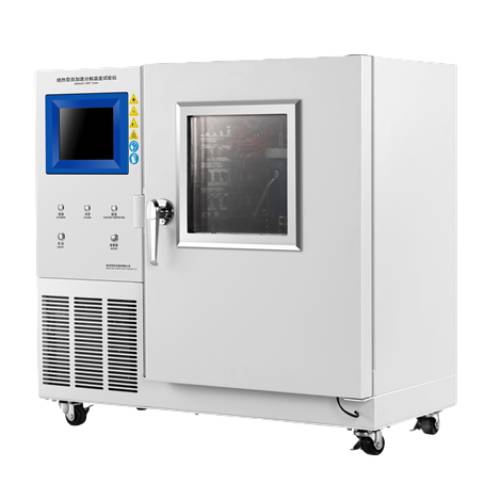
The Autocatalytic Decomposition Temperature Tester with Thermal Insulation (Adiabatic SADT Tester) i
WhatsApp : +86 15601902607
Email : info@qinsun-lab.com

The Autocatalytic Decomposition Temperature Tester with Thermal Insulation (Adiabatic SADT Tester) is a critical instrument for evaluating the thermal hazards of energetic chemicals. By precisely determining the rate of heat generation as a function of temperature under adiabatic conditions, this equipment allows you to calculate the Self-Accelerating Decomposition Temperature (SADT). This data is essential for characterizing how a substance behaves within its packaging, ensuring safety during transport and storage. Whether you are dealing with IBCs, tanks, or small containers, this tester provides the foundational thermal loss data required to prevent catastrophic thermal runaway.
The Autocatalytic Decomposition Temperature Tester with Thermal Insulation is a core device for assessing the thermal hazards of chemicals, used to determine a substance's heat release rate as it changes with temperature. The measured heat release parameters, combined with thermal loss data for the relevant package, are used to determine the substance's autocatalytic decomposition temperature within its container. This method is applicable to all types of containers, including intermediate bulk containers and tanks.
1) Embedded processor with Windows CE operating system.
2) 8-inch LCD touchscreen for real-time display of test status.
3) Built-in air circulation system ensures uniform and stable chamber temperature.
4) Digital PID algorithm precisely controls heating temperature with high accuracy.
5) Equipped with a cooling system to prevent sample overheating and potential explosions.
6) Auxiliary safety device provides overheat protection, automatically shutting off the heating system at a predetermined temperature.
7) Instrument fault detection and audible/visual alarm functions ensure enhanced test safety.
8) Features an explosion-proof glass observation window on the front and a pressure relief door on the rear. Internal thrust exceeds 2.5 kgf; opening the pressure relief door ensures safer testing.
9) Displays real-time operating duration and temperature, automatically plots test curves, and allows access to raw data.
10) Offers versatile test selection; users can configure parameters based on sample characteristics.
11) Fully automated testing process requires no manual intervention, supporting parameter settings, data storage, and report viewing.
| Item | Specifications |
| Operating Environment | (-5 ~ 45)°C, <95% RH |
| Chamber Temperature Control Range | -20°C ~ 220°C |
| Temperature Control Accuracy | ±1°C |
| Sample Temperature Measurement Range | (-50 ~ 500)°C |
| Sample Temperature Measurement Resolution | 0.1°C |
| Sample Temperature Measurement Accuracy | ±(2.5或0.0075×|t|)℃ |
| Dewar Flask Capacity | 1 L |
| Constant Power Adjustment Range | 0.1W ~ 2W |
| Constant Power Accuracy | ≤0.015W |
| Temperature Rise Rate Range | 0 ~ 2°C |
| Refrigerant Circulation Rate | ≥3 L/min |
| Dewar Flask Material | Glass inner liner |
| Instrument Dimensions (L×W×H) | 930mm × 545mm × 875mm |
Glass Dewar Flask (1L): High-insulation vessel for adiabatic containment.
High-Precision Temperature Probes: Specialized sensors for sample and environment monitoring.
Coolant Circulation Kit: Pumps and hoses for the active cooling system.
Pressure Relief Door Assembly: Rear-mounted safety mechanism.
Software Suite: Pre-installed Windows CE testing and reporting software.
1. Power-Up and System Self-Test
Connect the power supply and activate the control panel (typically an 8-inch touchscreen).
The system automatically performs a self-test: verifying the Dewar flask's airtightness, air circulation system, explosion-proof window status, and temperature sensor communication.
2. Sample Loading
Place the sealed sample at the center of the Dewar flask, ensuring good contact with the temperature probe.
Close and lock the explosion-proof glass observation window. Initiate the vacuum/inert gas purge procedure (if applicable).
3. Parameter Setup
Select test mode: Adiabatic Mode, compliant with UN H.2 standards.
Set initial temperature (typically room temperature or estimated SADT lower limit). Default heating rate is 0.1°C/min (cannot be manually increased).
Enable “Automatic Data Logging” to capture real-time sample temperature, ambient temperature, and heat flux changes.
4. Operation and Monitoring
After experiment initiation, the system enters unattended mode.
Key Monitoring Indicators:
Sample temperature sustained rise rate > 0.5°C/min → Triggers self-accelerating decomposition warning
Temperature difference (sample-environment) > 5°C → Identified as thermal runaway precursor
The system automatically plots a time-temperature curve and stores raw data (supports exporting CSV or PDF reports).
5. Experiment Termination
When the sample temperature reaches a plateau phase or triggers a safety shutdown threshold (e.g., ≥220℃), the system automatically powers down and initiates a cooling procedure.
Only after the equipment has cooled to room temperature may the observation window be opened to retrieve the sample.
1.Why is the adiabatic H.2 test preferred over the isothermal H.1 test?
The H.2 test better simulates the conditions found in large-scale storage (like IBCs or tanks) where the heat generated by the chemical cannot easily escape to the surroundings. This "worst-case" scenario provides a more conservative and safer SADT value for industrial packaging.
2.How does the system compensate for the heat capacity of the Dewar flask?
The software utilizes a calibration factor, often referred to as the Phi-factor ($\phi$), to account for the heat absorbed by the glass liner. This ensures the data reflects only the energy released by the chemical substance itself.
3.What happens if a power failure occurs during a multi-day test?
The embedded processor features data-retention capabilities. However, for SADT testing, a power interruption typically invalidates the adiabatic state. It is highly recommended to connect the unit to an Uninterruptible Power Supply (UPS).
4.Can this tester accommodate samples that evolve gas during decomposition?
Yes, but you must ensure that the Dewar is properly vented or sealed according to the specific pressure-handling capabilities of the vessel used. The rear pressure-relief door of the tester is specifically designed to handle accidental overpressurization of the chamber.
5.Is it possible to customize the temperature rise rate for non-standard screening?
While the UN H.2 standard requires a specific approach, the diversified test selection menu allows you to adjust parameters for R&D purposes. However, for official classification, the pre-programmed standard protocols must be followed.
Qinsun Instruments Co., LTD is a professional laboratory testing instrument manufacturer in China,Have been focusing on laboratory instrument R&D more than 30 years and have rich industry experience,Based on international testing standards,We are also the instrument supplier for BV SGS laboratory,We provide one-stop solutions for lab instruments,Free Training and Turn-Key Service,Products exported all over the world,Offer 36 month warranty and are a trustworthy partner.

Company Phone
+86-21-6420 0566
Working hours
Monday to Friday
Mobile phone:
13816217984
Email:
info@qinsun-lab.com