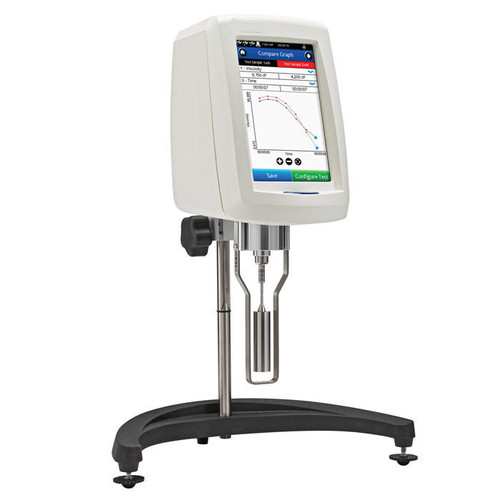
A rheometer is a scientific instrument used to measure the rheological properties of materials, desc
WhatsApp : +86 15601902607
Email : info@qinsun-lab.com

A rheometer is a scientific instrument used to measure the rheological properties of materials, describing how they flow and deform when subjected to external forces. Rheometers are commonly used in fields such as materials science, polymer science, food science and pharmaceuticals. Rheometers typically apply a controlled rate of stress, strain, or deformation to a sample of material and then measure the resulting response, such as stress, strain, or viscosity. This allows researchers and engineers to characterize the materials' flow behavior, viscoelastic properties and other rheological parameters, which are important for understanding their performance in various applications.
Rheometers are valuable tools for R&D, quality control and process optimization of materials with complex rheological behavior such as polymers, slurries, suspensions, emulsions and foams. They provide insights into material flow behavior and mechanical properties that aid in the formulation, design and performance evaluation of a wide variety of products and processes.
Rheometers can be divided into different types according to their working principles, such as rotational rheometers, capillary rheometers, oscillatory rheometers, and extensional rheometers. One of the commonly used types is the rotational rheometer, which consists of a rotating spindle or cone-plate geometry that applies shear stress to the sample. Capillary rheometers measure the flow of materials through small diameter capillaries to study their viscosity and flow behavior under different conditions. Oscillatory rheometers apply an oscillatory deformation to a sample to study its viscoelastic properties such as storage modulus, loss modulus, and phase angle.
ISO 6502 / ISO 13145
ASTM D5289 / ASTM D6048 / ASTM D6204
ASTM D6601 / ASTM D7605 / ASTM D7050
ASTM D8059
DIN 53529
Dimensions: 8.5" Depth x 12.5" Width x 25.5" Height
Weight: 66 lbs (with bath) or 61 lbs (with carbon block)
Pressure Range: Atm to 2,000 psi
Sample Size: 32 to 78 ml
Resolution: 0.01% of full scale range or better
Temperature Range: Ambient (20 °F with Chilling Device) to 500°F (260°C)
Speed Range: 0.0001 to 1,100 rpm continuous
Frequency Range: 0.01 to 5 Hz (Optimized at 0.2 to 3 Hz)
Amplitude Range: 0.1% to 500 % (Optimized at 0.2% to 500%)
Shear Rate Range: 0.00004 to 1870 sec-1
Shear Stress Range: 1 to 15,000 dyn/cm2
Viscosity Range: 0.5 to 5,000,000 Centipoise
Torque: 14 μN.m to 100 mN.m
Repeatability: ±0.05% of full scale range or better
Voltage: 110-120V AC (220-240V AC with Transformer)*
Prepare the sample material according to the specifications of the rheometer and the specific rheological properties being measured. This may involve measuring and mixing different ingredients, controlling temperature and humidity, and ensuring samples are free of air bubbles or other contaminants.
Following the manufacturer's instructions, load the prepared sample onto the measurement geometry of the rheometer, such as a spindle or plate. The geometry used depends on the type of rheometer and the rheological properties being measured.
Set up the rheometer according to the desired test parameters, such as temperature, shear rate or stress, frequency and amplitude (for oscillatory rheometers), and other relevant settings. These parameters will depend on the specific test being performed and the characteristics of the material being tested.
Start the rheometer and start the test according to the desired measurement mode (e.g. rotational, capillary or oscillatory) and the desired test duration. A rheometer will apply a specified deformation to a sample and measure the resulting response, such as stress, strain or viscosity.
Collect and record the data generated by the rheometer during the test, such as stress versus time, strain versus time or frequency sweep curves, which can be used to analyze the rheological behavior of materials and extract relevant rheological parameters.
Analyze the collected data using appropriate rheological analysis techniques, such as determining viscosity, shear stress-shear rate relationship, viscoelastic properties, yield stress, and other relevant parameters. Interpret results in the context of material behavior and specific application or research questions.
Interpret results and draw conclusions based on measured rheological properties. Consider how a material's rheological behavior can affect its performance in real-world applications, or how it can inform further research or development efforts.
Document test procedures, results and analyzes in a clear and comprehensive manner. This may involve preparing formal reports, generating graphs or diagrams, and recording relevant experimental details for future reference.
Qinsun Instruments Co., LTD is a professional laboratory testing instrument manufacturer in China,Have been focusing on laboratory instrument R&D more than 30 years and have rich industry experience,Based on international testing standards,We are also the instrument supplier for BV SGS laboratory,We provide one-stop solutions for lab instruments,Free Training and Turn-Key Service,Products exported all over the world,Offer 36 month warranty and are a trustworthy partner.

Company Phone
+86-21-6420 0566
Working hours
Monday to Friday
Mobile phone:
13816217984
Email:
info@qinsun-lab.com