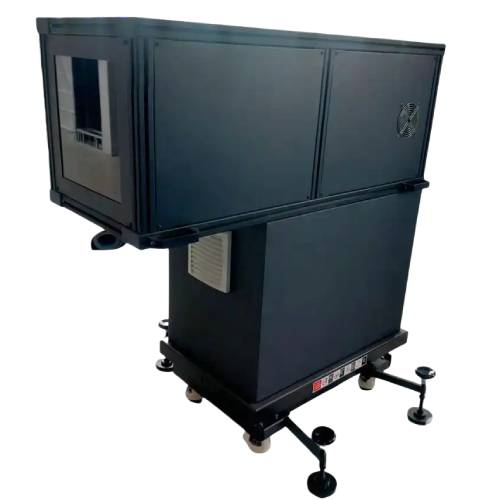
AAA-Class Solar Simulator is a high-performance device designed to replicate sunlight for testing an
WhatsApp : +86 15601902607
Email : info@qinsun-lab.com

AAA-Class Solar Simulator is a high-performance device designed to replicate sunlight for testing and research purposes. It can simulate key parameters of solar irradiation, including intensity, spectrum, color, uniformity, and temporal stability. The simulator is essential for evaluating solar cells, solar water heaters, and other photovoltaic products. The “AAA” designation represents the highest international standard ratings for spectral match, irradiance uniformity, and temporal stability, ensuring highly accurate and reproducible results in material science, photovoltaics, and environmental testing applications.
The AAA-Class Solar Simulator is widely applied across various research and testing scenarios, including:
Photovoltaic Testing:
Efficiency measurements of solar cells (I-V curves, quantum efficiency)
Module aging and reliability tests (PID, LID effects)
Materials Research:
Evaluation of photocatalytic materials
Performance testing of photothermal conversion materials
Environmental Simulation:
Accelerated weathering tests for spacecraft components
UV aging tests for automotive coatings
The simulator supports a wide range of solar energy products, material studies, and environmental simulation experiments.
The simulator conforms to key international standards, including:
(1) IEC 60904-9:2020 – Photovoltaic devices – Part 9: Solar simulator performance requirements
(2) ASTM E927 – Classification of solar simulators for photovoltaic device testing
(3) JIS C8912 – Solar simulators for crystalline silicon photovoltaic cells and modules
| Item | Specification |
|---|---|
| Wavelength range | 300–1100 nm (AM0), 400–1100 nm (AM1.5G) |
| Spectral irradiance distribution | Matches AM1.5G standard within ±25% for AAA class |
| Irradiance non-uniformity | ≤2% over effective test area (≥100 mm diameter) |
| Temporal stability | Short-term ≤0.5%, Long-term ≤2% (Class A) |
| Light sources | Xenon lamp, LED array, halogen lamp with filter |
| Effective test area | 50×50 mm to 200×200 mm (adjustable) |
| Light collimation | Optional parallel light for space simulation experiments |
| Irradiance intensity | Adjustable up to 1000 W/m² standard test conditions |
| Power supply | AC 220V, 50/60 Hz (dependent on configuration) |
| Control system | Real-time feedback for irradiance stability |
| Uniformity control | Integrating sphere or homogenizer system |
| Temperature stability | Maintains consistent irradiance across temperature variations |
| Spectral calibration | AM1.5G filter and software-based spectral correction |
| Control interface | Integrated software for spectral calibration, irradiance adjustment, and multi-region testing |
Simulates full solar spectrum, including UV, visible, and near-infrared bands
AAA-class spectral match, irradiance uniformity, and temporal stability
Multiple light source options: xenon lamp, LED array, halogen lamp with filters
Optical homogenizers ensure uniform illumination over the effective test area
Real-time feedback control maintains irradiance stability during long tests
Integrated software allows automated spectral calibration, multi-zone testing, and irradiance adjustment
Optional collimated beam configuration for space environment simulations
Effective area adaptable to different sample sizes, up to 200×200 mm
(1) Standard AM1.5G filter
(2) Light homogenizer/integrating sphere
(3) Sample holders for 50–200 mm square samples
(4) Xenon or LED lamp modules
(5) Control software with spectral calibration and irradiance logging
Setup: Install the simulator in a controlled dark room and connect the power supply.
Calibration: Perform spectral calibration using the AM1.5G filter and verify uniformity with test photodiodes.
Sample placement: Position the sample on the holder within the effective illumination area.
Irradiation: Adjust the light intensity to desired test conditions (e.g., 1000 W/m²) and begin the test sequence.
Monitoring: Track irradiance, uniformity, and temporal stability through the integrated software.
Data recording: Collect and store irradiance and spectral data for subsequent analysis.
Maintenance Information
Regularly clean optical components (lamp window, filters, and homogenizer) to ensure spectral accuracy.
Replace lamps or LED modules according to operating hours or performance degradation.
Verify irradiance uniformity periodically using calibration photodiodes.
Maintain stable ambient temperature and dark room conditions for reliable operation.
Software updates should be applied to ensure accurate data acquisition and control functions.
1. What is the purpose of the AAA-Class Solar Simulator?
The AAA-Class Solar Simulator is a high-performance device designed to replicate sunlight for testing and research purposes. It can simulate solar irradiation parameters including intensity, spectrum, color, uniformity, and temporal stability. This simulator is essential for evaluating solar cells, solar water heaters, and other photovoltaic products. Its “AAA” classification ensures the highest ratings for spectral match, irradiance uniformity, and temporal stability, providing highly accurate and reproducible results in material science, photovoltaics, and environmental testing applications.
2. What types of testing and applications is the simulator suitable for?
The simulator is widely used for photovoltaic testing, including I-V curve and quantum efficiency measurements, as well as module aging and reliability tests such as PID and LID effects. In materials research, it evaluates photocatalytic materials and photothermal conversion performance. It is also used for environmental simulations, including accelerated weathering of spacecraft components and UV aging tests of automotive coatings. The simulator supports a wide range of solar energy products, material studies, and environmental simulation experiments, making it versatile for research and quality control.
3. Which international standards does the AAA-Class Solar Simulator conform to?
The simulator conforms to key international standards, including IEC 60904-9:2020 for solar simulator performance requirements, ASTM E927 for classification of solar simulators, and JIS C8912 for crystalline silicon photovoltaic cells and modules. Compliance with these standards ensures that testing results are reliable, reproducible, and globally recognized.
4. What are the main technical features of the AAA-Class Solar Simulator?
The system simulates the full solar spectrum, including UV, visible, and near-infrared bands. It achieves AAA-class spectral match, irradiance uniformity, and temporal stability. Multiple light sources are available, including xenon lamps, LED arrays, and halogen lamps with filters. Optical homogenizers or integrating spheres provide uniform illumination over the effective test area. Real-time feedback control maintains irradiance stability during long tests. The integrated software allows automated spectral calibration, multi-zone testing, and irradiance adjustment. An optional collimated beam configuration enables space environment simulations.
5. How is testing performed with this simulator?
To perform testing, the simulator is installed in a controlled dark room and connected to power. Spectral calibration is carried out using the AM1.5G filter, and uniformity is verified with test photodiodes. Samples are placed on holders within the effective illumination area, and light intensity is adjusted to the desired test conditions, such as 1000 W/m². Irradiance, uniformity, and temporal stability are monitored via the integrated software, and data is collected and stored for analysis. This process ensures precise, repeatable, and accurate testing results.
6. What maintenance is required for the AAA-Class Solar Simulator?
Regular maintenance ensures accuracy and reliability. Optical components such as lamp windows, filters, and homogenizers should be cleaned regularly to maintain spectral accuracy. Lamps or LED modules must be replaced according to operating hours or performance degradation. Periodically, irradiance uniformity should be verified using calibration photodiodes. Maintaining stable ambient temperature and dark room conditions is critical for reliable operation. Software updates should be applied to ensure correct data acquisition, calibration, and control functions.
Qinsun Instruments Co., LTD is a professional laboratory testing instrument manufacturer in China,Have been focusing on laboratory instrument R&D more than 30 years and have rich industry experience,Based on international testing standards,We are also the instrument supplier for BV SGS laboratory,We provide one-stop solutions for lab instruments,Free Training and Turn-Key Service,Products exported all over the world,Offer 36 month warranty and are a trustworthy partner.

Company Phone
+86-21-6420 0566
Working hours
Monday to Friday
Mobile phone:
13816217984
Email:
info@qinsun-lab.com