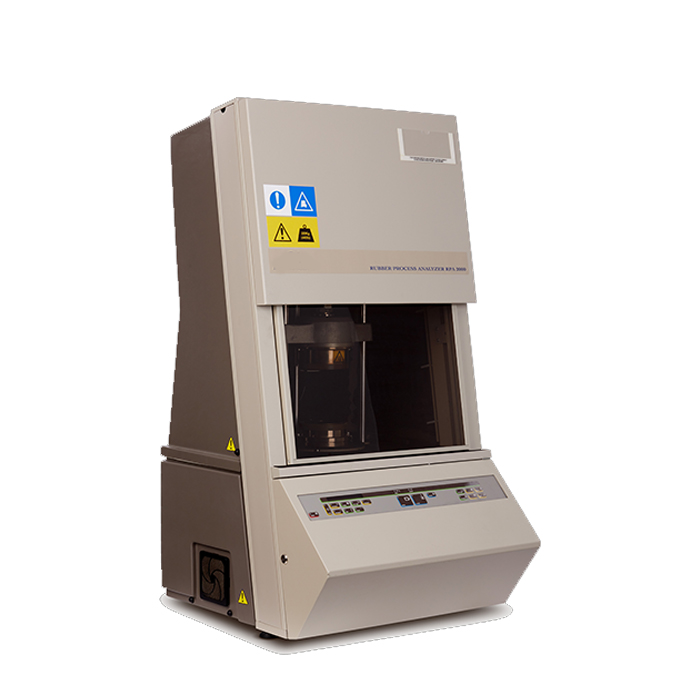
This machine is designed to get the characteristic curve and characteristic parameters of rubber vul
WhatsApp : +86 15601902607
Email : info@qinsun-lab.com

This machine is designed to get the characteristic curve and characteristic parameters of rubber vulcanization by measuring the applied moment of rubber to the oscillating dye body. NG-ODR rotor-free vulcameter has an excellent stability of results. The data and diagrams can be used as a reference for development, research and production quality.
ODR describes precisely and quickly the curing and processing characteristics of vulcanized rubber compounds. It works on a very simple principle. A test piece of rubber compound is contained in a sealed test cavity under positive pressure and maintained at a specified elevated temperature. A Rotor (oscillating disc) is embedded in the test piece and is oscillated through a small specified rotary amplitude. This action exerts a shear strain on the test piece and the torque (force) required to oscillate the disc depending on stiffness (shear modulus) of the rubber compound.
In the context of Rheometer, the cross linking Isotherm is thus the function of time, of the oscillating shear force B. or of the Rheometer indicating proportionality to it – occurring at a given temperature as a result of vulcanization. A plot of this torque (F) value against time gives a typical graph called “Cure Curve or Rheo graph. A trained eye can monitor the Initial trough le. processing behavior of the compound; the slope of rise during cure phase i.e., curing characteristics and the final shape of the curve on Internationally designated parameters.
ASTM D2084、ASTM D5289, ISO 6502
The plot of torque against time is analyzed to obtain the various results. In the Oscillating Disc Rheomoter, the Rheo graph is displayed in real time and at the end of test time, computer analyses the graph and results are automatically then, computed and displayed on the screen.
The results are then, categorized into three columns of which the significance is described further
| Temperature Range | Room Temperature to 22°C - 200°C |
| Temperature Accuracy | Within ±0.3°C |
| Temperature Display Resolution | 0.01°C |
| Oscillation Frequency | 1.6Hz, (100r/min) |
| Heating Rate | 120 °C / min |
| Torque Range | 0 - 20nm |
| Minimum Torque Reading | 0.001nm |
| of Swing Angles | ± 0.5°C ± 1°C ± 2°C (standard matching angle 1 degree) |
| Swing Angle | 100r / min (1.66hz) |
| Control | Computer Controlled |
| Communication Mode | COM Port |
| Air Pressure | 65psi (4.6 bar) - Not including air compressor |
| Specimen Dimensions | 5cm |
| Display | NextGen Software |
| Dimension (W x D x H) | 51.5x22x24.4" |
| 131x56x62cm | |
| Weight | 498lbs / 226kg |
| Power | 110V/60Hz or 220V/50Hz |
| 1000 W |
1、With VCH software, the accuracy of die oscillating frequency and torque transmission can be checked automatically.
2、Our U-CAD software provides contour lines of physical properties to help the users choosing excellent formula matching easily.
Functions:
1、In compliance with manufacturing standards ASTM D2084 , ISO 6502.
2、Providing S', S", S*, ML, MH, CRI, loss angle, tangent δ, etc.
3、Plots and % of compounding homogeneity variation.
4、Excellent reproducibility and repeatibility by our exclusive DSP analyzing program.
5、Automatically calibrate loss angle and torque.
6、High sampling rate up to 1200 points per one oscillating sign wave to reflect the curing and chemical interaction.
7、Automatic zero adjustment at every start of testing.
8、High speed temperature recovery.
Sealing rings: 10pcs
Heating plate: 2pcs
High temperature paper: 3 copies
Desktop (PC): 1 set
Printer: 1 set
Hexagonal wrench: 1 set
At first glance, the oscillating disc rheometer looks like a simple piece of lab equipment, but what happens inside is far more precise. The core idea is to measure how rubber behaves under controlled deformation, especially during the vulcanization process. That’s the moment when rubber transitions from a soft, moldable state into a durable, elastic material. And the ODR captures this transition with surprising clarity.
The setup involves placing a sample of rubber compound inside a heated die cavity. A disc (or rotor) sits in the middle and begins to oscillate, moving back and forth at a constant rate. As the rubber heats and starts to cure, its resistance to this motion increases. The machine continuously tracks the torque, or force, needed to keep the disc moving. These values are plotted over time, creating a curve that tells you exactly how the material responds.
The curve typically includes a minimum torque value (before curing begins), a rising slope (as vulcanization kicks in), and a maximum torque value (when the rubber has fully cured). From this curve, you can extract key performance indicators like scorch time, optimum cure time, and final stiffness. It’s not about abstract numbers—it’s real, physical behavior that affects how a product performs in the field.
Unlike static hardness or density measurements, the ODR gives dynamic feedback. You’re not just testing the final product—you’re watching the transformation happen in real time. That makes it especially useful when tweaking recipes or comparing batches.
Qinsun Instruments Co., LTD is a professional laboratory testing instrument manufacturer in China,Have been focusing on laboratory instrument R&D more than 30 years and have rich industry experience,Based on international testing standards,We are also the instrument supplier for BV SGS laboratory,We provide one-stop solutions for lab instruments,Free Training and Turn-Key Service,Products exported all over the world,Offer 36 month warranty and are a trustworthy partner.

Company Phone
+86-21-6420 0566
Working hours
Monday to Friday
Mobile phone:
13816217984
Email:
info@qinsun-lab.com