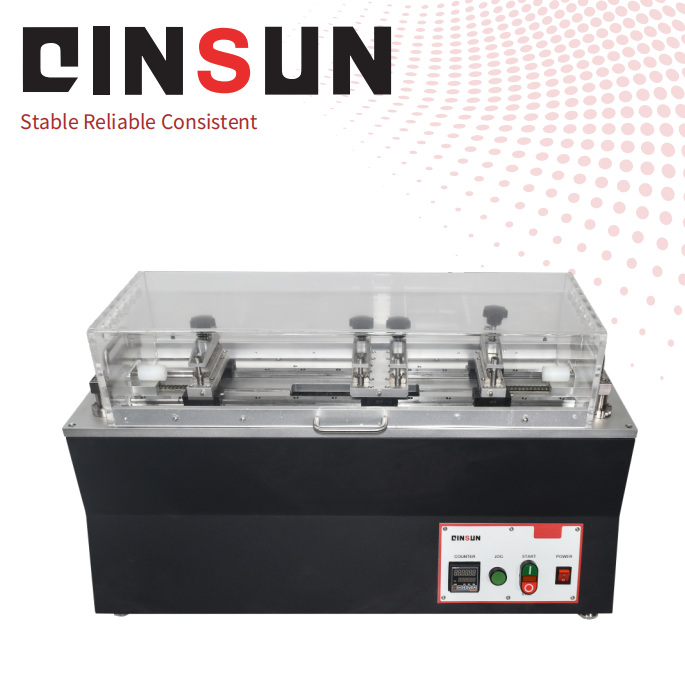
A precision instrument for evaluating seam durability in leather, footwear, and automotive textiles.
WhatsApp : +86 15601902607
Email : info@qinsun-lab.com

The leather seam fatigue testing machine is used to test interior materials by subjecting samples to periodic tensile and recovery cycles under specified test conditions. After a specified number of cycles, the maximum needle hole elongation at the seam is measured to evaluate the fatigue resistance of the seam.
The leather seam fatigue testing machine is used to evaluate the fatigue strength of seams in automotive seat surface materials. Automotive seat surface materials (genuine leather, synthetic leather, fabric, etc.) often have a stitched seam structure, and the stitching strength and fatigue resistance of these seams directly affect the lifespan of the seat. By testing the strength and lifespan of the material seams, it is possible to effectively predict the seat's lifespan and identify areas for improvement to extend its service life.
ISO 5402: Leather physical testing – Flex tester method for adhesion and strength analysis.
SATRA TM55: Seam fatigue testing for footwear, ensuring stitching integrity under cyclic stress.
ASTM D6193: Loop strength testing for leather goods, critical for accessories like belts and bags.
GB/T 3903.32: Chinese national standard for footwear seam fatigue resistance.
EN 13520: Flexometer testing for coated fabrics, validating bonding durability in automotive interiors.
Quad-Testing Stations: Independent clamping mechanisms for parallel evaluation of seams, loops, or bonded joints.
Customizable Testing Modes:
Seam Fatigue: SATRA/ISO-compliant bending cycles (e.g., 50.000 cycles for footwear uppers).
Loop Strength: ASTM-standard tension tests for leather accessories.
Adhesion Integrity: EN 13520-compliant coating delamination analysis.
Advanced Control System:
7-inch touchscreen with preset protocols for footwear, automotive, and fashion industries.
Adjustable load cell (0–50N) for tension/compression testing.
Fail-Safe Mechanisms: Auto-stop function upon seam failure or cycle completion, with real-time data logging.
Ergonomic Design: Quick-release clamps for rapid sample mounting and tool-free angle adjustments.
| Parameter | Specification |
|---|---|
| Test Stations | 1–4 (simultaneous operation) |
| Stroke Frequency | 100–300 cycles/min (adjustable) |
| Bending Angle | 0–90° (customizable) |
| Load Capacity | 0–50N (adjustable) |
| Sample Dimensions | 150 × 30 mm (standard) |
| Control System | PLC with touchscreen (programmable cycles, angles, loads) |
| Power Supply | 220V/50Hz, 120W |
| Dimensions | 600 (L) × 450 (W) × 500 (H) mm |
| Net Weight | 45 kg |
| Cycle Counter | Digital (1–999.999 cycles) |
Standard accessories
Abrasion test components: 1 piece of H10 abrasion wheel (standard specification for leather wear testing), 1 box of wheel reconditioning abrasive papers (for maintaining the abrasion wheel's surface consistency).
Load weights: 250g, 500g, and 1000g standard weights (to apply specified pressure during the abrasion test, meeting common test standard requirements).
Auxiliary equipment: 1 vacuum cleaner machine (for cleaning debris generated during the abrasion process, ensuring test environment cleanliness and result accuracy).
Basic accessories: Power cord, user manual, certificate of conformity (standard supporting items for normal equipment operation and compliance verification).
Optional accessories
Additional abrasion wheels: Specialized wheels (e.g., CS-10. CS-17 wheels) for testing different leather types (such as soft garment leather or hard industrial leather).
Extended load weights: Lighter (e.g., 100g) or heavier (e.g., 2000g) weights to adapt to non-standard pressure test requirements.
Test result auxiliary tools: Abrasion loss weighing balance (for precise measurement of leather weight loss after testing), surface roughness tester (for evaluating post-abrasion surface smoothness of leather).
The operator installs the height setting gauge between the pair of sample clamps at the test station. The sewn sample is aligned and clamped in place, and the height gauge is removed. A second test station is then set up, the second sample is aligned and clamped in place, the height gauge is removed, the number of test cycles is entered into the counter, and the test is started. The machine will automatically stop once the set number of test cycles is reached, and the test samples are evaluated visually.
Qinsun Instruments Co., LTD is a professional laboratory testing instrument manufacturer in China,Have been focusing on laboratory instrument R&D more than 30 years and have rich industry experience,Based on international testing standards,We are also the instrument supplier for BV SGS laboratory,We provide one-stop solutions for lab instruments,Free Training and Turn-Key Service,Products exported all over the world,Offer 36 month warranty and are a trustworthy partner.

Company Phone
+86-21-6420 0566
Working hours
Monday to Friday
Mobile phone:
13816217984
Email:
info@qinsun-lab.com