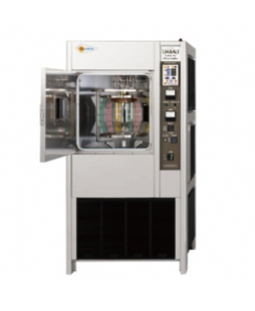
Carbon arc aging chamber is mainly used to simulate the destructive effects of ultraviolet rays, tem
WhatsApp : +86 15601902607
Email : info@qinsun-lab.com

Carbon arc aging chamber is mainly used to simulate the destructive effects of ultraviolet rays, temperature, humidity and other factors in natural climate on materials, and accelerate the aging process of materials through the radiation generated by carbon arc lamps. It is often used in industries such as plastics, rubber, and coatings to help evaluate the aging resistance of materials in order to improve product quality and extend service life.
The Carbon Arc Aging Chamber employs alternating current to ignite carbon rods, generating an arc light source. After passing through a filter, this light possesses higher irradiance than sunlight, thereby accelerating sample aging when directed onto surfaces. Equipped with a spray system, it simulates not only sunlight exposure but also rainfall conditions, enabling effective accelerated testing of samples' weather resistance.
JIS B7753 Sunlight Carbon Arc Lamp Test for Lightfastness and Weather Resistance
ISO 4892-4 Plastics - Laboratory light exposure methods - Part 4: Open carbon arc lamp
JIS A1415 Laboratory light exposure methods for polymeric building materials
ASTM G23 Operating procedures for carbon arc exposure apparatus with and without water for nonmetallic materials
Accelerated Weathering: Rapidly simulates sunlight, artificial light, and rainfall, providing faster results than natural aging.
High-Intensity Carbon Arc: Uses 4 pairs of carbon electrodes (2 upper, 2 lower) to generate stable, high-intensity light similar to solar spectrum.
Filtered Spectrum: Light passes through high-quality filters to reproduce sunlight-like wavelengths, ensuring consistent irradiation on test surfaces.
Precision Electrode Control: Automatic vertical movement of carbon electrodes maintains stable voltage and current within strict tolerances.
Moisture Simulation: Programmable spray system replicates rainfall exposure during testing.
Large Sample Capacity: Accommodates up to 76 test specimens simultaneously.
| Item | Specifications |
|---|---|
| Control Mode | Automatic |
| Carbon Arc Lamp Continuous Lighting Time | 78 hours |
| Carbon Arc Lamp Discharge Voltage | 50V±2V |
| Carbon Arc Lamp Discharge Current | 60A±2A |
| Carbon Arc Lamp Radiation Irradiance | 255 W/m² |
| Black Panel Temperature | 63°C±3°C or 83°C±3°C |
| Spray Pressure | 0.08–0.13 MPa; Water flow: 2100ml±100ml/min; Water temperature: 16°C±5°C |
| Working Chamber Humidity | 50% RH±5% RH |
| Sample Size | 150mm×70mm; Maximum sample capacity: 76 pieces |
| Sample Rotation Frame Speed | 1 RPM |
| Sample Rotation Frame Diameter | 960mm±6mm |
| Distance Between Arc Center and Sample Surface | 480mm±3mm |
| Power Supply | 380V 50Hz |
| Weight | 375 kg |
| Overall Dimensions (L×W×H) | 165cm×150cm×220cm |
Carbon Electrode Sets (4 pairs): Upper thick and lower thin electrodes.
Filter Lenses: Solar spectrum simulation filters surrounding the electrodes.
Water Spray System: Includes pump, piping, and nozzles for controlled spray.
Sample Rotating Frame: Provides uniform exposure of all samples.
Control Unit: Automated interface for BPT, lamp power, and spray control.
Preparation: Inspect carbon electrodes, filters, and water system for cleanliness and integrity.
Sample Loading: Mount up to 76 specimens on the rotating frame; ensure uniform distribution.
Parameter Setting: Select black panel temperature (63°C or 83°C), continuous arc duration, and spray settings via control panel.
Test Execution: Start the chamber. The electrodes will arc, and the rotating frame will expose all samples to consistent irradiance. Spray cycles operate as programmed.
Monitoring: Periodically check BPT, lamp current, and water flow logs to confirm system stability.
Completion: After the test period, shut down the chamber, remove samples, and evaluate for color change, gloss reduction, or mechanical degradation.
1.What is the primary purpose of the Carbon Arc Aging Chamber?
It simulates accelerated weathering to evaluate colorfastness, yellowing, and mechanical property changes of materials exposed to sunlight, indoor light, and rainfall.
2.Which materials can be tested?
Plastics, polymers, coatings, automotive components, building materials, and other nonmetallic products requiring weathering assessment.
3.How is sunlight simulated in this chamber?
High-intensity carbon arc lamps produce light similar to the solar spectrum, which is further refined through filter lenses to mimic natural sunlight wavelengths.
4.How is moisture exposure applied?
The chamber uses a programmable water spray system with adjustable pressure and flow to simulate rainfall on test specimens.
5.How are electrodes maintained for consistent testing?
Regular inspection and replacement of carbon electrodes are required. Automatic vertical adjustment ensures stable voltage and current during operation.
6.What is the maximum number of samples that can be tested simultaneously?
The rotating frame can hold up to 76 specimens of 150 × 70 mm each.
Qinsun Instruments Co., LTD is a professional laboratory testing instrument manufacturer in China,Have been focusing on laboratory instrument R&D more than 30 years and have rich industry experience,Based on international testing standards,We are also the instrument supplier for BV SGS laboratory,We provide one-stop solutions for lab instruments,Free Training and Turn-Key Service,Products exported all over the world,Offer 36 month warranty and are a trustworthy partner.

Company Phone
+86-21-6420 0566
Working hours
Monday to Friday
Mobile phone:
13816217984
Email:
info@qinsun-lab.com