Sample making:1. The test plate of the fireproof coating tester (small chamber method) is made of bi
WhatsApp : +86 15601902607
Email : info@qinsun-lab.com

The fire-retardant coating tester (combustion chamber method) is primarily used to test the flame-retardant performance of fire-retardant coatings applied to the surface of combustible substrates under laboratory conditions. According to the GB12441-2018 standard, the test methods include the small chamber method, the large panel method, and the tunnel method. The test results are usually evaluated based on the mass loss during combustion and the charring volume to assess the quality of the fire-retardant coating.
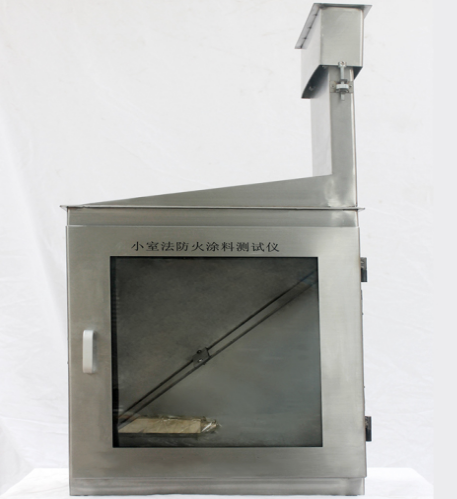
The fire-retardant coating combustion test apparatus (small chamber method) and the fire-retardant coating small sample test furnace are used to conduct combustion tests under laboratory conditions to determine the flame spread performance of fire-retardant coatings applied to the surface of combustible substrates.
GB 14907—1994: General specifications of fire resistive coating for steel structure
GB 14907—2002: Fire resistive coating for steel structure
ETAG:2006: European Technical Approval Guideline 2006
BS 8202:1992:2: Coatings for fire protection of building elements - Part 2: Code of practice for the use of intumescent coating systems to metallic substrates for providing fire resistance
Complies with national standards: The testing instrument complies with the requirements of GB12441-2018 "Classification and Test Methods for Fire Performance of Decorative Fire-Retardant Coatings," ensuring the accuracy and reliability of the test results.
Compatible with multiple test methods: The equipment is compatible with various test methods, including the small chamber method, large panel method, and tunnel method, meeting different testing needs.
Testing under laboratory conditions: Suitable for testing the fire resistance performance of fire-retardant coatings applied to the surface of combustible substrates under laboratory conditions, using combustion mass loss and charring volume to evaluate the quality of the fire-retardant coating.
Structural design: The equipment has a reasonable structural design, complying with international flame retardant testing standards, ensuring the safety and effectiveness of the testing process.
Wide range of applications: Suitable for determining the flame resistance characteristics and flame resistance time of decorative fire-retardant coatings applied to the surface of combustible substrates, as well as experiments on flame propagation characteristics.
1. The test plate of the fireproof coating tester (small chamber method) is made of birch five-layer plywood conforming to GB738-75 "broadleaf wood plywood", its size is 300mmx150mmx5mm, and the surface of the sample should be smooth and smooth, without joints and other defects.
2. before the test board is coated with fireproof paint, the state should be adjusted to constant at the temperature of 25±1℃ and the relative humidity of 60%——70% (the weight change of 24h interval is not more than 0.1%)。
3. according to the coating ratio of 200——250g/m2 (thick paste coating allows to increase to 500g/m2) to test the fire retardant coating evenly covered on the surface of the test plate and around, when the need for multiple coating, the interval between two times should be 24h.
The finished specimens shall be adjusted to constant weight according to the condition state specified in 2 articles, and ten specimens of each fireproof coating shall be prepared.
| Item | Description |
|---|---|
| Instrument Structure | Composed of a main control box and a combustion box. The control box is movable, made of electrostatic steel plate (t=1.2mm) with a spray-painted surface for a smooth and aesthetic appearance. |
| Observation Window | Equipped with a glass window on the front for observing the sample's combustion status at any time. |
| Burner Material | Made of brass. |
| Temperature Control System | Digital temperature control system. |
| Thermocouple Specifications | Outer diameter: 2mm, Accuracy: Class II, Range: 1300℃. |
| Timer Accuracy | Error not exceeding 1s/h. |
| Alarm System | Alarms every 15 seconds during the test to remind the operator to record the current combustion status. Combustion duration: 4 minutes. |
| Gas Source | Liquefied petroleum gas or natural gas. |
| Rotameter | Adjustable flow rate of combustion gas. |
| Pressure Regulator | High-precision pressure regulator to adjust the gas pressure to standard requirements. |
| Power Requirements | AC220(±10%)V/50HZ. |
| Control System | Relay control system with all electronic components from well-known domestic brands to ensure better machine performance and detection accuracy. |
| Safety Features | Overload and short-circuit protection for the power supply. |
| Instrument Dimensions | Approximately 340mm x 230mm x 794mm. |
| Sample Holder Tilt Angle | Can be tilted 45° ± 2°. |
| Copper Combustion Cup Specifications | Outer diameter: 24mm ± 0.1mm, Wall thickness: 1mm ± 0.06mm, Height: 17mm ± 0.1mm, Volume: 6mL. |
| Fuel | Chemically pure grade anhydrous ethanol. |
Combustion Test Chamber: Typically a metal box with glass doors and windows, used to create a closed combustion environment.
Fuel Cup: A container for holding fuel (such as anhydrous ethanol), providing the energy source for combustion.
Specimen Holder: Used to fix and support the fire-retardant coating specimen under test, ensuring it is in the correct testing position.
Draft Hood and Chimney: Help control the flow of smoke generated during combustion, ensuring the stability of the test environment.
Air Inlet: Regulates the amount of air entering the combustion chamber to control combustion conditions.
Burner: Some equipment is equipped with a burner to provide a stable ignition source.
Thermocouple: Measures temperature changes in the specimen or combustion chamber during combustion, ensuring the accuracy of test data.
Temperature Control System: Precisely controls the temperature inside the combustion chamber to simulate different fire scenarios.
Data Acquisition and Analysis Software: Records and analyzes various data during the testing process, such as temperature changes and burning time, to evaluate the performance of the fire-retardant coating.
Ensure the testing equipment is in good working order; repair or replace any damaged or malfunctioning parts promptly.
Operators should wear appropriate personal protective equipment, including safety glasses, gloves, and protective clothing.
During operation, pay attention to fire safety and strictly prohibit the use of flammable materials.
Check that the power connection of the testing instrument is secure and that the sensors and control system are functioning correctly.
Prepare the test samples and related testing materials.
Apply the paint sample to be tested onto a standard test panel and cure it according to the paint manufacturer's instructions.
Place the test panel in the testing chamber of the instrument and close the chamber door.
Set the parameters of the testing instrument, including temperature and time.
Start the testing instrument to begin the test.
During the test, record the temperature and time data displayed by the testing instrument.
After the test is completed, turn off the testing instrument and remove the test panel.
Qinsun Instruments Co., LTD is a professional laboratory testing instrument manufacturer in China,Have been focusing on laboratory instrument R&D more than 30 years and have rich industry experience,Based on international testing standards,We are also the instrument supplier for BV SGS laboratory,We provide one-stop solutions for lab instruments,Free Training and Turn-Key Service,Products exported all over the world,Offer 36 month warranty and are a trustworthy partner.

Company Phone
+86-21-6420 0566
Working hours
Monday to Friday
Mobile phone:
13816217984
Email:
info@qinsun-lab.com