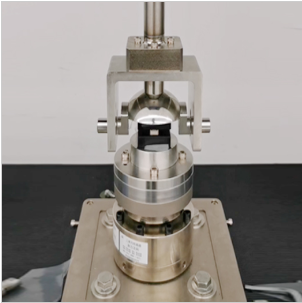
Specifically, the main applications of the compression fatigue testing machine for intervertebral fu
WhatsApp : +86 15601902607
Email : info@qinsun-lab.com

The Compression Fatigue Testing Machine is a mechanical testing device designed to evaluate the fatigue performance of materials or components under repeated compressive loads. It simulates the cyclic forces that a specimen would experience in real-life applications, helping assess durability, structural integrity, and long-term reliability.
(1)YY/T 0959-2014 (China): Specifies compression fatigue testing protocols for intervertebral fusion devices, including load ratios, frequency, and failure criteria.
(2)ASTM F2077-17 (International): Defines methodologies for evaluating the fatigue strength of intervertebral body fusion devices under compressive loading.
(3)ISO 12189-1: Additional compliance for mechanical testing of spinal implant components.
The Compression Fatigue Testing Machine is used to evaluate the durability and fatigue resistance of materials, mechanical components, and structural parts under repeated compressive loads. It helps manufacturers and researchers predict long-term performance, optimize designs, and ensure compliance with mechanical testing standards.
High-Frequency Stability: Advanced electromagnetic actuator maintains 0.1–20 Hz frequency range with ±0.05% force accuracy.
Ultra-Precision Loading: 25 kN axial force capacity with 1 N resolution for submicron displacement control.
Dynamic Load Control: Programmable R=0.1–10 load ratios with real-time stiffness compensation.
Biorelevant Environment: Temperature-controlled (37±1°C) lubrication bath with 20±2 g/L protein concentration.
Extended Durability: Capable of 10+ million cycle testing with <0.2% drift in calibration.
Modular Design: Six-station configuration allows parallel testing of multiple specimens.
Electromagnetic Servo Motor: 25 kN axial force capacity with programmable load ratios (R=0.1–10).
Triaxial Strain Gauge: Measures axial/radial strains simultaneously (0.1 με resolution).
Dynamic Load Control: 0.1–20 Hz frequency range with programmable waveforms (sine, square, random, custom).
Thermal-Mechanical Chamber: ±0.3°C temperature stability with integrated humidity control (10–95% RH).
High-Resolution Imaging: Optional integration with micro-CT systems for in-situ crack analysis.
Safety System: Emergency stop, overload clutches, and laser-based specimen breakage detection.
| Parameter | Specification |
|---|---|
| Max. Axial Force | ±25.000 N (25 N resolution) |
| Frequency Range | 0.1–20 Hz (0.01 Hz increments) |
| Load Ratio (R) | 0.1–10 (adjustable) |
| Axial Displacement | ±10 mm (0.1 μm resolution) |
| Temperature Control | -20°C to +50°C (PT1000 sensors) |
| Humidity Control | 10–95% RH (non-condensing) |
| Data Sampling Rate | 100 kHz (synchronized across 16 channels) |
| Power Requirements | 220V/110V ±10%, 50/60Hz, 3.000W |
| Dimensions (W×D×H) | 2.000 × 1.500 × 2.200 mm |
| Weight | 1.200 kg (including environmental chamber) |
| Noise Level | <65 dB (A-weighted) |
(1)Spinal Implant Fixture Kit:
Self-centering collet system (8–20 mm implant diameter compatibility)
Anatomically shaped loading anvils with diamond-like carbon (DLC) coating
(2)Thermal-Mechanical Chamber:
25L capacity with rapid cooling/heating (15°C/min)
316L stainless steel interior with HEPA filtration
(3)CompressionMaster Pro Software:
Automated stiffness degradation tracking and fatigue limit calculation
21 CFR Part 11-compliant audit trail with blockchain timestamping
Remote monitoring via dedicated iOS/Android app
(4)Operator Kit:
Calibrated torque wrench set (0.5–50 Nm)
Specimen alignment gauges (ASTM F2077 compliant)
(5)Calibration Bundle:
NIST-traceable force calibration weights
Strain gauge verification tool
(6)Safety Kit:
Laser safety curtains
Acoustic enclosure with 30 dB noise reduction
1. What is the main purpose of this machine?
It evaluates the fatigue performance of materials or components under repeated compressive loads, simulating real-life operational conditions.
2. What types of materials can be tested?
The machine can test metals, plastics, composites, mechanical components, and structural parts.
3. How does the machine simulate fatigue conditions?
It applies cyclic compressive loads at controlled frequencies and magnitudes to replicate the stresses experienced over the component’s service life.
4. Which standards does this machine comply with?
It supports testing according to international standards, including ASTM, ISO, and other relevant mechanical testing protocols.
5. Who typically uses this equipment?
Manufacturers, research laboratories, and quality control teams use it for material evaluation, component design verification, and durability testing.
Qinsun Instruments Co., LTD is a professional laboratory testing instrument manufacturer in China,Have been focusing on laboratory instrument R&D more than 30 years and have rich industry experience,Based on international testing standards,We are also the instrument supplier for BV SGS laboratory,We provide one-stop solutions for lab instruments,Free Training and Turn-Key Service,Products exported all over the world,Offer 36 month warranty and are a trustworthy partner.

Company Phone
+86-21-6420 0566
Working hours
Monday to Friday
Mobile phone:
13816217984
Email:
info@qinsun-lab.com