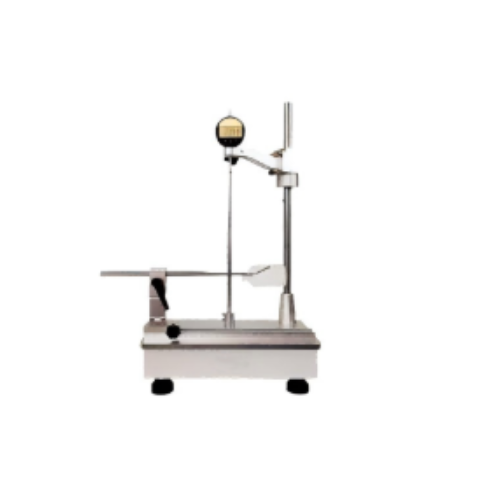
The wall and bottom thickness tester for bottles is a measuring instrument widely used in the pharma
WhatsApp : +86 15601902607
Email : info@qinsun-lab.com

The wall and bottom thickness tester for bottles is a measuring instrument widely used in the pharmaceutical, food, cosmetics, and other industries.
The wall and bottom thickness tester for bottles is mainly used to measure the thickness of the walls and bottoms of containers such as glass bottles and plastic bottles. Through testing, we can understand the physical properties and structural characteristics of the bottles, thus optimizing the production process and material selection. At the same time, this tester also plays an important role in product quality control and safety assessment. By sampling and inspecting bottles on the market and evaluating their quality and safety, it helps regulatory authorities protect consumers' rights and interests.
The design and manufacture of the wall and bottom thickness tester for bottles comply with a series of national and international standards to ensure the accuracy and reliability of test results. Among the more common standards are YBB00322002 - 2015 Low - Boron - Silicate Glass Ampoules, YBB00332003 - 2015 Soda - Lime Glass Injection Bottles, YBB00322004 - 2015 Soda - Lime Glass Oral Liquid Bottles, and GB 12415 - 90 Test Methods for Internal Stress of Pharmaceutical Glass Containers. These standards specify in detail the test methods for the wall and bottom thickness of bottles, specimen preparation, test conditions, etc., providing a unified standard for the use of the tester.
1. Precise Measurement: Electronic digital display reduces human error, ensuring accurate and reliable measurement data. Its high-precision capacitive grating sensing technology achieves a measurement accuracy of 0.01mm, far exceeding similar products.
2. Easy Operation: Utilizing advanced capacitive grating sensing technology, operation is simple and intuitive. The dual-head design allows operators to quickly switch between measuring the bottle bottom and bottle wall, improving work efficiency.
3. Strong Applicability: Meets the thickness measurement needs of various industries and bottle types. Whether glass or plastic bottles, bottles of different capacities and sizes can be accurately measured. Customizable sample diameter and height ranges further expand its applicability.
4. High Stability: The instrument's rational structural design and carefully optimized internal circuitry ensure stability during long-term use. Even in complex production environments or under frequent use, it maintains accurate measurement performance.
| Technical Parameter | Specification |
|---|---|
| Measurement Range | Usually 0 - 12.7mm (varies by instrument model); covers wall/bottom thickness testing needs of most bottles. |
| Resolution/Division Value | Generally 0.001mm or higher; enables precise measurement of bottle thickness changes. |
| Sample Dimensions | Sample diameter: usually 5 - 120mm (customizable); sample height: 5 - 330mm (customizable); adapts to bottles of different specifications/shapes. |
| Testing Principle | Adopts magnetic measurement principle or capacitive-grid sensing technology:- Magnetic principle: Steel balls placed inside the bottle for measurement.- Capacitive-grid technology: Measuring head contacts the bottle (matching the probe); sensors collect data, then the system calculates wall/bottom thickness. |
| Power Supply | Usually AC 220V 50Hz; ensures normal operation of the tester. |
| External Dimensions | Generally about 400mm (length) × 360mm (width) × 700mm (height); facilitates placement and movement. |
| Weight | Varies by model/brand; usually compact and lightweight for easy portability and operation. |
1. Main Unit: Bottle Wall and Bottom Thickness Tester, featuring an advanced capacitive grating sensing measurement system, electronic digital display, and operation buttons. The main unit is robust and ergonomically designed for easy operation.
2. Measuring Heads: Equipped with two high-precision measuring heads, one for measuring the thickness of the bottle bottom and the other for the bottle wall. The measuring heads are made of a special material with excellent wear and corrosion resistance, ensuring long-term accuracy.
3. Calibration Tools: To ensure measurement accuracy, the instrument is equipped with standard calibration tools. Operators can periodically calibrate the instrument to ensure consistently reliable measurement results.
4. Instruction Manual and Warranty Card: A detailed instruction manual is provided to help users quickly familiarize themselves with the instrument's operation and precautions. A warranty card is also included, providing comprehensive after-sales support.
1. Equipment Preparation: Connect to AC 220V 50Hz power supply. Calibrate the equipment using a standard thickness sample (ensuring resolution ≥ 0.001mm) and confirm normal equipment operation.
2. Sample Preparation: Select the bottle to be tested (diameter 5-120mm, height 5-330mm, or customized specifications). Clean the bottle wall/bottom surface, ensuring it is free of impurities and damage.
3. Select Test Mode: Select the test principle based on the bottle type (glass/plastic)—magnetic measurement (placing matching steel balls inside the bottle) or capacitive grid sensing (measuring head contacts the sample).
4. Sample Clamping: Fix the sample on the fixture and adjust the position of the steel balls or the contact point of the measuring head according to the test mode.
5. Parameter Setting: Set parameters such as the measurement range (0-12.7mm) through the interface to match the sample requirements.
6. Start Test: Run the program; the equipment automatically collects data and calculates the bottle wall/bottom thickness.
7. Result Processing: Export the data and verify that it meets the requirements of compliance standards such as YBB00322002-2015.
8. Post-processing: Remove the sample, clean the fixtures and measuring components, and turn off the power.
1.What is a Bottle Wall and Bottom Thickness Tester?
A Bottle Wall and Bottom Thickness Tester is an instrument used to measure the thickness of glass or plastic bottles at various points, including the walls and the bottom. This device ensures that bottles meet safety and quality standards, as variations in thickness can affect the durability and performance of a bottle.
2.Why is it important to measure bottle thickness?
Measuring bottle thickness is crucial for quality control in manufacturing. Uniform thickness ensures that bottles can withstand pressure, impacts, and temperature changes without breaking. Inconsistent thickness can lead to product leakage or failure, which can be costly for manufacturers and potentially dangerous for consumers.
3.How does a Bottle Thickness Tester work?
Most Bottle Thickness Testers utilize ultrasonic technology to measure wall and bottom thickness accurately. The device emits sound waves that travel through the bottle material; by measuring the time it takes for the waves to return, the tester can calculate the thickness. This method is non-destructive, allowing bottles to be used after testing.
4.What types of bottles can be tested?
Bottle Thickness Testers are versatile and can be used on various types of bottles, including glass, PET, and other plastic bottles. Whether for food and beverage containers, pharmaceuticals, or personal care products, these testers can adapt to different shapes and sizes to ensure comprehensive quality control.
5.Are there specific standards for bottle thickness?
Yes, there are specific industry standards for bottle thickness that vary by application and material. For example, food and beverage bottles may have stricter requirements for safety and pressure resistance. Manufacturers must consult relevant guidelines and standards to ensure compliance while using a Bottle Wall and Bottom Thickness Tester.
Qinsun Instruments Co., LTD is a professional laboratory testing instrument manufacturer in China,Have been focusing on laboratory instrument R&D more than 30 years and have rich industry experience,Based on international testing standards,We are also the instrument supplier for BV SGS laboratory,We provide one-stop solutions for lab instruments,Free Training and Turn-Key Service,Products exported all over the world,Offer 36 month warranty and are a trustworthy partner.

Company Phone
+86-21-6420 0566
Working hours
Monday to Friday
Mobile phone:
13816217984
Email:
info@qinsun-lab.com