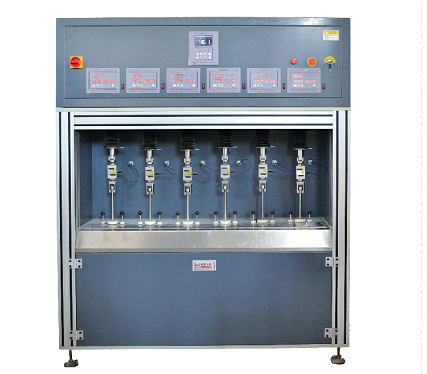
Main use:Evaluate the creep properties of materials:The full notch creep testing machine can simulat
WhatsApp : +86 15601902607
Email : info@qinsun-lab.com

This testing machine is used to test the environmental stress cracking performance of plastic materials. The equipment features touchscreen operation, weight loading, and ensures independent operation of each workstation, uniform temperature distribution, and stable and consistent test results. In addition, a water level monitoring function alerts the operator when the water level is too low.
1. Plastics/Piping Industry: Testing the high-temperature creep fracture behavior of pipe materials such as PE and PPR to verify long-term service reliability (e.g., water supply and gas pipelines);
2. Automotive Industry: Evaluating the creep stability of plastic/metal components under high-temperature conditions around the engine and exhaust system;
3. Aerospace/Electronics: Verifying the creep resistance of composite materials and electronic packaging materials in high-temperature environments to ensure long-term equipment operation;
4. Chemical/Energy Industry: Testing the creep fracture strength of materials used in chemical equipment and energy storage devices in high-temperature media to meet industrial safety requirements;
5. Materials Research and Development: Screening high-temperature suitable materials, optimizing material formulations and processes, and providing long-term performance data support.
(1)ISO 16770: Exclusively designed for full-notch creep testing (FNCT) of thermoplastics under sustained stress.
(2)ASTM D2990: Configurable for tensile, compressive, and flexural creep testing of polymers and composites.
1. Uncompromising Precision
Independent 6-Zone Control: Each station operates with ±1% force accuracy (0–2.000N) and ±0.1°C temperature stability.
Hybrid Loading System: Combines motorized force application with manual fine-tuning via touchscreen-guided weights.
2. Versatile Testing Environments
Dual Bath Compatibility: Switch between water (up to 95°C) and oil (up to 150°C) baths for high-temperature polymer analysis.
Expanded Force Capacity: Upgradeable to 4.000N max. load per station for heavy-duty applications.
3. Intelligent Monitoring
Auto-Level Sensing: Real-time solution height detection prevents test interruptions from evaporation or leaks.
Visual Alerts: Touchscreen displays color-coded status indicators for all stations.
4. Future-Ready Design
Modular Architecture: Add stations or upgrade controllers without replacing the entire system.
Multi-Language Interface: Operate in English, German, Chinese, or Spanish.
| Specification | Details |
|---|---|
| Stations | 6 fully independent test positions |
| Force Range (per station) | 0–2.000N (standard) / 0–4.000N (optional) |
| Temperature Control | Water: 40–95°C |
| Force Accuracy | ±1% FS (0.5% with calibration kit) |
| Power Supply | 220V/50Hz (110V/60Hz available) |
| Bath Capacity | 15L per station (90L total) |
| Dimensions (W×D×H) | 1.800mm × 750mm × 1.650mm |
| Weight | 380 kg (net) |
(1)Test Media:
High-temperature silicone oil (150°C max.)
Deionized water reservoir with auto-refill.
(2)Sample Fixtures:
Self-tightening grips for notched specimens (ISO 16770 compliant).
Flat dog-bone clamps for ASTM D2990 testing.
(3)Software Bundle:
CreepVision Pro™: AI-assisted strain analysis with Weibull modulus calculation.
LabShare Cloud: Remote monitoring for up to 50 concurrent users.
(4)Calibration Kit:
NIST-traceable force gauge and thermocouple set.
(5)Extended Warranty:
5-year comprehensive coverage for load cells and controllers.
1. Pre-test preparation
Check that the instrument's power supply, heating system, and loading mechanism are functioning correctly. Calibrate the temperature and load sensors. Clean the test chamber and fixtures of any debris. Ensure that there is sufficient high-temperature medium (such as heat transfer oil).
2. Sample preparation and installation
Prepare samples with full notches according to the standard, and record basic information such as sample dimensions and notch parameters. Fix the sample onto the special fixture, ensuring that the notch direction is consistent with the force direction, and that the clamping force of the fixture is uniform to prevent sample misalignment.
3. Parameter setting
Set the test temperature, constant load value, and holding time (or fracture termination condition) through the control panel. Set the data acquisition frequency. After confirming that the parameters meet the test standard (e.g., ISO 16770), save the settings.
4. Starting the test
Close the test chamber door, start the heating system, and after the chamber temperature stabilizes to the set value and is maintained for a period of time, start the loading program. The instrument will automatically apply a constant load and start timing, recording creep deformation data in real time.
5. Test monitoring
During operation, monitor the temperature and load stability, observe the sample deformation and crack propagation, and promptly handle any abnormal alarms to ensure continuous testing.
6.Test completion and cleaning
After the sample fractures or reaches the set duration, the instrument automatically unloads and shuts down. After the test chamber cools down to room temperature, open the chamber door, remove the sample, and record data such as fracture time and deformation amount. Clean the fixtures and test chamber, turn off the instrument power, and prepare the test report.
(1)Clean the testing area, sample holders, and notched fixtures regularly to prevent debris accumulation.
(2)Inspect and lubricate moving parts, guides, and mechanical components to ensure smooth operation.
(3)Check load cells, sensors, and electrical connections periodically for proper function and measurement accuracy.
(4)Calibrate the machine regularly according to manufacturer guidelines to maintain reliable creep testing results.
(5)Replace worn or damaged parts, such as clamps, fixtures, or mechanical components, promptly.
(6)Update software or firmware as recommended to ensure proper operation and accurate data logging.
(7)Maintain detailed records of maintenance, inspections, and calibrations to ensure consistent performance.
1. What is a Full Notch Creep Tester used for?
It measures the creep resistance and time-to-failure of notched polymer and plastic samples under constant stress.
2. How does the tester operate?
The sample with a notch is subjected to a controlled load, and deformation over time is recorded until failure or a set endpoint.
3. What types of materials can be tested?
Commonly used for plastics, polymers, and composite materials that require evaluation of long-term stress performance.
4. How is test data recorded and analyzed?
Deformation, strain, and time-to-failure are recorded digitally, displayed on the interface, and can be exported for further analysis.
5. What maintenance is required for the tester?
Routine cleaning, lubrication of moving parts, calibration checks, inspection of load cells and fixtures, and timely replacement of worn components.
Qinsun Instruments Co., LTD is a professional laboratory testing instrument manufacturer in China,Have been focusing on laboratory instrument R&D more than 30 years and have rich industry experience,Based on international testing standards,We are also the instrument supplier for BV SGS laboratory,We provide one-stop solutions for lab instruments,Free Training and Turn-Key Service,Products exported all over the world,Offer 36 month warranty and are a trustworthy partner.

Company Phone
+86-21-6420 0566
Working hours
Monday to Friday
Mobile phone:
13816217984
Email:
info@qinsun-lab.com