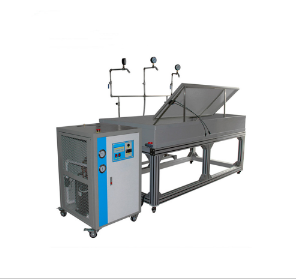
The Wet Leakage Current Test System is designed for high-precision evaluation of insulation resistan
WhatsApp : +86 15601902607
Email : info@qinsun-lab.com

The Wet Leakage Current Test System is designed for high-precision evaluation of insulation resistance and leakage current in photovoltaic modules under simulated wet conditions. It replicates real-world rain, dew, and irrigation scenarios while providing accurate temperature control and corrosion-resistant construction, ensuring reliable PID and insulation defect testing.
(1) Wet insulation resistance measurement of framed and frameless PV modules
(2) Detection of leakage currents to evaluate PID (Potential Induced Degradation) risk
(3) Qualification testing per IEC 61215 and UL 61730 standards
(4) Laboratory testing of module materials, encapsulants, and junction boxes
(5) R&D of PV module waterproofing and sealing technologies
(1) IEC 61215 – Terrestrial Photovoltaic (PV) Modules: Design Qualification and Type Approval
(2) UL 61730 – Safety Standard for Photovoltaic Modules
(3) ISO 17025 – General Requirements for the Competence of Testing and Calibration Laboratories
(4) CE Certification – Conformité Européenne
(5) Optional: IEC 60529 – Degrees of Protection Provided by Enclosures (IP Code)
IEC 61215 Compliance: Maintains 22±3°C for consistent wet insulation resistance measurements.
Precise Liquid Resistivity: <3,500 Ω·cm ensures accurate leakage current detection per standard requirements.
Multi-Directional Spray Simulation: 360° adjustable nozzles with 0–10 bar flow for customizable rain/dew exposure.
Corrosion-Resistant Design: 15mm Plexiglass tank and 316L stainless steel fittings resist salt spray and UV exposure.
Safety Features: 30mA GFI and door interlock system for operator protection during wet cycles.
Smart Data Acquisition: 16-bit ADC captures microamp-level leakage currents; AI diagnostics flag insulation defects.
User-Friendly Operation: Dual-zone temperature control, 7” touchscreen HMI, remote monitoring, and self-cleaning protocols.
Modular Testing: Expandable from single-module to 10-module parallel testing.
| Parameter | Specification |
|---|---|
| Test Tank Dimensions | 2,100 mm × 1,000 mm × 250 mm (W×D×H) |
| Tank Material | 15 mm Cast Acrylic (Plexiglass) |
| Temperature Range | 15°C to 40°C (operational) |
| Temperature Stability | ±0.5°C (at 22°C setpoint) |
| Liquid Resistivity | <3,500 Ω·cm (deionized water recommended) |
| Spray Pressure | 0–10 bar (adjustable) |
| Flow Rate | 0–15 L/min (per nozzle) |
| Power Supply | 230V AC, 50/60Hz (single-phase) |
| Dimensions (W×D×H) | 2,500 mm × 1,200 mm × 1,500 mm |
| Weight | 350 kg (net) / 450 kg (gross) |
(1) PV module test fixtures (4 pcs, adjustable for frameless/framed modules)
(2) Insulated test leads with alligator clips (10 pcs)
(3) Software Suite: LeakTest Pro license (Windows/Linux), 1-year cloud-based I-V curve analyzer
(4) Calibration & Safety: NIST-traceable conductivity meter, emergency eyewash station (wall-mounted)
(5) Maintenance Kit: Spare acrylic tank seal, nozzle gaskets, non-corrosive tank cleaning solution
(6) Documentation: Multilingual quick-start guide (printed + digital), compliance certificates for IEC/UL/ISO standards
Install PV module on test fixture and connect insulated leads to module terminals.
Fill tank with deionized water and set liquid resistivity below 3,500 Ω·cm.
Configure chamber and water temperature via HMI to 22±3°C.
Adjust nozzle orientation and spray pressure to desired testing conditions.
Initiate test sequence; system sprays water while measuring leakage current and recording data.
Monitor results in real-time through HMI or remote software interface.
Upon completion, stop spray, drain water using automated self-cleaning system, and safely remove the PV module.
Export recorded data for analysis and reporting.
Clean tank surfaces, nozzles, and PV module fixtures regularly to prevent residue buildup.
Replace acrylic seals, nozzle gaskets, and test leads as needed.
Periodically calibrate conductivity meters and data acquisition channels.
Verify GFI and door interlock functionality before each test cycle.
Maintain tank and equipment in a dry environment when not in use.
1. What is a Wet Leakage Current Test System for Photovoltaic Modules?
This system is designed to evaluate the insulation performance of photovoltaic (PV) modules under wet conditions by measuring leakage current. It ensures the module’s safety and compliance with international electrical standards.
2. How does the wet leakage current test work?
The PV module is sprayed or immersed in water to simulate rainy or humid conditions. A voltage is applied across the module, and the system measures leakage current to detect insulation defects or weak points.
3. What types of PV modules can be tested?
It can test monocrystalline, polycrystalline, and thin-film solar modules of various sizes, including framed and frameless designs. The system is compatible with different junction box configurations.
4. What parameters are measured during testing?
The system measures leakage current (µA or mA), insulation resistance, voltage withstand capability, and potential hotspots. Advanced models provide automated data logging and alarm notifications if limits are exceeded.
5. Why is wet leakage current testing important?
Testing ensures PV modules are safe under wet conditions, preventing electric shock, short circuits, or fire hazards. It helps manufacturers meet IEC and UL safety standards and guarantees reliable performance in outdoor environments.
Qinsun Instruments Co., LTD is a professional laboratory testing instrument manufacturer in China,Have been focusing on laboratory instrument R&D more than 30 years and have rich industry experience,Based on international testing standards,We are also the instrument supplier for BV SGS laboratory,We provide one-stop solutions for lab instruments,Free Training and Turn-Key Service,Products exported all over the world,Offer 36 month warranty and are a trustworthy partner.

Company Phone
+86-21-6420 0566
Working hours
Monday to Friday
Mobile phone:
13816217984
Email:
info@qinsun-lab.com