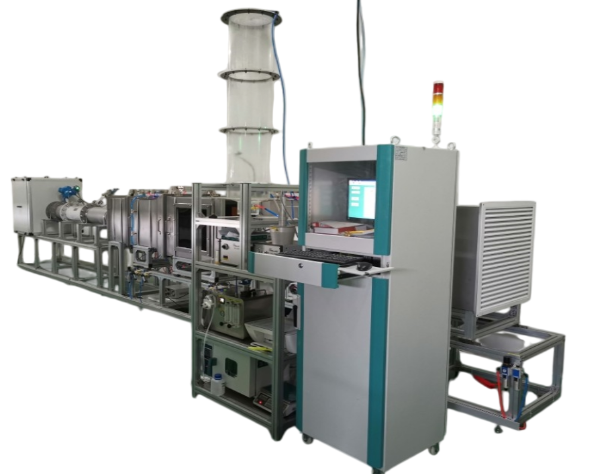
This test bench is mainly used for ventilation air filters. It classifies filters based on performan
WhatsApp : +86 15601902607
Email : info@qinsun-lab.com

This test bench is mainly used for ventilation air filters. It classifies filters based on performance measured according to test procedures. Two types of artificial aerosols are used during testing: KCl aerosol for measuring filtration efficiency in the particle size range of 0.3 μm–1.0 μm, and A2 dust for testing dust holding capacity and related performance (optional). The filter testing platform is developed in accordance with standards such as GB14295, ISO 11155-1, and EN779. It provides a cost-effective solution compared with imported filter testing platforms and meets the needs of domestic small and medium-sized enterprises. The laboratory uses a V-cone flowmeter for measurement, allowing accurate testing of airflow changes.
The system operation is controlled by a programmable logic controller (PLC). Measurement values are collected, processed, and stored by a computer, allowing real-time analysis of data and test results. The system realizes fully automated control, including automatic measurement, automatic recording, and automatic storage of test reports (dust holding capacity testing requires manual weighing).
Filtration efficiency testing of general ventilation air filters
Performance testing of HVAC air conditioning system filters
Automotive air conditioning filter performance testing
Industrial clean air filter testing
Air purifier filter element research and development testing
Air conditioning equipment and ventilation system filter component testing
Filter performance testing by third-party inspection institutions
Air filtration technology research in universities and research institutes
GB/T 14295
GB/T 6165
ISO 11155-1
ISO 16890
EN 779 ,EN 1822-4
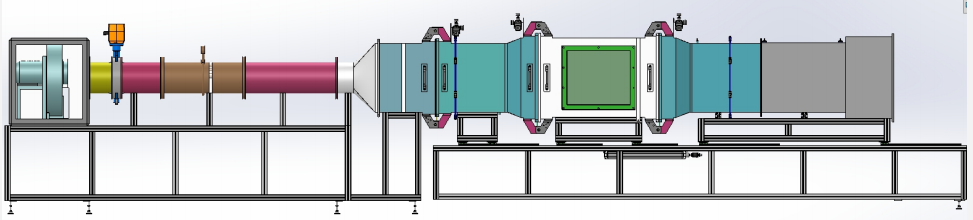
The system performs semi-automatic testing of initial resistance, counting efficiency, and dust holding capacity for F-group, G-group, and M-group filters. Test reports can be generated automatically, with data storage and printing functions.
Airflow is designed according to wind duct simulation imaging to ensure uniform airflow.
Air passes through a pre-filter and then through a high-efficiency or ultra-high-efficiency filter before entering the rectification section. Clean air from the rectification section enters the mixing chamber and mixes fully with the aerosol.
The mixture then enters the static pressure chamber. The upstream sampling pipe samples inside the chamber, while the downstream scanning probe performs scanning tests.
According to customized requirements, parameters such as outlet air velocity, filter pressure drop, atmospheric pressure, temperature, and humidity can be obtained. All test parameters are stored in the data report and physical hard disk. Test report format and content can also be customized.
Indoor air
Medium-efficiency filter – removes large dust particles and extends the service life of the HEPA filter
Fan – provides the required airflow for the system
HEPA filter – provides clean air for the static pressure chamber
Static pressure chamber – ensures aerosol passes uniformly through the tested filter
Tested filter
Downstream sampling probe – collects aerosol concentration after passing through the filter
Downstream particle counter – used for downstream sampling
Processor – processes upstream and downstream signals and differential pressure signals
Differential pressure sensor – outputs resistance signals to the processor
Upstream particle counter – used for upstream sampling
Computer – processes data, displays results, and controls equipment operation
Airflow sensor – outputs airflow signals to the processor
Frequency inverter – controls fan speed to achieve different airflow rates
Aerosol generator – converts KCl into the aerosol used as the dust source for testing
System Technical Parameters
| No. | Item | Parameter | Technical Requirement | Remarks |
|---|---|---|---|---|
| 1 | Airflow | Flow range | 450–1500 m³/h | Customizable |
| Measurement error | ≤ ±5% (reading) | EN779 | ||
| Measurement accuracy | ≤ ±3% (reading) | |||
| 2 | Resistance | Measurement range | 0–500 Pa | |
| Measurement accuracy | 0–100 Pa ±3 Pa | |||
| >100 Pa ±5% | EN779 | |||
| 3 | Aerosol uniformity | Duct uniformity | ≤ ±15% | |
| 4 | Initial efficiency repeatability | <40% | ≤ ±30% | |
| 40–60% | ≤ ±15% | |||
| 60–80% | ≤ ±8% | |||
| 80–90% | ≤ ±4% | |||
| 90–99% | ≤ ±2% | GB14295 | ||
| 5 | Counting efficiency range | 40%–99.95% |
Test Bench Parameters
| No. | Item | Parameter | Specification |
|---|---|---|---|
| 1 | Particle size | Test particle size | ≥0.3 μm |
| 2 | Filter size | Tested filter size | 300×300 – 630×630 mm |
| 3 | Function | Filtration efficiency | KCl aerosol counting efficiency |
| 4 | Filtration resistance | 0–500 Pa | ±3% |
| 5 | Dust holding capacity | A2 standard dust | |
| 6 | Pre-filter | Efficiency | 40%–99.95% @0.3 μm |
| 7 | Power consumption | Whole system | 10 kW |
| 8 | Duct material | 304 stainless steel | |
| 9 | Footprint | 8500 × 2000 mm | |
| 10 | Particle counter | Sampling flow | 28.3 L/min ±5% |
The test bench uses pneumatic sealing for filter installation, which is simple, fast, and reliable, effectively solving sealing problems.
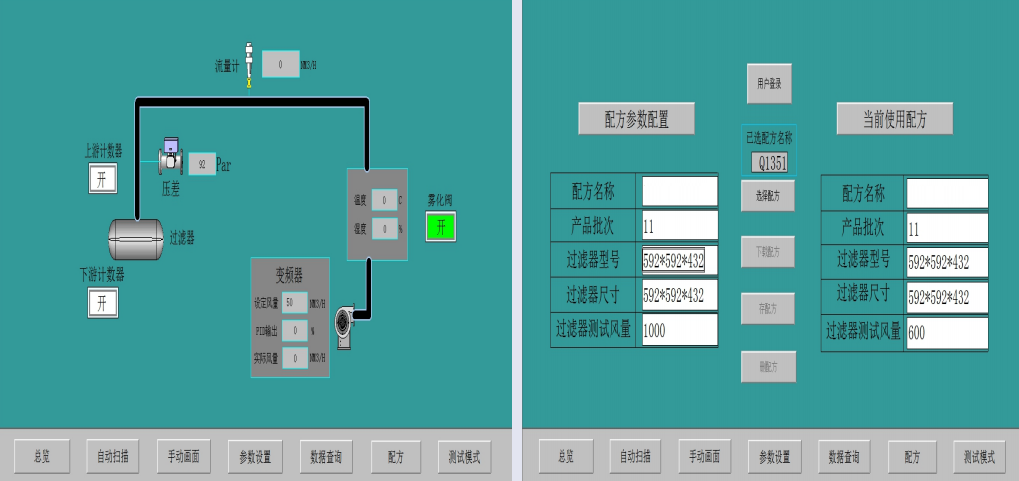
The online monitoring software displays all scanning detection processes directly on the computer screen, making the process clear and intuitive. Test results and data processing are automatically printed.
The standard test bench can be customized according to customer requirements.
Fan airflow is adjusted through a frequency inverter, allowing faster and more accurate airflow adjustment compared with bypass devices.
High-precision particle counters ensure reliable performance and continuous upgrades.
The aerosol generator uses a thermal generation principle, which is not affected by environmental temperature changes.
Proven software stability and low maintenance cost based on extensive customer usage.
| No. | Category | Name | Specification | Quantity | Brand |
|---|---|---|---|---|---|
| 1 | Sensor | Differential pressure sensor | 0–500 Pa | 1 | Alpha |
| 2 | Flow measurement | V-cone flowmeter | 450–1500 m³/h | 1 | Foword |
| 3 | Control device | Frequency inverter | FSCG05.1-4K00 | 1 | — |
| 4 | Aerosol device | KCl aerosol generator | Standard particle source | 1 | — |
| 5 | Dust generator | A2 dry powder generator | BEG1000 | 1 | Palas |
| 6 | Fan | Roots blower | YKF125 | 1 | — |
| 7 | Valve | Electric butterfly valve | DN250 | 2 | Shuopu |
| 8 | Data system | Software console | Control software | 1 | — |
| 9 | Counter | Particle counter | 28.3 L/min | 2 | — |
| 10 | Electrostatic device | Electrostatic neutralizer | Standard type | 1 | — |
The Primary and Medium Efficiency Air Filter Performance Test Bench is designed to evaluate the filtration performance of air filters according to relevant standards. It enables accurate testing of key parameters such as filtration efficiency, pressure drop, and dust holding capacity. With automated control and reliable measurement, the system provides an efficient and standardized solution for air filter quality testing and research.
1. What types of filters can be tested with this system?
The test bench is designed for primary and medium efficiency air filters used in ventilation and HVAC systems. It can test filters within the size range of approximately 300 × 300 mm to 630 × 630 mm.
2. What test standards does the system comply with?
The system is designed in accordance with standards such as GB/T 14295, GB/T 6165, ISO 11155-1, and EN 779 for air filter performance testing.
3. What parameters can be measured during the test?
The system can measure filtration efficiency, pressure drop (resistance), airflow rate, and dust holding capacity. It can also record environmental parameters such as temperature and humidity.
4. What type of aerosol is used for the filtration efficiency test?
KCl aerosol is used to measure filtration efficiency for particles in the size range of 0.3 μm to 1.0 μm. A2 standard dust can also be used for dust holding capacity testing.
5. Is the testing process automated?
Yes. The system uses PLC control and computer software for automated operation, including automatic data collection, real-time monitoring, data storage, and report generation.
Qinsun Instruments Co., LTD is a professional laboratory testing instrument manufacturer in China,Have been focusing on laboratory instrument R&D more than 30 years and have rich industry experience,Based on international testing standards,We are also the instrument supplier for BV SGS laboratory,We provide one-stop solutions for lab instruments,Free Training and Turn-Key Service,Products exported all over the world,Offer 36 month warranty and are a trustworthy partner.

Company Phone
+86-21-6420 0566
Working hours
Monday to Friday
Mobile phone:
13816217984
Email:
info@qinsun-lab.com