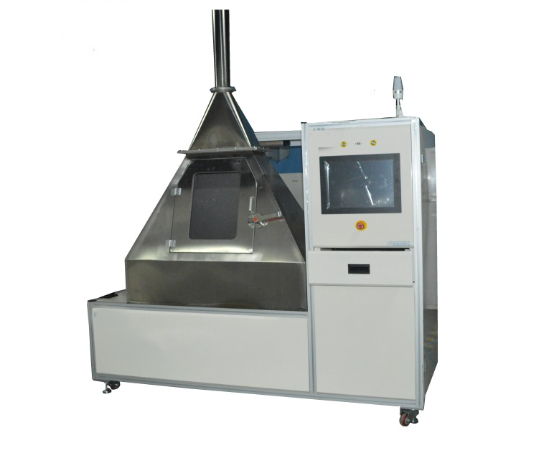
This equipment is designed for comprehensive evaluation and testing of vacuum cleaner and air purifi
WhatsApp : +86 15601902607
Email : info@qinsun-lab.com

The vacuum cleaner filter efficiency test equipment primarily employs a self-developed control system, coupled with imported laser particle counting. It comprehensively evaluates and tests the dust separation capability of vacuum cleaners through upstream and downstream test data. A dust generator is used to evenly distribute dust into a 100mm diameter suction duct, which then draws the dispersed floating dust into the test chamber. A standard diameter exhaust duct and relevant dust particle size sampling devices are installed on the top of the test chamber. Filtration efficiency is analyzed and calculated using the upstream and downstream sampling devices and the control system.
This testing equipment is designed for evaluating the filtration efficiency of vacuum cleaners, air purifiers, and industrial filtration systems. It is suitable for:
Quality control during production
Laboratory research on filter performance
Performance testing of HEPA and ULPA filters
Comparative evaluation of different dust types and particle sizes
The system measures upstream and downstream particle concentrations to determine the dust separation efficiency accurately. It is ideal for scenarios requiring standardized, repeatable testing of filter media and complete devices.
The equipment is designed to comply with international and industry standards:
ASTM F1977 – Standard test method for initial fractional filtration efficiency of vacuum cleaner systems
ASTM F3150 – HEPA filtration system performance for residential and commercial vacuum cleaners
EN 1822‑1 / ISO 29463 – Classification and testing of high-efficiency particulate air filters (HEPA/ULPA)
ASHRAE 52.2 – Air filter efficiency testing in ventilation applications (particle size 0.3–10 µm)
EN 60312-1:2017 - Standard test method for initial fractional filtration efficiency of vacuum cleaner systems
High Precision & Reliability: Uses imported laser particle counter; upstream and downstream measurements ensure accurate filter efficiency evaluation
Visual Observation: Test hood equipped with a viewing window for real-time monitoring
Data Export: USB output allows easy reporting and documentation
Flexible Testing: Compatible with multiple aerosol types (DEHS, NaCl, Pural, etc.) for diverse testing scenarios
Automated Operation: PLC-controlled industrial computer automates testing procedures, simplifying operation and improving repeatability
| Parameter | Unit | Value |
|---|---|---|
| Measurement range (particle size) | µm | 0.3 … 10 |
| Measurement range (CN count) | particles/cm³ | < 1 … 1.000.000 |
| Power supply | – | 220 V, 50/60 Hz, 1.5 kW |
| Filter efficiency calculation | – | Laser particle counter |
| Control system | – | 17" touch industrial computer, Mitsubishi PLC |
| Particle counting method | – | Upstream and downstream synchronization |
| Dust generator | – | Vacuum dispersion technology |
| Test hood dimensions (W × D × H) | mm | 1100 × 600 × 1400 |
| Test hood weight | kg | approx. 170 |
| Gas filtration technology | – | High Efficiency Filter (HEPA) |
| Equipment dimensions (W × D × H) | mm | 1850 × 820 × 2250 |
Vacuum cleaner filter efficiency testing equipment is widely used in vacuum cleaner production, testing, and quality control. This equipment accurately measures the filtration efficiency of vacuum cleaners by simulating real-world vacuuming environments, ensuring that products meet relevant standards and regulations.
Vacuum Cleaner Production: Used to ensure that vacuum cleaners achieve the expected filtration efficiency and performance standards during the manufacturing process.
Testing Agencies: Used to test the filtration efficiency of vacuum cleaners, ensuring the safety and effectiveness of products used by consumers.
Quality Control: By regularly testing the filtration efficiency of vacuum cleaners, it helps manufacturers and testing agencies to promptly identify and resolve product quality issues.
The operation method for vacuum cleaner filter efficiency testing equipment includes the following steps:
Equipment Preparation: Ensure the equipment is in good working order and all testing instruments are calibrated.
Test Environment: Clean the test area, ensuring it is clean, tidy, and meets testing requirements.
Test Equipment: Use standard dust as the test medium to simulate dust conditions in a real-world usage environment.
Test Procedure: Conduct the test within the specified temperature and humidity range to ensure the validity of the test results.
Data Recording: Use precise testing instruments, such as power meters and anemometers, to ensure the accuracy of the test results.
Result Analysis: Calculate the vacuum cleaner's filtration efficiency and other performance indicators based on the test data.
These steps ensure the accuracy and reliability of vacuum cleaner filter efficiency testing, providing a scientific basis for vacuum cleaner performance evaluation.
Qinsun Instruments Co., LTD is a professional laboratory testing instrument manufacturer in China,Have been focusing on laboratory instrument R&D more than 30 years and have rich industry experience,Based on international testing standards,We are also the instrument supplier for BV SGS laboratory,We provide one-stop solutions for lab instruments,Free Training and Turn-Key Service,Products exported all over the world,Offer 36 month warranty and are a trustworthy partner.

Company Phone
+86-21-6420 0566
Working hours
Monday to Friday
Mobile phone:
13816217984
Email:
info@qinsun-lab.com