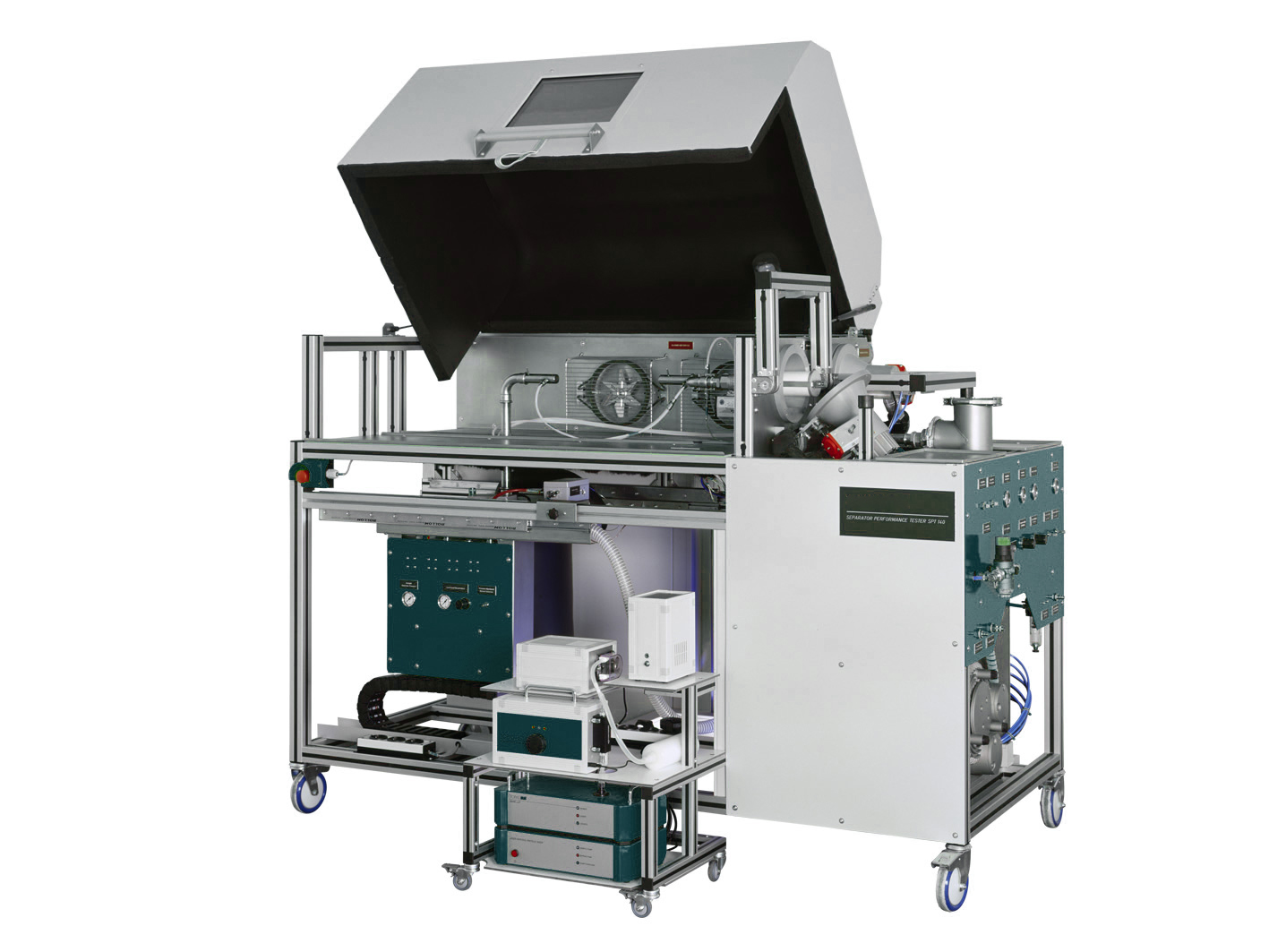
Test System for testing of separator, especially for blow-by oil mist separators.
WhatsApp : +86 15601902607
Email : info@qinsun-lab.com

The Oil Separator Test Rig is designed for automated testing procedures in order to obtain results regarding flow regimes and gravimetric and fractional particle removal efficiency.
Crankcase ventilation systems are using oil separators in order to reduce oil consumption and even more important nowadays to reduce final emission rates of the engine. Catalysts can also be adversely affected by burned oil residuals in the exhaust. Crankcase ventilation systems CCV are optimized by measurements of:
- fractional particle removal efficiency
- discharge curve (pressure and volume flow)
- pressure regulation curve
- leakage
at engine test benches.
An increasing number of oil separator manufacturers are now using special test benches like the Q 140 to study the performance and to optimize separators design by simulating the above parameters. The sample is tested in over and under pressure mode with an especially conditioned aerosol (mass flow rate, temperature). The environment of the sample is tempered as well. The separated and passed oil is measured depending on volume flow rate. The measurement is done gravimetric with an absolute filter. The oil mass leaked from the separator is detected online. Likewise the leakage of the oil drain can be measured. The test rig simulates typical application of oil mist separators. Recording the pressure regulation curve is made by measuring the “pressure in the crankcase ventilation system ” versus “air intake pressure” at several volume flow rates. The fractional particle removal efficiency has also become an important parameter in recent studies.
Test System SPT for testing of separator, especially for blow-by oil mist separators
ISO 11155 series – air filtration and separator standards
DIN 71460-1/2 – cabin and related oil mist separator standards
ISO 12103-2 – test dust and particle characteristics
ISO 5011 – filter media performance testing (referenced for separator elements
ISO/TS 16332-2006 – Road vehicles — Crankcase ventilation systems — Test method for oil mist separators
ISO 4020-2001 – Rubber — Determination of effect of liquids on material properties (applicable if testing rubber components of separators)
SAE J905-1999 – Automotive CCV systems — Test methods for crankcase ventilation oil separators
compact test bench
wide range of flow rate
sample holder adjustable for different sample dimension
heated oil mist generator (maximum 120°C)
closed loop system for different pressure regimes
possibility of opening up the secured testing channel
heatable Aerosol Generator ATM 243 also utilizable without SPT 140
Software guided testing procedure
test rig control and data acquisition software for Windows
precise flow rate analysis
| Parameter title | Unit | Value |
|---|---|---|
| test flow rate | m³/h | 0.9 ... 18 or 1.2 ... 24 |
| test aerosol | - | droplet aerosol based on mineral or synthetic engine oil |
| differential pressure of test specimen | Pa | ± 20000 |
| operating medium, gas/air | - | room air (common laboratory conditions) |
| operating medium, gas/air - compressed air supply | bar | max. 6 (300 L/min) |
| operating medium, water - water supply | bar | max. 6 (from water network, max. 20 L/h, for cooling circuit) |
| power supply | - | 400 V, 16 A |
| aerosol generation technology | - | ATM 243 or LDG 243 (optional) |
| dimensions (w × h × d) | mm | 2100 × 1200 × 925 |
| weight | kg | approx. 400 |
oil droplet generator LDG 244 to produce large droplets for the simulation of oil film and oil gush effects
Install the separator in the adjustable sample holder, ensuring complete sealing.
Start the oil mist generator and set the flow rate and temperature.
Start the automated test program; software guides the test process.
Measure separation efficiency, oil leakage, and differential pressure changes.
Record pressure regulation curves and flow characteristics.
Upon completion, move the separator to a safe area; software generates the test report.
Export data for long-term analysis, performance optimization, and standard compliance.
1.What is this product?
This system is a specialized test platform for evaluating oil mist separators in automotive CCV systems and industrial applications, measuring particle capture efficiency, pressure response, and leakage.
2.What is this product used for?
It is used for R&D, production quality control, and standardized performance validation of oil mist separators.
3.Why is this product important?
Ensures separators effectively remove oil mist, control pressure, and prevent oil emissions, supporting system efficiency, regulatory compliance, and environmental safety.
4.What industries is this product suitable for?
Automotive manufacturers, oil separator suppliers, industrial air filtration system developers, and research laboratories.
5.What types of this product are available?
The system supports different separator sizes, aerosol types, and testing modes including positive/negative pressure and oil particle/larger droplet simulations.
Qinsun Instruments Co., LTD is a professional laboratory testing instrument manufacturer in China,Have been focusing on laboratory instrument R&D more than 30 years and have rich industry experience,Based on international testing standards,We are also the instrument supplier for BV SGS laboratory,We provide one-stop solutions for lab instruments,Free Training and Turn-Key Service,Products exported all over the world,Offer 36 month warranty and are a trustworthy partner.

Company Phone
+86-21-6420 0566
Working hours
Monday to Friday
Mobile phone:
13816217984
Email:
info@qinsun-lab.com