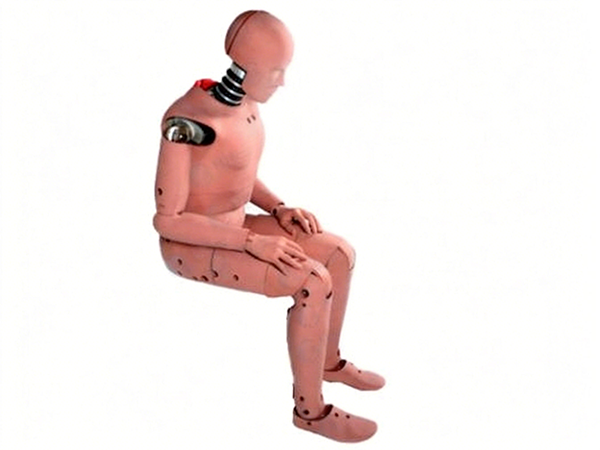
The Crash Test Dummy is designed based on Chinese anthropometric data and represents an average adul
WhatsApp : +86 15601902607
Email : info@qinsun-lab.com

The Crash Test Dummy is designed based on Chinese anthropometric data and represents an average adult male (50th percentile). Its structure and functionality are similar to international 50th percentile dummies, featuring human-like form and biomechanical responses. It can serve as a surrogate for humans in frontal crash testing, measuring acceleration, force, moment, and displacement at key body regions including the head, neck, thorax, pelvis, thighs, knees, and lower legs. This dummy supports occupant safety research and injury analysis.
The Crash Test Dummy is primarily used for:
(1) Frontal crash occupant protection testing;
(2) Verification of seat and seatbelt restraint systems;
(3) NCAP and new car assessment crash tests;
(4) High-repetition research and laboratory crash testing;
(5) Vehicle occupant injury analysis and biomechanics research;
(6) Performance evaluation of occupant safety systems in aerospace, rail, and other transport applications.
(1) GB/T 11551 – Protection of occupants in frontal and side collisions
(2) GB 14166 – Motor vehicle seat belts and restraint systems
(3) ISO 9790 / ISO/TR 9790 – Road vehicles – Side impact dummy – Evaluation method
(4) FMVSS 208 – Occupant crash protection
(5) FMVSS 214 – Side impact protection
(6) UNECE R94 – Frontal collision protection
(7) UNECE R95 – Lateral collision protection
(8) Euro NCAP – Frontal and side impact test protocols
Dimensional Data
| No. | Item | Dimension (mm) |
|---|---|---|
| A | Sitting height | 872.1 ±5.1 |
| B | Shoulder pivot height | 518 ±7.6 |
| C | H-point height (reference) | 98 ±2.5 |
| D | H-point to seatback (reference) | 115 ±2.5 |
| I | Shoulder to elbow length | 295 ±7.6 |
| K | Hip to knee length | 565 ±12.7 |
| L | Leg bent height | 421 ±12.7 |
| M | Knee pivot to floor height | 480 ±7.6 |
| P | Foot length | 265 ±7.6 |
| R | Foot width | 104.2 ±7.6 |
| V | Maximum shoulder width | 423 ±7.6 |
| W | H-point hip width | 341.6 ±7.6 |
Mass Distribution
| Component | Mass (kg) |
|---|---|
| Head | 4.2 ±0.05 |
| Neck | 1.3 ±0.05 |
| Upper torso (including chest skin, neck to spine box base) | 14.7 ±0.35 |
| Lower torso (including femur and lumbar adapter) | 19.54 ±0.35 |
| Thighs (left/right) | 5.3 ±0.1 |
| Lower legs (left/right, including feet) | 5.3 ±0.15 |
| Upper arms (left/right) | 1.5 ±0.1 |
| Lower arms/hands (left/right) | 1.6 ±0.1 |
| Total dummy weight | 67.14 ±1.18 |
Sensor Configuration
| Location | Sensor | Channels |
|---|---|---|
| Head | Accelerometer | 3×1 |
| Upper neck | Gyroscope | 3×1 |
| Thorax | 6-channel load cell | 1×6 |
| Thorax | 6-channel load cell | 1×6 |
| Pelvis | Accelerometer | 3×1 |
| Thigh | Displacement sensor | 1×1 |
| Knee | 5-channel load cell | 1×5 |
| Upper tibia | 6-channel load cell | 1×6 |
| Lower tibia | Accelerometer | 3×1 |
| Foot | 6-channel load cell | 2×6 |
(1) Based on Chinese anthropometric 50th percentile parameters, reflecting domestic human ergonomics;
(2) Human-like shape and joint structure, providing high-fidelity frontal crash biomechanical response;
(3) Measures acceleration, force, moment, and displacement at head, neck, thorax, pelvis, thigh, knee, and lower leg;
(4) Suitable for NCAP, GB, and international crash testing standards;
(5) Reusable, structurally stable, suitable for high-repetition research and crash labs;
(6) Compatible with multi-channel data acquisition systems for advanced injury assessment.
(1) Calibrate the dummy and all sensors before testing, including zero-point and sensitivity checks;
(2) Ensure proper seating posture and alignment according to standard requirements;
(3) Connect the data acquisition system securely, avoiding cable interference during impact;
(4) Follow GB and international standards testing procedures to ensure data reliability;
(5) Inspect limbs, skeleton, and sensors after each test to prevent cumulative damage affecting accuracy.
(1) Inspect head, neck, thorax, pelvis, limbs, and joints for wear or damage;
(2) Verify all sensors and data acquisition connections;
(3) Lubricate joints and check modular connections;
(4) Keep dummy surfaces clean and dry, avoid exposure to corrosive agents;
(5) Store in controlled temperature and humidity;
(6) Record maintenance and usage after each experiment.
The Crash Test Dummy offers a high-fidelity representation of a 50th percentile adult male based on domestic anthropometric data. It accurately reproduces human biomechanical responses in frontal collisions, enabling precise measurement of forces, accelerations, moments, and displacements at critical body locations. The dummy supports regulatory testing, NCAP evaluation, and advanced vehicle safety research.
(1) What is this product?
A 50th percentile male anthropomorphic dummy based on Chinese anthropometric data.
(2) What is this product used for?
Frontal crash safety assessment, seatbelt/restraint system verification, NCAP tests, and biomechanics research.
(3) How does it work?
It reproduces human skeletal, joint, and soft tissue biomechanics. Sensors collect acceleration, force, moment, and displacement data during frontal collisions.
(4) Why is it important?
It provides reliable crash response data for evaluating vehicle safety systems and occupant protection.
(5) What industries is it suitable for?
Automotive OEMs, crash labs, research institutes, and universities conducting vehicle safety studies.
Qinsun Instruments Co., LTD is a professional laboratory testing instrument manufacturer in China,Have been focusing on laboratory instrument R&D more than 30 years and have rich industry experience,Based on international testing standards,We are also the instrument supplier for BV SGS laboratory,We provide one-stop solutions for lab instruments,Free Training and Turn-Key Service,Products exported all over the world,Offer 36 month warranty and are a trustworthy partner.

Company Phone
+86-21-6420 0566
Working hours
Monday to Friday
Mobile phone:
13816217984
Email:
info@qinsun-lab.com