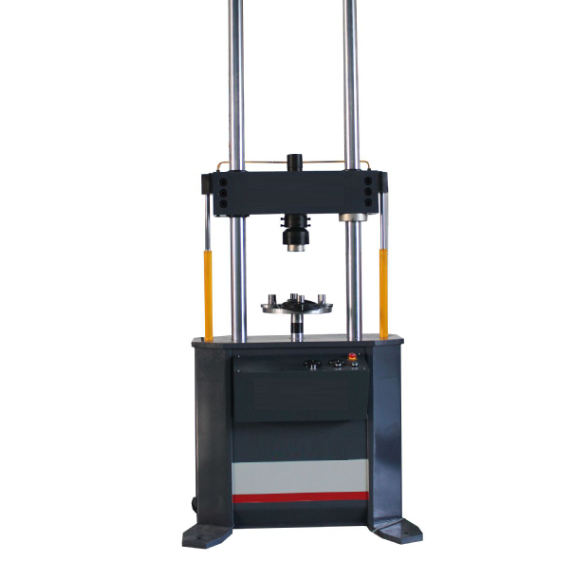
The Railway Rubber Pad Dynamic & Static Stiffness Fatigue Testing Machine is a specialized testing d
WhatsApp : +86 15601902607
Email : info@qinsun-lab.com

The Railway Rubber Pad Dynamic & Static Stiffness Fatigue Testing Machine is a specialized testing device based on microcomputer-controlled electro-hydraulic servo technology. It is primarily used to evaluate the mechanical performance of railway rubber pads and fastening systems under static, dynamic, and cyclic fatigue conditions. Designed according to relevant standards for high-speed and conventional railways, the machine can comprehensively measure static stiffness, dynamic stiffness, fatigue life of rubber pads, and overall assembled fastening system performance, meeting the railway engineering field’s requirements for high precision, high repeatability, and long-term stable operation.
This testing machine is suitable for performance evaluation of railway track structures and related elastic components, including but not limited to:
Rubber pads for high-speed railways
Rubber pads for conventional railways
Elastic baseplates for track fastening systems
Complete track slab–fastening–rail assembly systems
Railway vibration damping pads, isolation pads, and elastic gaskets
Rail pads for urban transit (subway, light rail)
Material R&D, type testing, and factory inspection for railway engineering
Mechanical testing in railway institutes, testing centers, universities, and research institutions
The machine is designed to meet and cover the following standards:
TB/T 3395-2015 – Technical conditions for high-speed railway fasteners
TB/T 2626 (relevant clauses) – General technical conditions for railway track fasteners
TB/T 2329 (reference) – Technical conditions for railway elastic baseplates
TB/T 3274 (reference) – Testing methods for railway rubber products
Relevant mechanical and fatigue testing standards (reference)
GB/T 16826 – Electro-hydraulic servo fatigue testing machine
GB/T 2611 – General technical requirements for testing machines
Note: The equipment supports static stiffness, dynamic stiffness, and fatigue tests according to railway industry standards, and test methods can be expanded per user technical specifications.
| Item | Technical Specification |
|---|---|
| Maximum Dynamic Load | ±50 kN / ±100 kN / ±200 kN / ±500 kN / ±1000 kN (optional) |
| Load Measurement Range | 2% – 100% FS |
| Static Load Accuracy | ±1% |
| Maximum Piston Stroke | ±50 mm / ±75 mm (depending on model) |
| Frequency Range | 0.001 – 30 Hz |
| Test Waveform | Sine, Triangle, Square, Trapezoid, Ramp |
| Test Space (H×W) | 450×350 – 750×700 mm (depending on model) |
| Frame Type | Dual-column / Four-column, actuator mounted at bottom |
| Deformation Measurement | External three-channel high-precision measurement |
| Hydraulic Source Flow | 10 – 160 L/min (expandable) |
| Power Supply | AC 220V / 380V (customizable) |
Designed according to TB/T 3395-2015, suitable for testing railway rubber pads and fastening systems.
Microcomputer-controlled fully digital electro-hydraulic servo system, providing fast dynamic response and high control precision.
Supports integrated static stiffness, dynamic stiffness, and fatigue testing.
External three-channel synchronous deformation measurement system, meeting 0.01-level deformation detection requirements.
Multiple loading waveforms and frequency support, covering real train operating conditions.
Intelligent self-diagnosis and inspection functions, suitable for long-term unattended fatigue testing.
Modular hydraulic source configuration adaptable to different load levels.
| Name | Specification / Description | Remarks |
|---|---|---|
| Load Sensor | High-precision electro-hydraulic servo sensor | Standard |
| Deformation Measurement Device | Three-channel high-precision displacement meter | Standard |
| Hydraulic Oil | Anti-wear hydraulic oil | Consumable |
| Test Specimen Press Plate / Fixture | Dedicated for rubber pads and fasteners | Optional |
| Servo Valve | Electro-hydraulic proportional valve | Key Component |
| Cooling Fan | Automatic oil temperature air cooling | Standard |
| Computer System | Industrial PC + Display | Standard |
The testing machine uses an electro-hydraulic servo actuator as the loading execution unit. Through a closed-loop control system, static or dynamic loads are applied precisely. Load signals are collected in real-time by high-precision sensors, while displacement and deformation are synchronously recorded via an external multi-channel measurement system.
Dynamic stiffness testing: Periodic loading is applied, and the force–displacement response is measured to calculate material stiffness under dynamic conditions.
Fatigue testing: Cyclic loads are applied at set amplitudes and frequencies until the sample reaches the specified number of cycles or failure conditions.
Ensure test specimens are firmly installed to avoid eccentric loads or local stress concentration.
Dynamic stiffness tests must follow standard-prescribed frequencies and load amplitudes.
For long-term fatigue tests, activate the automatic oil temperature air-cooling system to prevent hydraulic overheating.
Do not exceed the rated load range during testing.
Switch test modes or control methods only under unloaded conditions.
In emergencies, the test can be immediately interrupted using the emergency stop button.
Install the rubber pad specimen and adjust the test fixture position.
Set preload to eliminate initial gaps in the specimen.
Configure loading frequency and dynamic load amplitude according to the standard.
Start dynamic loading and collect force and displacement data.
Calculate dynamic stiffness and record the test results.
For fatigue testing, continue cyclic loading until the specified number of cycles is reached.
Automatically generate and save test curves and reports.
Regularly inspect hydraulic oil levels and replace oil per manufacturer recommendations.
Periodically check sensors and deformation measurement devices for calibration accuracy.
Maintain cooling systems and ensure unobstructed airflow.
Verify actuator and servo valve performance before long-term fatigue tests.
Keep the test frame clean and lubricate mechanical joints as necessary.
1. What is this product?
It is a specialized electro-hydraulic servo testing machine for evaluating the static stiffness, dynamic stiffness, and fatigue performance of railway rubber pads and fastening systems.
2. What is this product used for?
It measures mechanical properties and fatigue behavior of railway elastic components under static, dynamic, and cyclic loads, ensuring compliance with railway technical standards.
3. Why is this product important?
It provides precise, repeatable, and long-term stable testing, supporting design validation, quality control, type testing, and research in railway engineering.
4. What industries is this product suitable for?
Railway infrastructure laboratories
Testing centers and institutes
Universities and research organizations
Railway material manufacturers and production QA
5. What types of this product are available?
Models with different maximum dynamic loads (±50 kN to ±1000 kN)
Dual-column or four-column frames
Optional fixtures and test specimen holders for specific railway components
Qinsun Instruments Co., LTD is a professional laboratory testing instrument manufacturer in China,Have been focusing on laboratory instrument R&D more than 30 years and have rich industry experience,Based on international testing standards,We are also the instrument supplier for BV SGS laboratory,We provide one-stop solutions for lab instruments,Free Training and Turn-Key Service,Products exported all over the world,Offer 36 month warranty and are a trustworthy partner.

Company Phone
+86-21-6420 0566
Working hours
Monday to Friday
Mobile phone:
13816217984
Email:
info@qinsun-lab.com