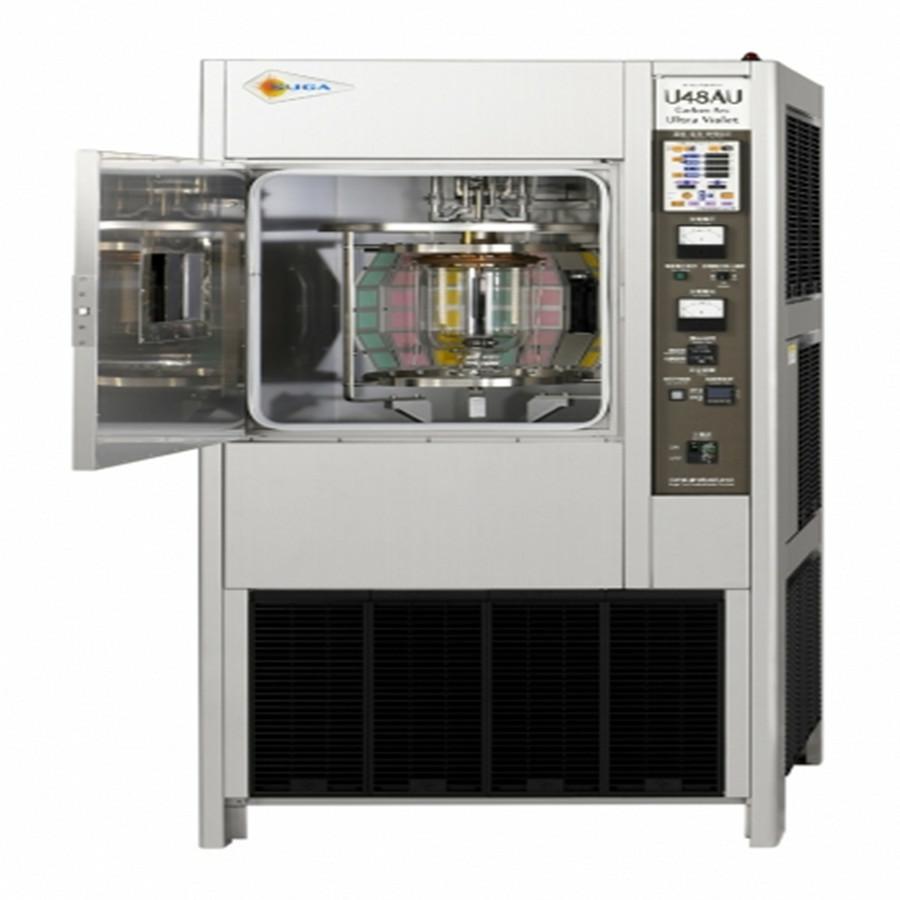
The S80 Carbon Arc Weathering Tester is a leading instrument for accelerated light aging tests,
WhatsApp : +86 15601902607
Email : info@qinsun-lab.com

The S80 Carbon Arc Weathering Tester is a specialized environmental simulation instrument designed to evaluate the lightfastness and weather resistance of materials using a sunlight-type carbon arc lamp. By utilizing a configuration of eight carbon arc rods (four pairs) across the top and bottom of the chamber, the system provides up to 78 hours of continuous, high-intensity illumination. This tester allows you to replicate the destructive effects of solar radiation and moisture, offering automated cycles of light exposure and water spray to accelerate the aging process of non-metallic materials, coatings, and automotive components.
The S80 Carbon Arc Weathering Tester utilizes eight sunlight carbon arc lamps capable of providing approximately 78 hours of continuous illumination. These lamps are arranged in four sets positioned at the top and bottom of the test chamber. The system automatically performs both illumination and illumination combined with spray application.
JIS B7751 Sunlight Carbon Arc Lamp Lightfastness Tester and Weathering Tester (Enclosed Carbon Arc Lamp)
JIS A1415 Test Method for Accelerated Exposure Aging of Plastic Building Materials
JIS D0205 Test Method for Weather Resistance of Automotive Parts
JIS L0842-2004 Test Method for Colorfastness to Enclosed Carbon Arc Lamp Light
JIS L0891-2007 Test Method for Accelerated Weathering Colorfastness Using Xenon Arc Lamp or Sunlight-Type Carbon Arc Lamp
JIS K7102 Test Method for Colorfastness of Plastics to Carbon Arc Lamp Irradiation
ASTM G153-13 Standard Practice for Testing Nonmetallic Materials Using a Closed Carbon Arc Lamp
ASTM D3980 Laboratory Testing Practices for Paints and Related Materials
ASTM G23 Testing Nonmetallic Materials Using Carbon Arc Exposure Apparatus (With and Without Water)
ASTM G114 Terminology Related to Natural and Artificial Weathering Tests of Nonmetallic Materials
ASTM G151 Laboratory Light Source Acceleration Test Apparatus for Nonmetallic Materials
ASTM G152 Open Carbon Arc Lamp Aging Exposure Method for Nonmetallic Materials
ISO 4892-3 Plastics - Laboratory Light Source Test Methods
ISO 4892-1 Plastics - Laboratory Light Source Test Methods, Part 1: General Guidelines
ISO 4892-4 Plastics - Laboratory Light Source Test Methods, Part 4: Open Carbon Arc Lamp
NES M0135 Weathering and Light Resistance Testing of Synthetic Resin Components
NES M0141 Test Methods for Coated Synthetic Resins
NISSAN MO 135:Nissan Motor Corporation Material Specification for Powder Coatings
GM 9125P:General Motors Engineering Specification for Powder Coatings
FORD BO 101-1:Ford Motor Company Engineering Specification – Powder Coating Performance Requirements
Chrysler LP-463PB-16-01:Chrysler Engineering Material Specification for Powder Coating Systems
Extended Testing Capability: The ultra-long-life carbon rods allow for 78 hours of uninterrupted testing, significantly reducing the downtime required for rod replacement compared to standard systems.
Simultaneous Exposure: The unique top-and-bottom arc configuration ensures uniform distribution of radiant energy across all 70 sample positions.
Automated Weathering: You can program complex sequences of light and rain (front spray) to simulate specific regional climates or seasonal changes.
Flexible Configurations: The system is available in specialized versions, including the SL80 for low-temperature requirements and the S80D for dew-cycle (darkness/moisture) simulation.
High Precision Control: The integrated system maintains strict tolerances for Black Panel Temperature (BPT) and Relative Humidity (RH), ensuring repeatable and reproducible results.
| Parameter | Specification |
|---|---|
| Light Source | 4 pairs of ultra-long-life carbon arc rods |
| Continuous Illumination Time | 78 hours |
| Voltage/Current | 50±2 V, 60±2 A |
| Test Modes | Light only, light + front spray (rain) |
| Temperature Range | 63±3°C BPT, 30–70±5% RH |
| Sample Capacity | Up to 70 pieces (150×70×1 mm) |
| Dimensions | 136 cm (W) × 135 cm (D) × 226 cm (H), 560 kg |
Carbon Arc Rods: High-purity sunlight-type carbon rods for spectral stability.
Glass Filter Set: Interchangeable filters to simulate indoor (behind window glass) or outdoor exposure.
Black Panel Thermometer (BPT): Standard sensor for monitoring specimen surface temperature.
Specimen Holders: Stainless steel clips designed for standard $150 \times 70\text{mm}$ samples.
Purified Water System Interface: Connection kit for intake of deionized water for spray cycles.
Exhaust Venting Kit: Includes stainless steel ducts and plastic extension tubes.
1. Equipment Installation
Location Placement: Choose a well-ventilated area away from heat sources.
Water Pipe Connection: Connect the inlet to the water purifier and the outlet to the outdoors, ensuring the water level remains below the drain outlet.
Air Duct Installation: Secure the stainless steel air duct, cover it with a plastic extension tube, and position the exhaust vent outward.
Filter Installation: Tilt the filter into the lamp holder and align it with the mounting bracket.
Install Lamp Tube: Connect accessories, insert into filter, and tighten screws.
2. Program Setup
Power On: Enter the main menu.
Select Filtration System: Press DATA → Filtration System, then choose Indoor/Outdoor Standard.
Set Program: Enter “Program Design” to configure program number, mode, irradiation intensity, temperature, humidity, and duration.
Run: Press the START button.
1.How does the S80 sunlight-type carbon arc differ from standard enclosed carbon arcs?
The sunlight-type carbon arc used in the S80 provides a spectral distribution that more closely matches natural sunlight, particularly in the ultraviolet and visible regions. Standard enclosed arcs often have a higher concentration of energy in certain bands that may not accurately reflect outdoor exposure.
2.Why is Black Panel Temperature (BPT) used instead of air temperature?
BPT represents the maximum temperature a dark-colored object would reach under direct sunlight. This is a more critical parameter for aging tests because heat accelerates chemical degradation (photo-oxidation) caused by the light source.
3.What is the purpose of the S80D Dew version of this equipment?
The S80D is designed to simulate the "dark/moisture" cycle, which replicates nighttime dew formation. This is essential for testing materials where moisture penetration and hydrolysis are as significant to degradation as UV exposure.
4.Can I use tap water for the rain spray function?
It is strongly recommended to use pure or deionized water. Tap water contains minerals that will leave white deposits on your samples, which can block light and interfere with the visual assessment of color or gloss changes.
5.How does the equipment ensure the arc current remains stable at 60A?
The S80 features an automated power supply system that adjusts the voltage to maintain a constant current of $60 \pm 2\text{A}$. This stability is vital for ensuring the irradiance level remains consistent over the 78-hour rod life.
6.Is it necessary to vent the exhaust air to the outside?
Yes. Carbon arc combustion produces heat and small amounts of ozone and combustion byproducts. Proper external venting is necessary to maintain the laboratory's air quality and ensure the cooling system of the chamber operates efficiently.
Qinsun Instruments Co., LTD is a professional laboratory testing instrument manufacturer in China,Have been focusing on laboratory instrument R&D more than 30 years and have rich industry experience,Based on international testing standards,We are also the instrument supplier for BV SGS laboratory,We provide one-stop solutions for lab instruments,Free Training and Turn-Key Service,Products exported all over the world,Offer 36 month warranty and are a trustworthy partner.

Company Phone
+86-21-6420 0566
Working hours
Monday to Friday
Mobile phone:
13816217984
Email:
info@qinsun-lab.com