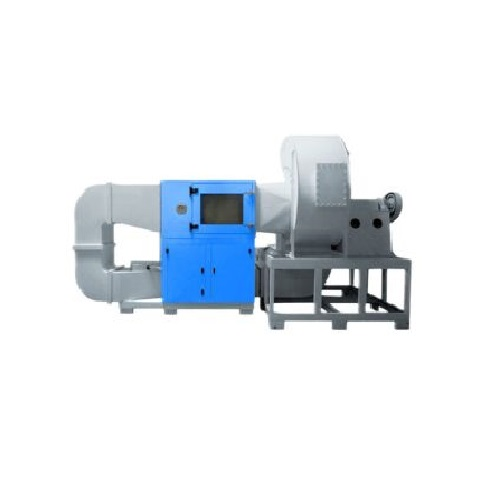
The purpose of the MIL STD 810H Test Method 510.7 sand and dust test is to evaluate the equipment’s
WhatsApp : +86 15601902607
Email : info@qinsun-lab.com

The purpose of the MIL STD 810H Test Method 510.7 sand and dust test is to evaluate the equipment’s resistance to dust that may block openings, seep into cracks, bearings and streets, and also to evaluate the working efficiency of the filter device. However, as the degree of mechanization of military operations increases, they cause more problems than the natural sand and dust environment, in order to help determine whether this test is applicable to the equipment tested.
The US military standard MIL-STD-810H does not refer to a certain test item. In our Chinese military equipment environmental test standard GJB 150A, It is adapted from the translation of the US military standard MIL-STD-810G standard. The standard covers the climatic environment, mechanical environment, etc. Test, common IEC60068 and GB/T2423 electronic equipment environmental test standards.
The main users that comply with the US military standard MIL-STD-810H are military, police, telecommunications engineering, construction sites, outdoor surveying and other products. The working environment of these products is prone to collision, rain, sand and dust, etc., which can cause equipment damage. In addition to shockproof, waterproof, drop-proof and dust-proof, it can also be installed and used in field vehicles. This standard has been widely used by military and police personnel in Europe, Japan, Singapore, Europe, Malaysia and other places.
Sand and Dust test chamber is suitable for all kinds of auto parts to do dust and dust test,Test parts include a light.Meter.Electric dust jacket.Steering system.Door lock, etc.
Sand and dust Chamber has a wide range of temperature and humidity control, which can meet the national standard GB4208GB/T2423.37-198
《Basic environmental testing procedures for electric and electronic products》
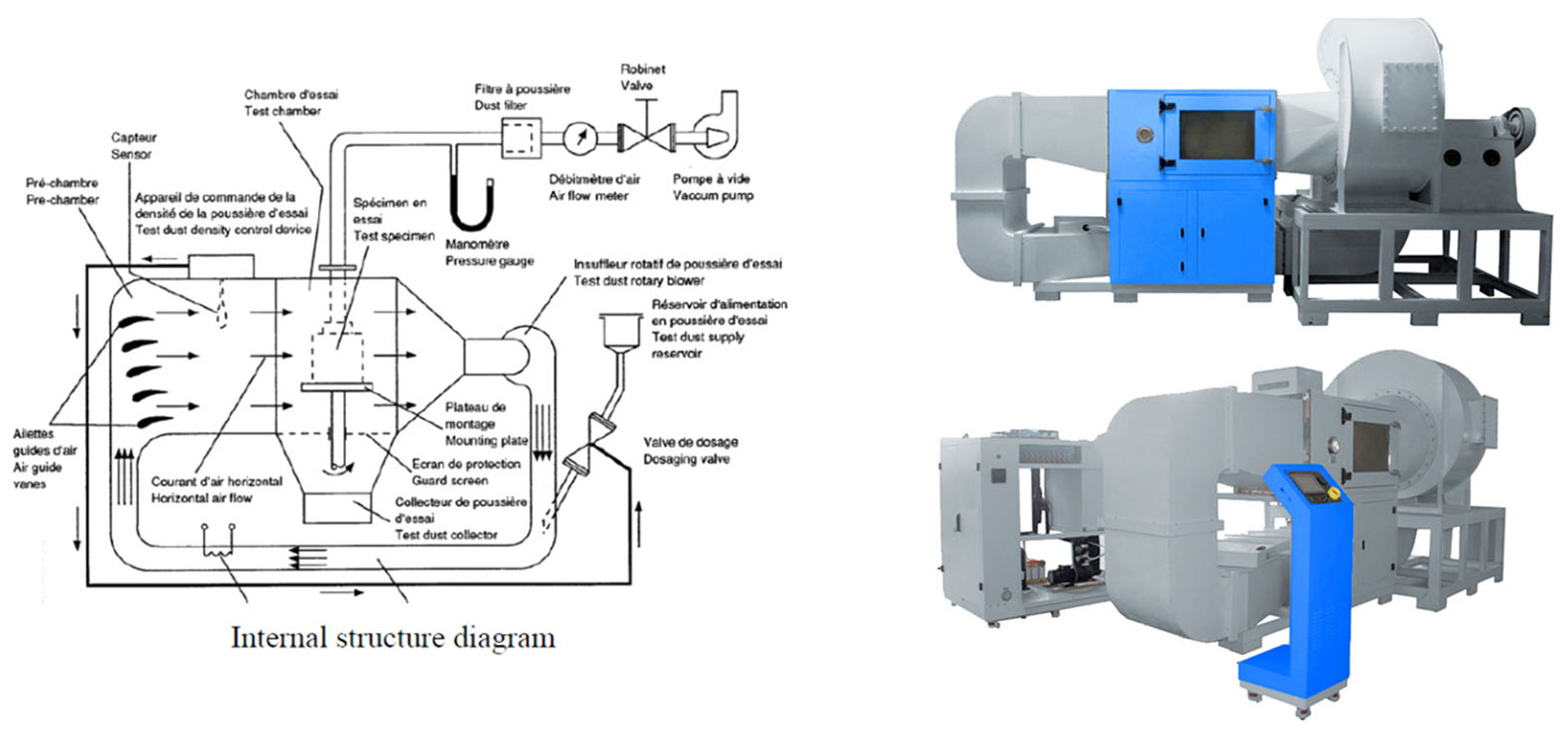
Dust Test Chamber door attached to the window, the door to the lower part of the electrical control area,Simulated sand dust of talc in the lower hopper of the test chamber. Use the of circulating fan and automatic jar will be blown into the upper network studio talcum powder through a 75 micron square hole,The test space form high density dust shape, test specimen.
1. Dust Chamber LCD Touch Screen Programmable Sand and Dust Ingress Testing MachineInner material: Stainless steel (SUS #304)
2. Sand and Dust Chamber LCD Touch Screen Programmable Dust Proof Test Equipment Outer material: Powder painting steel plate
3. Dust Test Equipment use imported touch screen programmable controller, can control dust blowing motor, dust
vibration and test time.
4. With sealing good chamber door, has lock device and glass observation window.There is lamp and dust brush to
ensure easy observation of inner chamber.
5. With strong dust blowing device and vibrator to ensure informity of each blowing.
6. Circulating air supplying device: Frequency converter and high pressure motor to ensure the air volume more
precision.
7. Large diameter strong stainless steel air hose, covered with heating device, can heat and dry the test chamber dust.
8. Anti-explosion handle, easy operation, strurdy and durable.
9. Imported high-precision electronic temperature humidity sensor and air speed sensor.
10. Test sample differential pressure test device, can set pumping rate freely according to sample inquiry.
11. There is a ψ50mm test hole on the left chamber and equipped with port lid and silica gel chock plug. Through this
hole can connect to outer test device.
12. There are casters with brake equipments and fixing foot pad to make the machine easy operation and level adjustment.
13. With voltage current indicator, equipped with corresponding sample DC12V power, DC24V / 20 a, interval, continuous power supply adjustable. Dust concentration wind speed regulating function. May control test total time, blow the dust of time interval and blowing dust cycle and sample with the power source of the intermittent time.
14. Vacuum system: Equipped with pressure meter, air filtration, dust dehumidification system, regulating triple pieces,connecting pipe (Vacuum pump should be prepare by customer)
| Model | Volume | Internal Dimension | External Dimension | Power |
| D*W*H (mm) | D*W*H (mm) | |||
| STD-095 | 216L | 600 x 600 x 700 | 2000 x 4200 x 2200 | 45kW |
| Specification | ||||
| Performance | Temperature Range | 23°C~70°C | ||
| Temperature Deviation | ≤ ±2°C | |||
| Humidity | < 30%R.H | |||
| Air Velocity | 1.5 ~ 8.9 m/s (blown dust) | |||
| 18.0 ~ 29.0 m/s (blown sand) | ||||
| Consentration | 3.0 ~ 17.6 g/m3 (10.7 ± 7 g/m3) - Blown dust | |||
| 0.18 + 0.2 g/m3 -Blown sand | ||||
| 1.1 ± 0.3 g/m3 2.2 ± 0.5 g/m3 -Blown sand | ||||
| Structure | External Casing | Cold-rolled A3 (Q235) steel plates with plastics painted. | ||
| Interior Working Room | Stainless Steel Plates SUS304 with miror surface | |||
| Air Circulation | Multiple-blades anti-abrasive blower | |||
| Dehumidification system | 0.7 Mpa air pressure, flow valume 10m3/h | |||
| Rotary Table | RMP and height is adjustable | |||
| Viewing Window | 300 x 300 mm big veiwing vision | |||
| Door | Manually operated sliding door with unlock button | |||
| Control System | Controller | Programmable Touch-screen controller with data logging and download function | ||
| Water Storage | Failure recording and self-analysis | |||
| Safety Protection | Power leakage protection, over-load or over-current protection/Dry burning protection. | |||
| Voltage | AC220V/380V/440V±10%, 50Hz/60Hz or as per requirement | |||
| Procedure I – Blowing Dust involves exposing a system to circulating dust particles, preferably from the region in which the system is expected to operate, for 12 hours. | Test Methods|Procedure I – Blowing Dust |
| Natural dust from specific region is not available, a test dust closest in composition can be used | |
| Temperature conditions should be kept at standard ambient air temperatures, as well as the system’s previously established high operating and storage temperatures. | |
| Relative humidity should not exceed 30 percent due to the caking of particles that occurs in particularly humid environments. | |
| Air velocity should be 300 +/-200 feet/minute to maintain test temperature conditions and increased to 1750 +/-250 feet/minute to effectively simulate desert winds. | |
| Other air velocities can be used to represent the system’s intended environment. | |
| The system in question is operated during testing if it is intended to operate during a real-world dust event|Wewon Environmental Chambers Co., Ltd. Copyrights | |
| Damage and impairment are also assessed once testing concludes. | |
| Procedure II – Blowing Sand involves exposing a system to particles of quartz sand resembling those in the region of interest for 90-minute intervals. | Test Methods|Procedure II – Blowing Sand |
| Given that there are 90 deserts across the globe, each with different sand particle size distributions, it is impossible to determine a distribution that accounts for every locale, which is why the standard 150-850 micrometer particle size is used during testing. | |
| If a MIL-STD-810H method 510 dust and sand test system is expected to operate in a region with an unusual sand composition, samples should be collected & analyzed to determine distribution of material used to stress-test computer. | |
| Temperature conditions should be kept at standard ambient air temperatures, as well as the system’s previously established high operating and storage temperatures. | |
| Air velocity should be 18-29 m/s, or 40-65 mph, to simulate real-world wind and wind gusts, as well as ensure that the particles remain suspended during circulation. | |
| System should be reoriented at 90-minute intervals so it can experience max erosion effects. | |
| Military sand and dust test chamber in question is operated during test if intended to operate during a real-world sand event. |
The main features of Sand and Dust Test Chamber:
1. Blowing dust and blowing sand functions made on one-piece machine.
2. Housing made of rugged stainless steels SUS304.
3. Air flow uniform and steered.
4. Toush-screen controller with data logging and download function
5. Failure recording.
6. Air velocity controllable.
7. Dust or sand consentration controllable.
8. Programmable controller with touch-screen display. Data logging and download.
9 Rotational speed of rotary table is adjustable.
10. Large viewing window for good vision.
11. Cable Access Hole available.
12. Tri-color Indicator and EMO(Emergency Off Switch) available.
13. Dehumidification system
14. Multiple protections on phase sequence, power leakage, etc.
15. Easily accessible maintenance elements
Qinsun Instruments Co., LTD is a professional laboratory testing instrument manufacturer in China,Have been focusing on laboratory instrument R&D more than 30 years and have rich industry experience,Based on international testing standards,We are also the instrument supplier for BV SGS laboratory,We provide one-stop solutions for lab instruments,Free Training and Turn-Key Service,Products exported all over the world,Offer 36 month warranty and are a trustworthy partner.

Company Phone
+86-21-6420 0566
Working hours
Monday to Friday
Mobile phone:
13816217984
Email:
info@qinsun-lab.com