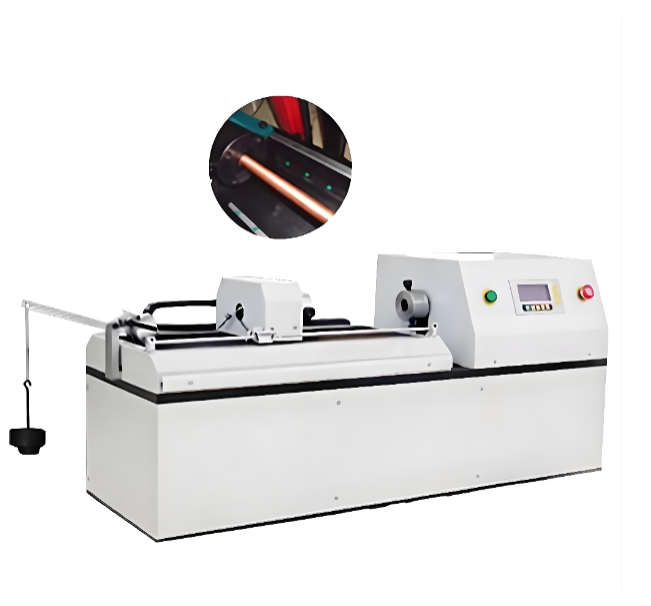
The Copper Rod / Steel Rod Torsion Testing Machine is designed to evaluate the ability of metal and
WhatsApp : +86 15601902607
Email : info@qinsun-lab.com

The Copper Rod / Steel Rod Torsion Testing Machine is designed to evaluate the ability of metal and non-metal wires or rods to withstand plastic deformation during unidirectional or bidirectional torsion. It can also reveal surface and internal defects in the test specimen.The machine is suitable for testing metal wires or rods with a diameter (or characteristic dimension) of 1–30 mm and is applicable to both unidirectional and bidirectional torsion tests.
1. Unidirectional Torsion Test
The test specimen is uniformly rotated around its own axis in one direction until the specified number of torsion cycles is reached or the specimen fractures.
2. Bidirectional Torsion Test
The test specimen is uniformly rotated around its own axis in one direction for a specified number of turns, and then rotated in the opposite direction for the same number of turns or until fracture occurs.
The Metal Wire Torsion Testing Machine is primarily used to determine the torsional plastic deformation resistance of metal wires and rods with diameters or characteristic dimensions of 1–30 mm. It is suitable for quality control, material inspection, research and development, and production testing of materials such as copper rods, steel rods, and other metal wires.
The test can be used to assess:
Torsional deformation resistance
Torsional durability
Surface defects
Internal defects
Fracture behavior during torsion
| Parameter | G20 | G30 |
|---|---|---|
| Product Model | G20 | G30 |
| Metal Wire Diameter Range | Φ10–Φ20 mm | Φ10–Φ30 mm |
| Gauge Length Between Chucks | 22d / 22D (customizable) | 22d / 22D (customizable) |
| Maximum Counting Capacity | 999.9 turns | — |
| Chuck Body Outer Diameter | — | 180 mm |
| Chuck Clamping Range | — | 10–30 mm |
| Torsion Speed | 2–6 r/min | 2–6 r/min |
| Speed Error | <±5% | — |
| Minimum Turn Count Resolution | 0.1 turn | — |
| Chuck Hardness | 55–65 HRC | 55 HRC or >20 HRC higher than the specimen |
| Guide Rail Parallelism | <0.2 mm | <0.2 mm |
| Chuck Coaxiality | <Φ0.4 mm | <Φ0.4 mm |
| Approx. Test Bench Weight | 220 kg | 800 kg |
| Power Supply | 220 V, 50 Hz | 220 V, 50 Hz |
These torsion testing machines are primarily designed for larger-diameter metal wires and rods, with different equipment configurations available depending on the testing requirements.
Test Materials: Suitable for a wide range of metal wire and rod diameters. Common models can accommodate specimens from Φ1 mm to Φ10 mm, while heavy-duty models can test Φ10–Φ30 mm or larger specimens.
Core Functions: Supports both unidirectional torsion and bidirectional (reverse) torsion tests to simulate different torsional stresses encountered by wire and rod materials during actual service.
Key Performance Parameters: To ensure testing accuracy, typical specifications include a minimum turn-count resolution of 0.1 revolution, speed error controlled within ±5%, and chuck hardness of 55–65 HRC to minimize wear.
Different Configuration Levels: Torsion testing machines are generally available in two configurations:
Basic Turn-Counting Type: Primarily records the number of torsion turns before specimen fracture. It is suitable for routine quality control and production inspection and offers a cost-effective solution.
Advanced Torque Acquisition Type: Equipped with a high-precision torque sensor and angle encoder to generate real-time torque–torsion angle curves and calculate mechanical parameters such as maximum torque and shear modulus. This configuration is mainly used for material research, development, and advanced analysis.
The design and testing methods for copper rod and steel rod torsion testing machines may follow the following national and international standards:
GB/T 239.1-2023 — Metallic Materials — Wire — Part 1: Test Method for Torsion Test: A key standard for unidirectional torsion testing of wire, covering nominal wire diameters from 0.1 mm to 14 mm.
GB/T 239.2-2023 — Metallic Materials — Wire — Part 2: Test Method for Reverse Torsion Test: A key standard for bidirectional torsion testing, covering nominal wire diameters from 0.3 mm to 10.0 mm.
GB/T 3952 — Copper Wire Rod for Electrical Purposes: A product standard for copper wire rod. Torsion testing may be used as part of quality inspection in accordance with applicable product requirements.
GB/T 4909.4 — Test Methods for Bare Wires — Part 4: Torsion Test: Applicable to torsion testing of bare wires and commonly referenced in the wire and cable industry.
ISO 7800 — Metallic Materials — Wire — Simple Torsion Test: An international standard for unidirectional torsion testing of wire.
ISO 9649 — Metallic Materials — Wire — Reverse Torsion Test: An international standard for bidirectional/reverse torsion testing of wire.
Qinsun Instruments Co., LTD is a professional laboratory testing instrument manufacturer in China,Have been focusing on laboratory instrument R&D more than 30 years and have rich industry experience,Based on international testing standards,We are also the instrument supplier for BV SGS laboratory,We provide one-stop solutions for lab instruments,Free Training and Turn-Key Service,Products exported all over the world,Offer 36 month warranty and are a trustworthy partner.

Company Phone
+86-21-6420 0566
Working hours
Monday to Friday
Mobile phone:
13816217984
Email:
info@qinsun-lab.com