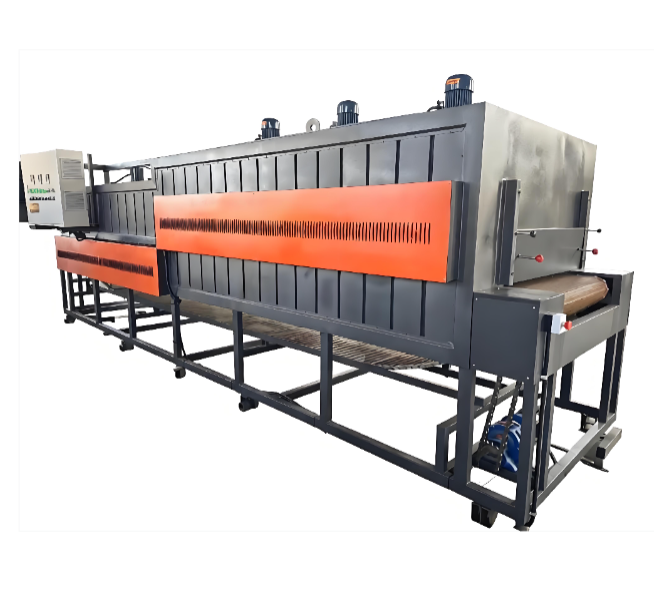
The Nylon Plate Heating Tunnel Oven is a continuous industrial heating equipment specially designed
WhatsApp : +86 15601902607
Email : info@qinsun-lab.com

The Nylon Plate Heating Tunnel Oven is a continuous industrial heating equipment specially designed for nylon (PA) plates and sheets for continuous preheating, stress-relief annealing, and drying processes.The equipment uses a conveyor system (such as chain conveyors or mesh belts) to transport nylon plates through the tunnel chamber. Through hot air circulation heating or far-infrared radiation heating, the plates are heated uniformly to prevent deformation during subsequent machining processes and improve dimensional stability.
Stress Relief Treatment
Used for annealing extruded or cast nylon plates before machining processes such as cutting and engraving, reducing internal stress and preventing cracking, warping, or deformation during processing.
Preheating for Thermal Forming
Used for uniform softening and preheating of nylon plates before:
Hot pressing
Stamping
Bending and forming processes
Moisture Removal and Drying
Since nylon has strong moisture absorption properties, the equipment is used for deep drying before machining to improve the physical properties and processing stability of finished products.
The equipment manufacturing and safety design generally comply with the following standards:
GB/T 10067.1
Basic Technical Requirements for Industrial Electric Heating Equipment
GB 5226.1
Safety of Machinery — Electrical Equipment of Machines, Part 1: General Requirements
JB/T 7629
Design and Installation Specification for Refractory Fiber Furnace Linings
Environmental Protection Standards
When exhaust emissions are generated during operation, the equipment shall comply with relevant national and local industrial VOC and exhaust emission standards.
Precise Temperature Control
Adopts multi-section independent PID digital intelligent temperature control, with temperature uniformity controlled within ±1°C to ±2°C, effectively preventing overheating and yellowing of nylon materials.
Uniform Heating Performance
Equipped with high-temperature-resistant long-shaft circulation fans for forced hot air circulation, or directional far-infrared radiation heating, ensuring consistent heating on both the upper and lower surfaces of nylon plates.
High Efficiency and Energy Saving
The furnace body uses high-density aluminum silicate fiber insulation cotton, which provides excellent thermal insulation, reduces external surface temperature, minimizes heat loss, and significantly reduces energy consumption compared with conventional ovens.
Continuous Production Operation
The conveyor speed adopts variable-frequency stepless adjustment, allowing seamless connection with upstream extrusion processes and downstream machining production lines.
Q1: What temperature is generally required for heating nylon plates?
A: The typical operating temperature range is between 80°C and 150°C.
For moisture removal and drying: usually 80°C–100°C
For stress relief annealing or thermal forming preheating: usually around 120°C–150°C
The actual temperature should be adjusted according to the thickness and processing requirements of the nylon plate.
Q2: How can the equipment prevent oxidation and yellowing of nylon plates during heating?
A: The heating temperature must be strictly controlled to avoid local overheating. The equipment can be designed with high-volume fresh air circulation and replacement systems. For applications requiring higher quality control, nitrogen protective atmosphere heating can also be adopted to reduce oxidation risks.
Q3: What materials are commonly used for the conveyor belt? Will it scratch the nylon plates?
A: Common conveyor systems include:
Stainless steel mesh belts
Chain plate conveyors
PTFE (Teflon) mesh belts
For nylon plates with high surface quality requirements, PTFE-coated mesh belts or non-metallic roller protection systems can be used to prevent surface scratches.
Q4: Why use a tunnel oven instead of a conventional batch-type oven for nylon plate heating?
A: Conventional ovens operate in batches. When nylon plates are stacked together, uneven heating may occur, and loading/unloading efficiency is low.
A tunnel oven uses single-layer continuous conveying, ensuring that each plate receives consistent heating. It provides higher production capacity, better dimensional stability, and lower deformation rates.
Q5: What daily maintenance is required for the equipment?
A: Daily maintenance mainly includes:
Regularly cleaning chips, dust, and impurities inside the tunnel chamber
Checking conveyor belt tension during each shift
Regularly lubricating transmission chains and high-temperature bearings with high-temperature-resistant lubricating oil
Proper maintenance ensures stable operation and extends equipment service life.
Qinsun Instruments Co., LTD is a professional laboratory testing instrument manufacturer in China,Have been focusing on laboratory instrument R&D more than 30 years and have rich industry experience,Based on international testing standards,We are also the instrument supplier for BV SGS laboratory,We provide one-stop solutions for lab instruments,Free Training and Turn-Key Service,Products exported all over the world,Offer 36 month warranty and are a trustworthy partner.

Company Phone
+86-21-6420 0566
Working hours
Monday to Friday
Mobile phone:
13816217984
Email:
info@qinsun-lab.com