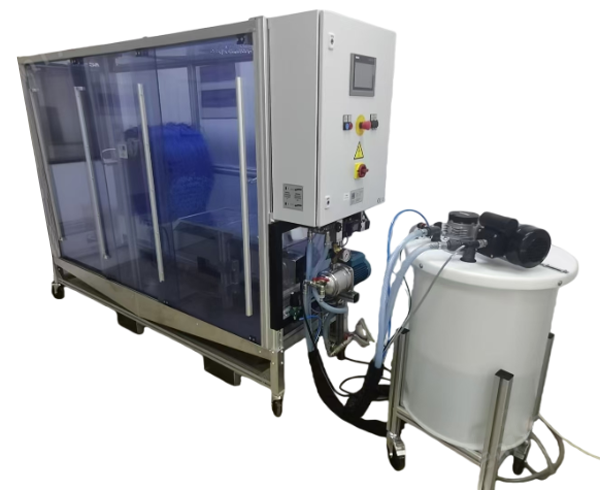
ISO 20566 Wheel Hub Scratch Resistance Laboratory Simulated Car Wash Testing Machine is a specialize
WhatsApp : +86 15601902607
Email : info@qinsun-lab.com

ISO 20566 Wheel Hub Scratch Resistance Laboratory Simulated Car Wash Testing Machine is a specialized testing apparatus designed to evaluate the scratch and scuff resistance of wheel hubs and associated coating systems under laboratory-scale car wash conditions. The equipment simulates the scrubbing, rinsing, and abrasive effects of actual car washing through controllable washing brushes, spray systems, and reciprocating motion platforms. It evaluates changes in surface performance of coating systems under prolonged washing conditions.
ISO 20566 Wheel Hub Scratch Resistance Laboratory Simulated Car Wash Testing Machine is suitable for testing and comparative evaluation of the scratch resistance of various coating systems and product surfaces using laboratory car wash methods. Typical applications include but are not limited to:
Automotive wheels and wheel surface coatings
Automotive exterior components and their surface coatings
Pigmented paint and clearcoat systems
Metal and alloy surface coatings
Functional and decorative coatings
Comparative durability testing of novel coating materials
Coating formulation screening and process validation during R&D
Laboratory quality control and type testing
ISO 20566:2020 Paints and varnishes - Determination of scratch resistance of coating systems by laboratory car wash
ISO 20566:2021 Paints and varnishes - Determination by laboratory scale car wash
ISO 13076 Visual assessment of coating surface appearance
ISO 2813 - Determination of gloss of coatings
ISO 13803 - Determination of haze of coatings
ISO 7724 - Colorimetry and evaluation of color difference
PV 3.3.3 - Specification for Scratch Resistance Testing of Automotive Interior/Exterior Surface Materials
MBN 10494-5 - Scratch Durability Testing of Automotive Materials - Part 5
| Item | Technical Parameter |
|---|---|
| Washing Brush Diameter | 1000 ± 40 mm |
| Washing Brush Width | 300 mm |
| Washing Brush Material | Ethylene |
| Washing Brush Profile | X-type splicing |
| Bristle Diameter | 0.8 ± 0.2 mm |
| Bristle Length | 440 ± 20 mm |
| Bristle Penetration Depth | 100 ± 20 mm |
| Brush Rotation Speed | 127 ± 5 RPM |
| Brush Rotation Direction | Opposite to the direction of test plate bracket travel |
| Stainless Steel Nozzle Angle | 65° |
| Spray Flow Rate | (2.2 ± 0.2) L/min (at 300 ± 50 kPa) |
| Test Plate Feed Speed | (5 ± 0.2) m/min |
| Motion Mode | Nozzle and brush work alternately, direction opposite to test plate travel |
| Washing Medium | Washing suspension containing silicon dioxide powder |
| Suspension Ratio | (150 ± 0.05) g silicon dioxide powder per liter of water |
| Average Particle Size of Silicon Dioxide | 24 μm |
| Operating Environment Temperature | 20 ~ 30 °C |
| Washing Solution Temperature | 15 ~ 30 °C |
Laboratory-scale car wash structure realistically simulates actual brushing and spraying conditions during vehicle washing
X-shaped brush assembly with controllable bristle parameters and excellent repeatability
Stable brush rotation speed and test panel movement velocity meet standard requirements for motion consistency
Stainless steel nozzle design ensures spray angles and flow rates comply with relevant standards
Nozzles operate in opposite direction to test panel movement, effectively enhancing scrubbing and rinsing effects
Suitable for scratch resistance comparison testing across multiple coating systems
Supports multiple cycles and comparative testing as specified by standards
Enables pre- and post-treatment analysis of coating appearance, gloss, haze, and color changes
| Name | Description |
|---|---|
| Washing Brush Assembly | Ethylene material, X-type splicing structure |
| Stainless Steel Nozzle | Spray angle 65° |
| Test Plate Bracket | For fixing test plates and ensuring stable feeding |
| Cleaning Solution Circulation System | For circulating the washing suspension |
| Agitation Device | Prevents precipitation of silicon dioxide powder |
| Silicon Dioxide Powder | Average particle size 24 μm |
| Fixing Bolts & Fixtures | For installing the washing brush and test plate |
The device employs a combination of rotating scrubbing brushes and nozzles spraying washing suspension to repeatedly scrub the surface of specimens fixed on test plate holders under controlled speed and pressure conditions. The scrubbing brushes rotate in the opposite direction to the test plate's movement, creating a stable, repeatable mechanical abrasion environment under the action of the spray medium. Through a specified number of reciprocating washing cycles, it simulates the scraping, flushing, and abrasion effects on coated surfaces during actual car washing processes. This evaluates the scratch resistance and surface appearance changes of coating systems.
Operating Instructions
Sampling and Preparation:
Select representative test products in accordance with ISO 15528
Inspect and prepare specimens according to ISO 1513
Test Panel Requirements:
Test panels shall be flat and free of deformation
Substrate and dimensions shall comply with relevant specifications
Test panel thickness shall be 0.5 to 5 mm
For panels of other thicknesses, adjust the test panel support height to ensure the washing brush operates at the required depth and angle
Test Conditions:
Conduct tests at room temperature between 20 and 30°C
Maintain washing suspension temperature between 15 and 30°C
Continuously agitate the washing suspension during testing to prevent silica precipitation
Test Procedure:
Install the washing brush assembly onto the equipment's rotating shaft and ensure secure mounting
Adjust the relative height and contact depth between the washing brush and test panel
Prepare the washing suspension containing silica powder at the specified ratio, maintaining continuous agitation
Perform a pre-run without test panels, completing 10 washing cycles (10 bidirectional operations) to ensure uniform distribution of the suspension within the system
Install the test panel onto the panel holder and confirm secure fixation.
Set the brush rotation direction, nozzle spray pattern, and test panel feed speed according to standard requirements.
Conduct formal washing tests within the specified test area.
After testing, evaluate the test panel for appearance, gloss, haze, and color changes.
Record and compare test results before and after the experiment.
1. What components can you test using this machine?
You can test wheel hubs, automotive exterior components, and coated panels representative of wheel and exterior coating systems.
2. Why is silicon dioxide powder used in the washing suspension?
Silicon dioxide provides controlled abrasive action that simulates real car wash contamination and mechanical wear.
3. Can you adjust the test parameters for different standards?
Yes. Brush speed, feed speed, suspension composition, and test cycles can be set according to applicable standards.
4. How do you evaluate coating performance after testing?
You assess appearance, scratch visibility, gloss reduction, haze increase, and color difference using standardized methods.
5. Is this equipment suitable for comparative material testing?
Yes. The controlled laboratory conditions make it ideal for comparing scratch resistance across different coating systems.
Qinsun Instruments Co., LTD is a professional laboratory testing instrument manufacturer in China,Have been focusing on laboratory instrument R&D more than 30 years and have rich industry experience,Based on international testing standards,We are also the instrument supplier for BV SGS laboratory,We provide one-stop solutions for lab instruments,Free Training and Turn-Key Service,Products exported all over the world,Offer 36 month warranty and are a trustworthy partner.

Company Phone
+86-21-6420 0566
Working hours
Monday to Friday
Mobile phone:
13816217984
Email:
info@qinsun-lab.com