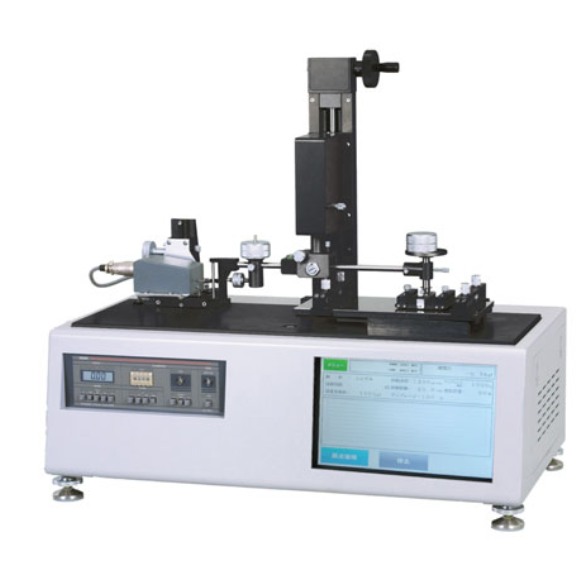
ISO 12137:2011 Scratch Resistance Tester is used to evaluate the scratch resistance of surfaces on e
WhatsApp : +86 15601902607
Email : info@qinsun-lab.com

ISO 12137:2011 Scratch Resistance Tester is used to evaluate the scratch resistance of surfaces on electronic information equipment, household appliances, coatings, and plastic materials. The instrument applies a constant or variable load to the sample surface via a scratch needle, forming scratches under controlled movement distance and speed conditions. This enables quantitative assessment of material surface hardness, abrasion resistance, and brittleness. It meets industry standard testing requirements for coatings, films, plastics, and metal surfaces.
Scratch resistance testing of enclosures and panels for information technology equipment;
Scratch resistance testing of enclosures for household and similar appliances;
Scratch resistance evaluation of coating materials, plastics, films, rigid organic materials, and soft metal surfaces;
Industry standard testing for coatings and paint films, such as automotive coatings, wheel coatings, and protective coatings for metal surfaces;
Material performance comparison during laboratory R&D and quality control phases;
Applicable for standard scratch testing in textile, electronics, chemical, automotive, and component industries.
GB 4943.1-2011 Part 1: Information Technology Equipment Safety — Clause 2.10.6.6: Mechanical Strength / Scratch Resistance of Enclosures
JIS K 5600-5-4:1999 Paint Scratch Hardness (Pencil Method)
ISO 12137:2011 Paints and varnishes — Measurement of resistance to scratching
ASTM D7027-05 Test for Resistance of Paint Films to Scratching
| Item | Technical Parameter |
|---|---|
| Stylus Type | Conical, R 0.005~1.0 mm, optional diamond stylus |
| Constant Load Weight | 0~200 g, higher load can be achieved by stacking continuous weights |
| Continuous Weights | 0~50 g, 0~100 g, 0~200 g; can be stacked with constant load weights to form 100~300 g load |
| Moving Speed | 5 mm/min ~ 6000 mm/min |
| Moving Distance | 1~100 mm |
| Motion Mode | Single mode: stops automatically after moving the set distance; Repeat mode: reciprocates the set distance (up to 99,999,999 times) |
| Worktable Size | 240 × 120 mm |
| Safety Device | Safety cover |
| Operating Environment | 0~50℃, ≤85% RH, no condensation |
| Drive Motor | AC servo motor |
| Drive System | Rack and pinion type |
| Power Supply | AC 100V 50/60Hz |
| Dimensions | Body: W630 × D350 × H390 mm, maximum height 460 mm |
Continuous Weight Quantification Capability: A mechanized continuous weighting mechanism precisely controls load variations, enabling quantification of scratch hardness and surface fracture strength.
High-Precision Scratch-Tip Adaptability: Adjustable scratch-tip radius from 0.005 to 1.0 mm, compatible with diverse materials including coatings, films, plastics, and metals.
Multi-Standard Compatibility: Meets GB, ISO, JIS, ASTM, and industry-standard scratch test requirements.
Automated Control: Single-pass and reciprocating modes allow customizable test cycles and stroke distances, ensuring experimental repeatability.
Optional Data Analysis: Supports Tribosoft software for recording stylus resistance, enabling quantification of scratch hardness and surface strength data.
Safety and Reliability: Protective housing safeguards operators, minimizing risks of misoperation and stylus injury.
| No. | Accessory/Consumable | Quantity | Remarks |
|---|---|---|---|
| 1 | Stylus | 1 piece | Conical, R 0.005~1.0 mm, optional diamond stylus |
| 2 | Constant Load Weight | Several | 0~200 g |
| 3 | Continuous Weight | Several | 0~50 g, 0~100 g, 0~200 g |
| 4 | Measuring Fixture | 1 set | For sample fixation |
| 5 | Safety Cover | 1 piece | For operational protection |
| 6 | Power Cable | 1 set | Standard configuration |
| 7 | Tools & User Manual | 1 set | For installation and operation |
| 8 | soft Software | Optional | For data acquisition and scratch resistance analysis |
The stylus applies a constant or variable load to the sample surface, moving at a set distance and speed to form a scratch. By observing changes in scratch width, depth, or resistance, it quantitatively evaluates the scratch resistance and scratch hardness of coatings, plastics, and metal surfaces. Continuous weights simulate dynamic scratching conditions with load variations during actual use, while constant-load weights are used for basic scratch hardness testing. Optional software analysis further quantifies surface fracture load and friction force.
Operating Instructions:
Sample Mounting and Fixing: Ensure samples are securely fixed, flat, and free of warping.
Scratch Tip and Weight Configuration: Select scratch tip radius and constant/continuous weight combination per test standards.
Safety Precautions: Activate safety guard to prevent operator hand contact with scratch tip.
Select motion mode: Single-pass mode for fixed-distance scratch testing; reciprocating mode for durability evaluation.
Adjust speed and stroke: Set movement speed and stroke length per standards or experimental requirements.
Temperature and humidity control: Operate between 0–50°C and below 85% RH to prevent condensation from affecting test accuracy.
Test Procedure:
Install the stylus and load weights, confirming the safety cover is in place.
Secure the sample in the workbench fixture and adjust the horizontal position.
Set the motion mode (single or reciprocating), movement speed, travel distance, and cycle count.
Start the instrument to create scratches on the sample surface with the stylus.
After testing, observe scratch width and depth or analyze scratch resistance data using software.
Record test results according to standard requirements and repeat experiments to verify consistency.
1. What materials can you evaluate using this scratch resistance tester?
You can test coatings, paint films, plastics, rigid organic materials, and soft metal surfaces used in electronics, appliances, and automotive components.
2. What is the difference between constant load and continuous load testing?
Constant load testing applies a fixed force throughout the scratch, while continuous load testing simulates gradually changing loads to evaluate surface fracture behavior under dynamic conditions.
3. Can you perform durability testing with repeated scratching?
Yes. The reciprocating mode allows repeated scratch cycles, making it suitable for durability and wear resistance evaluation.
4. How do you select the appropriate stylus radius?
You choose the stylus radius based on material hardness, coating thickness, and applicable test standards or internal specifications.
5. Is software required for standard testing?
Software is optional. Basic scratch resistance testing can be completed visually or with measurement tools, while software enables advanced quantitative analysis.
Qinsun Instruments Co., LTD is a professional laboratory testing instrument manufacturer in China,Have been focusing on laboratory instrument R&D more than 30 years and have rich industry experience,Based on international testing standards,We are also the instrument supplier for BV SGS laboratory,We provide one-stop solutions for lab instruments,Free Training and Turn-Key Service,Products exported all over the world,Offer 36 month warranty and are a trustworthy partner.

Company Phone
+86-21-6420 0566
Working hours
Monday to Friday
Mobile phone:
13816217984
Email:
info@qinsun-lab.com