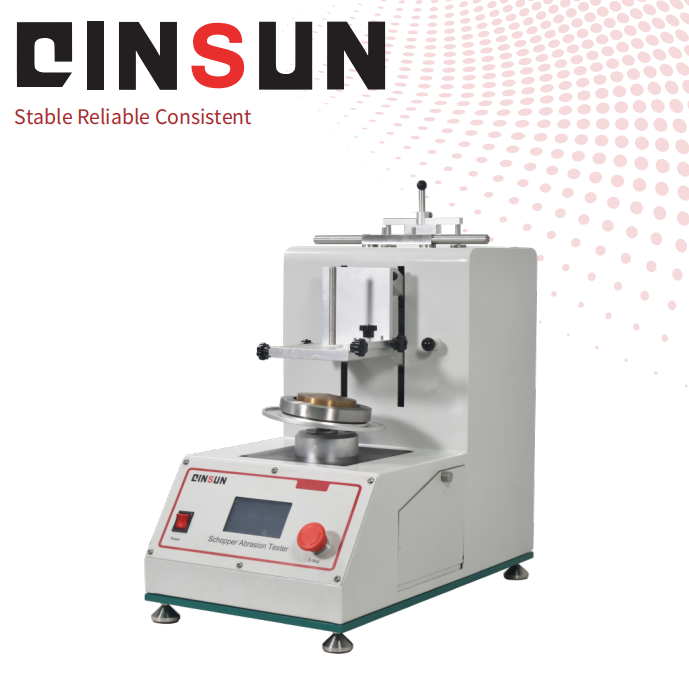
Schopper Abrasion Tester: Measures material durability under friction.
WhatsApp : +86 15601902607
Email : info@qinsun-lab.com

The T106 Schopper abrasion tester is a precision device specifically designed to evaluate the abrasion resistance of fabrics. By simulating friction scenarios in real-world use, it quantifies the surface changes of materials under dynamic friction. It is widely used in textiles, automotive interiors, footwear materials, leather, and other fields, providing crucial data support for material research and development, quality control, and industry standard verification.
Textile Industry: Evaluating the abrasion resistance of fabrics, carpets, curtains, and other materials to optimize fabric structure and surface treatment processes.
Automotive Interiors: Testing the scratch and abrasion resistance of seat fabrics, headliner materials, and door panel trims to ensure product durability.
Footwear and Leather: Simulating the friction between shoe soles and the ground to test the abrasion resistance of footwear materials; evaluating the abrasion resistance of leather surface coatings.
Research and Teaching: Providing standardized testing methods for materials science, textile engineering, and other fields to support the research and validation of new materials.
DIN 53863-2 Testing of textiles; abrasion test methods for textile fabrics, rotary abrasion test
GME 60345 Test Method for the Determination of the Resistance to Wear of Automotive Trim Materials
GMW 3283 Schopper Abrasion Wear Test
VW/Audi Zentral-Norm PV 3908 Test method for abrasion resistance of automotive interior materials (fabrics, carpets,e.g.)
Rotary Abrasion Mechanism: A specimen clamped on a rotating test head (166° taper angle) maintains line contact with an abrasion block, simulating tangential friction.
Modular Clamping System: Obtuse-angle cone chuck and mounting support ensure secure specimen fixation during high-speed rotation (75 revolutions/minute).
Touchscreen Interface: Real-time control panel with programmable cycles, load settings, and rotation reversal triggers.
Arc Height Adjustment: Built-in gauge for measuring sample deformation post-test, critical for assessing material resilience.
Load Customization: Interchangeable weights (50g–1500g) accommodate diverse testing requirements, from delicate fabrics to heavy-duty materials.
Space-Saving Design: Compact dimensions (325×565×560mm) and lightweight build (35kg) optimize laboratory workspace utilization.
| Parameter | Specification |
|---|---|
| Revolutions per Minute | 75 rpm |
| Taper Angle | 166° |
| Mounting Head Declination | 7° |
| Specimen Size | 100 cm² |
| Test Area | 50 cm² |
| Arc Height Adjustment | 0–10 mm (manual/automatic) |
| Load Range | 0.5–25 N (adjustable) |
| Standard Weights | 50g, 100g, 250g, 500g, 1000g, 1500g |
| External Dimensions | 325 (W) × 565 (D) × 560 (H) mm |
| Net Weight | 35 kg |
| Power Supply | 115/240V, 50/60Hz |
| Power Consumption | 130W |
Standard accessories:motor, conical chuck, sandpaper, tray, and weights.
1. Sample Installation
Fix the temperature and humidity treated sample onto the rotating test head, adjusting the arch height to 5-8 mm.
2. Sandpaper Fixation
Use the pressure plate clamp to install the sandpaper onto the lower surface of the pressure plate, ensuring it is flat and wrinkle-free.
3. Parameter Setting
Input parameters such as rotation speed, number of friction cycles, and pressure value via the touchscreen.
4. Test Start
Lower the pressure plate to bring the sandpaper into contact with the sample, beginning the friction test.
5. Result Evaluation
After the test, observe the sample's mass loss and the formation of holes to quantify its abrasion resistance.
1. What is the primary difference between the Schopper test and other abrasion tests like Martindale?
The Schopper test utilizes a rotary motion with a specific conical mounting head (166° taper), creating tangential friction. Unlike the Martindale's Lissajous pattern, the Schopper method is often preferred for specific automotive standards (GMW, VW) to evaluate how materials react to directional and circular abrasive forces.
2. What does this product do?
It helps determine a material's wear life under prolonged friction, color adhesion, and surface integrity, providing quantifiable abrasion resistance metrics.
3. How does it work?
The sample rotates on a turntable, driving two pressurized abrasion wheels. Since the contact axes of the wheels and sample are misaligned, combined vertical and radial friction creates a circular wear band.
4. Why is this product important?
It is crucial for ensuring product durability. By quantifying the abrasion level of fabrics or coatings, it helps prevent quality complaints and return risks caused by premature surface wear.
5. Which industries is this product suitable for?
It is widely applicable in automotive interiors, textiles and leather, plastic packaging, paint coatings, wood flooring, and electronic communications industries.
Qinsun Instruments Co., LTD is a professional laboratory testing instrument manufacturer in China,Have been focusing on laboratory instrument R&D more than 30 years and have rich industry experience,Based on international testing standards,We are also the instrument supplier for BV SGS laboratory,We provide one-stop solutions for lab instruments,Free Training and Turn-Key Service,Products exported all over the world,Offer 36 month warranty and are a trustworthy partner.

Company Phone
+86-21-6420 0566
Working hours
Monday to Friday
Mobile phone:
13816217984
Email:
info@qinsun-lab.com