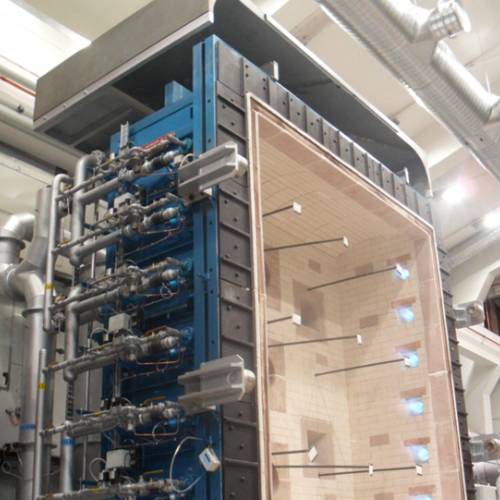
The Vertical Fire Resistance Test Furnace for Building Elements is designed for fire resistance test
WhatsApp : +86 15601902607
Email : info@qinsun-lab.com

The Vertical Fire Resistance Test Furnace for Building Elements is designed for fire resistance testing of vertical building components, including non-loadbearing vertical partitions, fire doors, and fire shutters. The furnace is manufactured in accordance with the technical requirements of GB/T 9978. integrating the furnace body, furnace roof, steel test platform, exhaust and air supply system, combustion and gas supply system, and a comprehensive test control system.
With built-in calibration capability, the system ensures that furnace temperature, pressure values, and distribution meet standard requirements, making it suitable for standardized fire resistance testing and performance evaluation of vertical building elements.
Vertical Building Elements
Fire resistance testing of non-loadbearing vertical partitions, walls, and separation elements.
Fire Doors and Fire Shutters
Performance evaluation of doors, rolling shutters, and related assemblies under standard fire exposure.
Building Fire Safety Evaluation
Verification of fire resistance performance for construction materials and assemblies used in buildings.
Fire Testing Laboratories and Certification Bodies
Standardized testing for product certification, compliance verification, and research applications.
The equipment complies with the following standards:
(1) GB/T 9978.4-2008 – Fire Resistance Tests — Elements of Building Construction — Part 4: Specific Requirements for Loadbearing Vertical Separating Elements
(2) GB/T 9978.8-2008 – Fire Resistance Tests — Elements of Building Construction — Part 8: Specific Requirements for Non-loadbearing Vertical Separating Elements
(3) GB/T 7633-2008 – Fire Resistance Test Methods for Doors and Shutters
(4) ISO 834 – Fire Resistance Tests — Elements of Building Construction
(5) EN 1363 – Fire Resistance Tests for Building Elements
| Item | Specification |
|---|---|
| Number of Burners | 12 proportional flat-flame burners (6 on each side, 5 m furnace length) |
| Operating Temperature | Maximum test temperature 1250 °C |
| Design Temperature | 1350 °C |
| Combustion Mode | Low-speed proportional flat-flame diffusion combustion |
| Gas & Air Pressure | ≤ 4000 Pa |
| Flame Length | ≤ 500 mm |
| Furnace Temperature Measurement Points | 9 points |
| Thermocouple Sleeve Extension | ≥ 25 mm |
| Temperature Accuracy | < ±15 °C |
| Fuel Gas | Liquefied petroleum gas |
| Equipment Dimensions | 3 m (W) × 3 m (L) × 1.25 m (H) |
| Power Supply | AC 380 V, 70 kW |
| Equipment Weight | Approx. 5 t |
Stable Furnace Structure
Frame-type furnace body with refractory bricks and high-temperature insulation fiber ensures thermal stability while minimizing heat loss to the surrounding environment.
Safe and Practical Platform Design
Steel platforms are installed around the furnace to facilitate operator movement and on-site inspection.
Automatic Flame-Out Protection
If a burner extinguishes unexpectedly, the control system immediately triggers visual and audible alarms and automatically cuts off the LPG supply to the affected burner while allowing other burners to operate normally.
Comprehensive Gas Supply Control
Equipped with gas solenoid valves, proportional valves, ball valves, and gas transmitters to ensure accurate gas flow control and operational safety.
Optimized Combustion Air Control
Combustion air is supplied by a dedicated blower with frequency control to maintain an appropriate air–fuel ratio.
Independent Control System
Dedicated control components are used to manage combustion processes and accurately simulate standard fire curves.
Automatic Temperature Curve Correction
The actual furnace temperature curve is continuously compared with the preset curve, and deviations are automatically corrected through burner output adjustment.
Complete Data Storage
All automatic control and test data are stored in the computer system for traceability and accuracy verification.
(1) Proportional flat-flame burners
(2) Gas solenoid valves and proportional valves
(3) Combustion air blower with frequency inverter
(4) Gas pressure regulators and filters
(5) Exhaust duct with refractory brick structure
(6) High-temperature exhaust fan with inverter
(7) PLC-based control system
(8) Computerized data acquisition and monitoring system
Install the vertical test specimen securely on the steel test platform according to the relevant standard.
Set test parameters through the control system, including fire curve and test duration.
Start the combustion and air supply systems and initiate the fire resistance test.
Monitor furnace temperature, pressure, and combustion status in real time.
The control system automatically adjusts burner output to maintain the specified fire curve.
After completion of the test, shut down the gas supply and allow the furnace to cool before specimen removal.
Regularly inspect burners, gas pipelines, valves, and sensors to ensure safe operation.
Verify calibration of temperature and pressure measurement systems periodically.
Clean exhaust ducts and combustion components to prevent residue accumulation.
Ensure proper operation of the exhaust fan and combustion air blower.
Back up test data to maintain long-term traceability and compliance records.
The Vertical Fire Resistance Test Furnace for Building Elements provides a reliable and standardized solution for evaluating the fire resistance performance of vertical building components, doors, and shutters. With accurate temperature control, comprehensive safety protection, and automated data acquisition, the system supports compliance testing, fire safety research, and product certification in accordance with national and international standards.
1. What types of building elements can be tested with this vertical furnace?
This furnace is suitable for fire resistance testing of non-loadbearing vertical partitions, fire doors, and fire shutters. It supports standardized testing in accordance with GB/T 9978 series standards, ISO 834. and EN 1363. allowing evaluation of integrity and fire exposure performance of vertical separating elements used in buildings.
2. How does the furnace ensure accurate temperature control during testing?
The furnace uses a computer-based control system combined with PLC and intelligent instruments to continuously monitor furnace temperature through multiple thermocouples. The actual temperature curve is compared with the preset standard fire curve in real time, and burner output is automatically adjusted to correct any deviation. This ensures that the furnace temperature and its distribution meet the strict requirements of fire resistance testing standards throughout the test duration.
3. What safety protections are included in the combustion system?
The system includes automatic flame-out detection, visual and audible alarms, automatic gas shutoff for extinguished burners, pressure relief devices, and explosion protection measures to ensure safe operation during high-temperature testing.
4. What type of fuel gas is used by the furnace?
The furnace uses liquefied petroleum gas as the combustion fuel, providing stable and controllable heat output for fire resistance testing.
Qinsun Instruments Co., LTD is a professional laboratory testing instrument manufacturer in China,Have been focusing on laboratory instrument R&D more than 30 years and have rich industry experience,Based on international testing standards,We are also the instrument supplier for BV SGS laboratory,We provide one-stop solutions for lab instruments,Free Training and Turn-Key Service,Products exported all over the world,Offer 36 month warranty and are a trustworthy partner.

Company Phone
+86-21-6420 0566
Working hours
Monday to Friday
Mobile phone:
13816217984
Email:
info@qinsun-lab.com