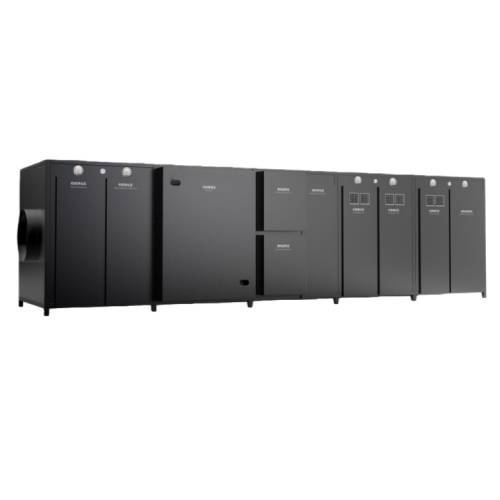
The Combustion Flue Gas Treatment System is designed to purify flue gases generated during sample co
WhatsApp : +86 15601902607
Email : info@qinsun-lab.com

The Combustion Flue Gas Treatment System is designed to purify flue gases generated during sample combustion in laboratory environments. This system integrates heat exchange, filtration, activated carbon adsorption, and UV photolysis to lower the temperature of the exhaust, remove solid particulates, eliminate odors, and ensure the emissions meet environmental standards before discharge.
The Combustion Flue Gas Treatment System is suitable for:
Laboratory combustion experiments producing gaseous by-products.
Industrial sample burning where flue gas contains particulate matter, VOCs, or odors.
Testing and research scenarios requiring clean gas emission control.
Specific Testing Equipment:
Sample combustion furnace
Experimental reactors producing gas emissions
Thermal analysis instruments producing exhaust gases
The system conforms to the following international and national standards:
GB 16297-1996 – Comprehensive Emission Standard of Air Pollutants (China)
ISO 14001 – Environmental Management Systems
EN 1822 – High-Efficiency Air Filters (HEPA)
ASHRAE 52.2 – Method of Testing General Ventilation Air-Cleaning Devices for Removal Efficiency by Particle Size
| Unit | Specification |
|---|---|
| Pre-filter Unit | Fiber felt (folded structure), removes large particulates; frame: aluminum/galvanized; Filtration grade: G2. G3; High-temperature and corrosion resistant, low resistance |
| Medium Filter Unit | Folded bag-type fine filter; frame: aluminum; Filtration grade: G3; single metal mesh support; low initial resistance, large capacity |
| High-Efficiency Filter Unit | Ultra-fine glass fiber filter paper; filters 0.1–0.3 μm particles; frame: galvanized or ABS; Filtration grade: H10. H13. H14; high dust capacity, low resistance |
| Dimensions | 6400 mm (W) × 1700 mm (L) × 1800 mm (H) |
| Power Supply | AC 380V, 25 KW |
| Weight | Approximately 2.5 T |
Steel structure cabinet with sealed design for durability and aesthetics.
Side-opening doors for easy replacement of consumables.
Heat exchange cooling system with exhaust duct, fan, heat exchanger, circulation pump, and piping for efficient gas cooling.
Exhaust duct equipped with heat exchanger; circulating water absorbs heat from high-temperature gas for effective cooling.
Electrostatic precipitation captures oil smoke particles via electron emission and charged particle attraction, effectively removing oil mist.
UV photolysis system efficiently eliminates VOCs, inorganic pollutants, H₂S, NH₃, thiols, and other odors.
Activated carbon adsorption concentrates harmful combustion by-products on its surface for further purification.
Exhaust fan controlled by a frequency inverter ensures adjustable smoke extraction.
Pre-filter panels (G2/G3)
Medium filter bags (G3)
High-efficiency HEPA filters (H10/H13/H14)
Heat exchanger unit
UV photolysis lamp assembly
Activated carbon adsorption module
Exhaust fan and ductwork
Circulating water pump and piping
Install and check all filter units, heat exchangers, and UV lamps.
Connect the system to the combustion equipment producing flue gas.
Start circulation pump and ensure water flow to the heat exchanger.
Power on the exhaust fan and set the desired extraction rate via frequency inverter.
Begin combustion experiment; monitor gas temperature, flow, and pollutant removal efficiency.
Periodically check filter units for dust load and replace if necessary.
Ensure UV lamps and activated carbon module operate effectively for VOC and odor removal.
Inspect filters monthly; replace pre-filters and medium filters every 3–6 months depending on use.
Clean high-efficiency filters carefully to maintain filtration efficiency.
UV lamps should be checked for intensity and replaced annually or as per manufacturer’s recommendations.
Heat exchanger and water circulation system should be inspected regularly for blockages or leaks.
Check and lubricate exhaust fan bearings periodically.
Ensure activated carbon modules are replaced when adsorption efficiency declines.
The Combustion Flue Gas Treatment System provides a complete solution for laboratory and industrial flue gas purification. Combining multi-stage filtration, heat exchange, electrostatic precipitation, UV photolysis, and activated carbon adsorption, the system effectively removes particulate matter, VOCs, odors, and other pollutants, ensuring safe and standard-compliant emissions. Its robust design, efficient operation, and easy maintenance make it ideal for environmental control in combustion experiments.
What types of pollutants can the Combustion Flue Gas Treatment System remove?
The system removes solid particles, oil smoke, VOCs, inorganic gases, H₂S, NH₃, thiols, and other odors. It uses multi-stage filtration, UV photolysis, and activated carbon adsorption to ensure flue gases meet environmental standards before discharge.
How does the heat exchange system lower the temperature of exhaust gas?
The heat exchange system uses circulating water through a heat exchanger placed in the exhaust duct. High-temperature gas transfers its heat to the water, effectively reducing the gas temperature and protecting downstream components and filters.
What maintenance is required for the high-efficiency filter unit?
High-efficiency HEPA filters should be inspected regularly for dust accumulation. Replace them when efficiency drops, typically every 12–18 months depending on usage. Careful cleaning may prolong service life, but avoid washing glass fiber materials as it can damage filtration performance.
Can the exhaust fan output be adjusted?
Yes, the exhaust fan is controlled via a frequency inverter, allowing precise adjustment of smoke extraction volume to match the gas flow from combustion experiments, ensuring optimal purification and energy efficiency.
What standards does the system comply with?
It meets GB 16297-1996 (China Comprehensive Emission Standard of Air Pollutants), ISO 14001. EN 1822 (HEPA), and ASHRAE 52.2 for air filter performance.
Qinsun Instruments Co., LTD is a professional laboratory testing instrument manufacturer in China,Have been focusing on laboratory instrument R&D more than 30 years and have rich industry experience,Based on international testing standards,We are also the instrument supplier for BV SGS laboratory,We provide one-stop solutions for lab instruments,Free Training and Turn-Key Service,Products exported all over the world,Offer 36 month warranty and are a trustworthy partner.

Company Phone
+86-21-6420 0566
Working hours
Monday to Friday
Mobile phone:
13816217984
Email:
info@qinsun-lab.com