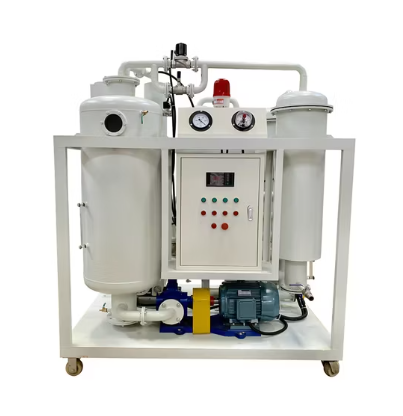
Evaluates performance of hydraulic oil filters and dewatering systems for removing particles and wat
WhatsApp : +86 15601902607
Email : info@qinsun-lab.com

The Hydraulic Oil Filtration and Dewatering Tester is an industrial device primarily used for dehydrating and filtering high-viscosity hydraulic oils, lubricating oils, and other fluids, with an applicable viscosity range of N32. The front end of the equipment utilizes a polypropylene (PP) bag filter, which can remove 98% of particulate contaminants. A dehydration filter element further reduces the water content to below 100 ppm at a low cost, eliminating the need for expensive imported ultra-fine dehydration filter elements. Combined with non-heated oil-water separation technology, it achieves dehydration efficiency more than 20 times that of traditional equipment. The downstream stage is equipped with a 3µm high-precision polypropylene filter, ensuring oil cleanliness reaches NAS8 level.
Hydraulic and lubrication system oil purification and filtration;
Hydraulic and lubrication system oil degassing;
Hydraulic and lubrication system oil demulsification;
Hydraulic and lubrication system oil dewatering.
GB/T 44053-2024:Hydraulic fluid power — Filters — Multi-pass method for evaluating filtration performance of filter elements
ISO 18237:2017:Hydraulic fluid power — In-line filters — Qualification test procedures
1. the oil filter includes two motor-driven special gear pumps, with low noise, self-absorption capacity, smooth operation and other characteristics;
2. high-pressure pipeline is equipped with an overflow protection device, which can effectively protect the hydraulic system's Safety;
3. the use of thermal relay protection to prevent motor damage caused by motor overload;
4. suction port coarse filter to protect the oil pump and extend the service life of the fine filter;. 5. the pump is equipped with a two-stage fine filter after the pump to protect the oil pump.
5. Two-stage fine filter is provided after the pump, so that the oil can quickly reach high cleanliness and achieve the required result;
6. The fine filter can be selected with different precision according to the different needs of users to achieve the required result;
7. The panel is equipped with a pressure gauge, which continuously indicates the operating status of the system and the degree of contamination of the filter element during the working time;
8. The adoption of a separate heating system can effectively solve the impact on the life of the filter element in case of a low ambient temperature. The influence on the life of the filter element is effectively solved in the case of low ambient temperature.
| Technical Parameters | Details |
|---|---|
| Rated flow rate (L/min) | 40. 100. 150 |
| Rated pressure (MPa) | 0.6 |
| Original pressure loss (MPa) | ≤0.2 |
| Coarse filtration precision (μm) | 100 |
| Primary filtration precision (μm) | 25. 40 |
| Secondary filtration precision (μm) | 3. 5. 10 |
| Motor power (Kw) | 1.1+0.75. 2.2+1.1. 4+1.1 |
| Voltage (V) | 380 |
| Weight (Kg) | 380. 480. 680 |
| External dimensions (mm, L×B×H) | 1500×800×1700. 1800×1000×1800. 2200×1100×1800 |
1. Filtration Performance Testing (Multi-pass Method / Efficiency Testing)
Core Components: Multi-pass test fixture, particle counter, variable speed circulation pump, flow control valve, upstream and downstream pressure sensors, contaminant particle injection device
2. Pressure Drop-Flow Characteristic Testing
Core Components: Flow regulating pump, upstream and downstream pressure transmitters, flow monitoring module, adapter pipe clamps
3. Rupture/Collapse Pressure Testing
Core Components: High-pressure hydraulic pump, filter element/housing dedicated sealing fixture, explosion-proof protective cover, high-precision pressure sensor
4. Contaminant Holding Capacity Testing
Core Components: Particle counter, contaminant injection system, circulation pipeline, differential pressure monitoring sensor
5. Structural Integrity Testing
Core Components: Sealing test fixture, air/hydraulic power source, leak detection sensor
Step 1: Test Preparation
Select the corresponding test item (e.g., multi-pass filtration performance), install the multi-pass test fixture, and seal and fix the filter element/filter assembly to be tested in the fixture.
Add a standard-compliant test fluid (e.g., hydraulic oil) to the media container, and connect the circulation pipeline, particle counter, and contaminant injection device.
Check the connection status of accessories such as pressure sensors and flow control valves, and initiate the equipment self-test.
Step 2: Parameter Setting
Select the test standard (e.g., GB/T 44053-2024) through the control system and set the following parameters:
Circulation flow rate (matching the instrument's rated flow rate, e.g., 40L/min);
Contaminant particle injection concentration;
Differential pressure monitoring threshold (used for determining contaminant holding capacity).
Step 3: Test Operation
Start the variable speed circulation pump to circulate the test fluid in the pipeline, and stabilize the flow rate through the flow control valve.
Start the contaminant particle injection device to continuously inject contaminants into the circulation system.
The particle counter collects particle data upstream and downstream of the filter in real time, and simultaneously records the pressure drop value fed back by the pressure sensor.
When the pressure drop reaches the set threshold, the system automatically records the dirt holding capacity at this point, completing the filtration performance test.
Step 4: Switch to Another Test (If Required)
If other items need to be tested (e.g., pressure drop-flow characteristics):
Stop the current cycle and replace the corresponding component (e.g., switch to the flow monitoring module).
Reset the parameters (e.g., gradient flow values), repeat the process in "Step 3." and collect pressure drop data at different flow rates.
Step 5: Finishing and Data Processing
Stop the equipment, drain the test fluid, disassemble the filter under test, and clean the fixtures and piping.
Export the test data (filtration efficiency, dirt holding capacity, pressure drop curve, etc.) and generate a test report.
Qinsun Instruments Co., LTD is a professional laboratory testing instrument manufacturer in China,Have been focusing on laboratory instrument R&D more than 30 years and have rich industry experience,Based on international testing standards,We are also the instrument supplier for BV SGS laboratory,We provide one-stop solutions for lab instruments,Free Training and Turn-Key Service,Products exported all over the world,Offer 36 month warranty and are a trustworthy partner.

Company Phone
+86-21-6420 0566
Working hours
Monday to Friday
Mobile phone:
13816217984
Email:
info@qinsun-lab.com