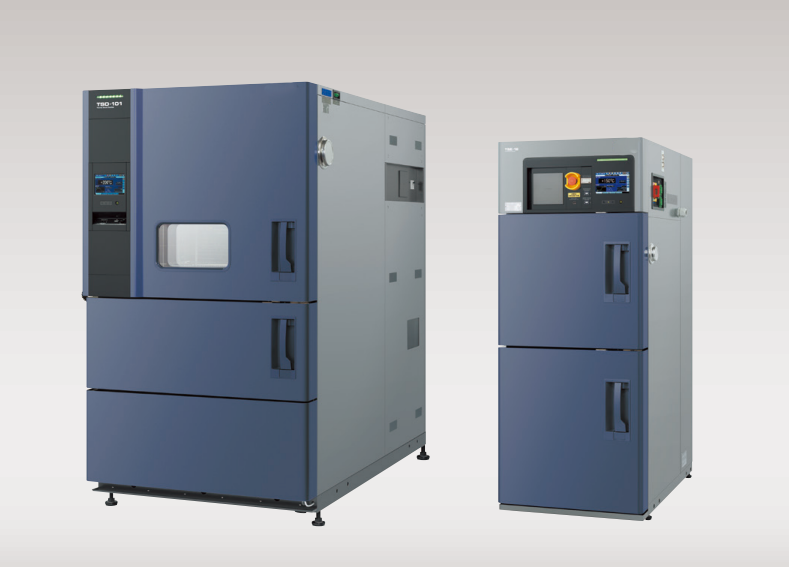
Measures material/component resistance to rapid temperature changes (thermal stress/shock/cycling).
WhatsApp : +86 15601902607
Email : info@qinsun-lab.com

The Osaka Type Thermal Stress Tester simulates thermal stresses that materials and components experience due to temperature fluctuations. It is designed to evaluate the reliability and lifespan of products by revealing defects such as cracking, delamination, solder fatigue, and material degradation. The instrument supports both thermal cycling and thermal shock tests, providing accelerated testing for quality assurance, R&D, and failure analysis.
(1) Electronic Components and Assemblies: Integrated circuits, PCBs, connectors, and semiconductor devices.
(2) Automotive Parts and Systems: Engine components, sensors, plastic housings, and electronic modules.
(3) Aerospace Components: Aircraft avionics, structural materials, and composite panels.
(4) Coatings and Surface Treatments: Protective coatings, paint layers, and metallized films.
(5) Plastics and Polymers: Thermoplastics, thermosets, and polymer-based components.
(6) Adhesives and Sealants: Bonded joints, encapsulants, and potting compounds.
(1) IEC 60068-2-14 — Environmental Testing — Thermal Shock Test
(2) MIL-STD-883 Method 1010 — Microelectronics, Temperature Cycling
(3) JESD22-A104 — Temperature Cycling for Electronic Components
(4) JASO-D902 — Automotive Component Thermal Shock Test
(5) IPC-TM-650 — Printed Boards and Electronics Thermal Reliability
(6) OEM/Industry-Specific Guidelines — For automotive, aerospace, and electronics thermal testing
(1) Simulates real-world thermal stresses to identify potential failure modes.
(2) Accelerates aging for objective evaluation of material performance.
(3) Fully programmable temperature ranges, dwell times, transition rates, and number of cycles.
(4) High-precision environmental test chambers with uniform temperature distribution.
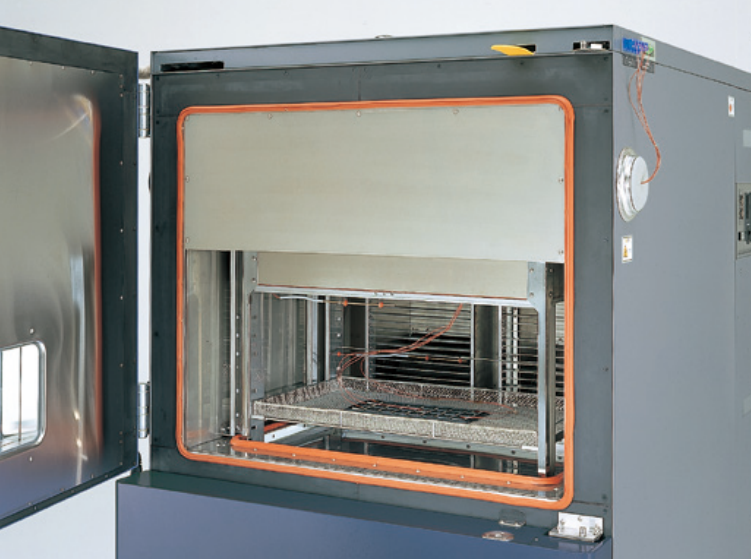
(5) Air circulation system ensures consistent thermal exposure across samples.
(6) Rapid temperature change for thermal shock or fast thermal cycling.
(7) Sample holders or baskets designed for efficient temperature transfer.
(8) Integrated data logging to monitor temperature profiles.
(9) Safety features: over-temperature protection, over-current protection, refrigerant high/low pressure alarms, door interlocks.
(10) Two-zone models feature rapid sample transfer between hot and cold chambers.
| Parameter | Specification |
|---|---|
| Test Temperature Range | High: +50 °C to +200 °C; Low: –75 °C to 0 °C |
| Temperature Accuracy | ±0.5 °C |
| Heat-up Time | Ambient → +200 °C: ≤ 15 min |
| Pull-down Time | Ambient → –75 °C: ≤ 50 min |
| Recovery Time | ≤ 5 min (5 kg specimen load) |
| High Dwell Time | 15–30 min (typical) |
| Low Dwell Time | 15–30 min (typical) |
| Transition Time | Automatic air-damper transfer ≤ 10 s |
| Total Cycles | 1–99,999 programmable |
| Test Area | 410 W × 460 H × 370 D mm (~70 L) |
| Maximum Specimen Load | 30–50 kg (uniform distribution) |
| Chamber Interior | Stainless steel plate |
| Chamber Exterior | Cold-rolled, rust-proof treated steel with melamine-resin coating |
| Insulation | Glass-wool + rigid polyurethane foam |
| Refrigeration System | Mechanical cascade; Compressors: hermetic scroll type; Refrigerants: R404A / R23 |
| Utilities | Power: 380–415 V AC, 3 φ, 50/60 Hz; Air: 0.4–0.7 MPa; Cooling water (if applicable): 0.2–0.5 MPa, 3–5 m³/h at 32 °C |
| Noise Level | ≤ 65 dB(A) at 1 m |
| Communication / Data | 7-inch color touch-panel controller, USB & Ethernet, CSV data logging, remote monitoring capable |
(1) Sample holders or baskets for different specimen types
(2) Temperature sensors for calibration and monitoring
(3) Optional two-zone transfer mechanism for thermal shock testing
(4) Controller interface cables (USB, Ethernet)
(5) User manual and software for programming and data logging
(1) Mount specimens securely in sample holders or baskets.
(2) Program test parameters: temperature setpoints, dwell times, transition times, and number of cycles.
(3) Start the test cycle; monitor real-time temperature profiles via the touch-panel controller.
(4) After completion, allow specimens to return to ambient temperature.
(5) Collect and export data for analysis of thermal performance.
(6) Inspect specimens for cracks, delamination, or other failure modes.
(1) Regularly clean chamber interiors and air circulation ducts.
(2) Inspect refrigeration system and compressors; replace refrigerant per manufacturer recommendations.
(3) Calibrate temperature sensors annually to maintain measurement accuracy.
(4) Ensure door interlocks and safety devices are functional.
(5) Keep the controller software up-to-date for precise test execution.
Qinsun Instruments Co., LTD is a professional laboratory testing instrument manufacturer in China,Have been focusing on laboratory instrument R&D more than 30 years and have rich industry experience,Based on international testing standards,We are also the instrument supplier for BV SGS laboratory,We provide one-stop solutions for lab instruments,Free Training and Turn-Key Service,Products exported all over the world,Offer 36 month warranty and are a trustworthy partner.

Company Phone
+86-21-6420 0566
Working hours
Monday to Friday
Mobile phone:
13816217984
Email:
info@qinsun-lab.com