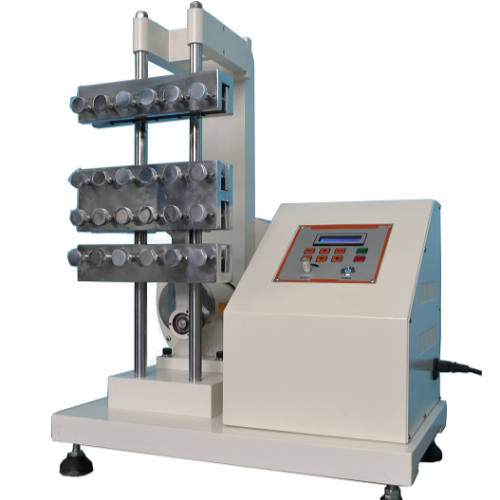
The DeMattia Flex Testing Machine is designed to test the flex-cracking and crack-growth resistance
WhatsApp : +86 15601902607
Email : info@qinsun-lab.com

The DeMattia Flex Testing Machine is designed to test the flex-cracking and crack-growth resistance of materials—such as rubber, leather, synthetic leather, shoe soles, films, and rubber-coated fabrics—at ambient temperature; it allows for the observation of the degree of cracking to assess or compare material durability.
ASTM D813-2014 Standard Test Method for Rubber Deterioration—Crack Growth
ISO 132:2017 Rubber, vulcanized or thermoplastic - Determination of flex cracking and crack growth (De Mattia)
GB/T 13934-2006 Rubber,vulcanized or thermoplastic - Determination of flex cracking and crack growth(De Mattia)
| Parameter | Specifications |
|---|---|
| Sample size | Usually rectangular, e.g. (108±0.5)×(70±0.5)mm or (154×25±1)×(6.3±0.15)mm, etc. |
| Distance between upper and lower clamps | The larger distance and smaller distance may be 76±0.2mm and 19±0.2mm, etc. respectively |
| Clamp stroke | Generally 57±0.5mm, etc. |
| Reciprocating frequency | Usually 300±10 cycles/min or 60~300r/min±10r/min, etc. |
| Stretching stroke | 0~100mm (adjustable), etc. |
| Number of test groups | 6 groups, 12 groups, 24 groups, 48 groups or 16 groups, etc. It depends on the model and manufacturer |
| Counting method | Each group of samples is counted independently, and the machine stops automatically after reaching the set number of times |
| Volume and weight | The volume may be about 340×620×756mm or 350×600×700mm, etc.; the weight may be about 68kg or 78kg, etc. |
| Power supply | Usually AC220V, 50/60Hz, etc. |
1. One set of standard laser cutting dies
2. One set of product instructions, one-year warranty certificate, and one "CNAS" internationally accredited calibration report
3. One set of repair tools
1. Sample Pre-treatment
According to the standards corresponding to the test materials (rubber, leather, synthetic leather, shoe soles, etc.) (e.g., ISO 132. JIS K6545), cut the test specimens (usually rectangular, such as (108±0.5)×(70±0.5) mm); place the specimens in a standard environment (23±2℃, 50±5% RH) for at least 24 hours to ensure the specimens are in a stable state.
2. Equipment Pre-check
Connect to a 220V AC 50/60Hz power supply, and check that the equipment's clamps and transmission parts are in good condition; start the equipment for 1-2 minutes without load to confirm that there is no jamming, abnormal noise, or other abnormalities.
3. Sample Clamping
Clamp the pre-treated specimens into the multiple sets of clamps on the equipment (supporting 6/12/24 test groups, etc.), ensuring that the specimens are flat and evenly stressed; adjust the distance between the upper and lower clamps (e.g., larger distance 76±0.2mm, smaller distance 19±0.2mm), and fix the specimens to prevent loosening during testing.
4. Parameter Setting
Set the test parameters through the equipment control panel:
Reciprocating frequency (usually 300±10 cycles/minute, or 60~300 cycles/minute)
Target number of test cycles for each set of specimens (set separately, e.g., 10000 cycles)
Clamp stroke (generally 57±0.5mm)
Confirm the parameters and save the settings.
5. Start Testing
After re-checking that the sample clamping and parameters are correct, start the equipment; the equipment will perform reciprocating bending tests according to the set parameters, simulating the repeated bending scenarios in the actual use of the material.
6. Test Monitoring and Termination
Observe the state of the specimens in real time during the test: if the specimens show obvious cracking, breakage, or other failure, the test for the corresponding group can be manually terminated; if the set number of cycles is reached, the equipment will automatically stop.
7. Data Recording and Completion
Record the actual number of test cycles for each set of specimens, the degree of cracking of the specimens (e.g., cracking level), and other results; turn off the equipment power, remove the specimens, clean the clamps and workbench, and complete the test.
(1) What is this product?
It is suitable for the folding resistance test of rubber, leather, synthetic leather, sole, film, rubber coated fabric and other materials under normal temperature conditions.
(2) What is this product used for?
The Demesia Zigzag Tester is used to determine the resistance of materials—such as rubber, leather, shoe soles, and synthetic materials—to cracking, fatigue, and flexural failure under repeated bending. It simulates walking motions to evaluate durability and flexibility.
(3) How does this product work?
The Demesia Zigzag Tester evaluates the bending resistance and fatigue life of materials like rubber, leather, and shoe soles. It works by clamping specimens and subjecting them to continuous, repeated flexion (bending) to measure resistance to cracking or breaking.
(4) Why is this product important?
The Demesia Zigzag Tester is vital for evaluating the durability, bending resistance, and flexibility of materials like rubber, leather, and footwear soles. By simulating repeated bending motions, it ensures products can withstand daily wear and tear, improving reliability.
(5) Which industries is this product suitable for?
The Demesia Zigzag Tester is primarily suited for the footwear, leather, and rubber industries. It tests the folding and bending resistance of materials like rubber, synthetic leather, shoes, and coated fabrics. It is used to measure durability against cracking under repeated flexing at normal temperatures.
Qinsun Instruments Co., LTD is a professional laboratory testing instrument manufacturer in China,Have been focusing on laboratory instrument R&D more than 30 years and have rich industry experience,Based on international testing standards,We are also the instrument supplier for BV SGS laboratory,We provide one-stop solutions for lab instruments,Free Training and Turn-Key Service,Products exported all over the world,Offer 36 month warranty and are a trustworthy partner.

Company Phone
+86-21-6420 0566
Working hours
Monday to Friday
Mobile phone:
13816217984
Email:
info@qinsun-lab.com