Applicable standards:The National Standard of the People's Republic of China (GB) : such as GB 15083
WhatsApp : +86 15601902607
Email : info@qinsun-lab.com

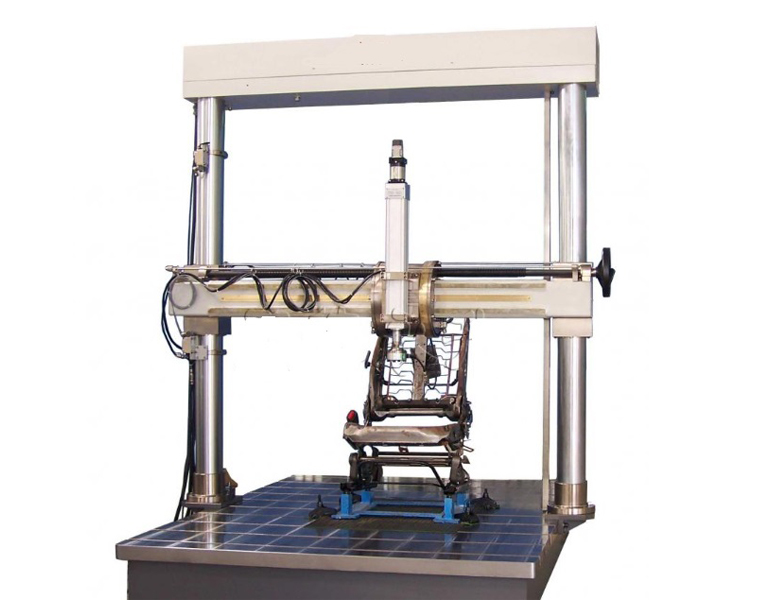
The Automobile Seat Frame Strength Test Bench is designed for evaluating the structural strength and durability of automotive seat frames, seat fixers, and headrests under specified static and cyclic load conditions. The system simulates real vehicle load scenarios such as forward loading, backward loading, and torsional loading to verify structural integrity and safety performance. It is suitable for use in automotive OEMs, seat manufacturers, third-party testing laboratories, and research institutions for compliance verification, quality control, and product development.
(1) Automobile seat frame static strength testing, including forward load, backward load, and combined load conditions, used to verify the structural safety of complete seat frames.
(2) Strength and durability testing of passenger car seat assemblies, including driver seats, front passenger seats, and rear seats.
(3) Structural strength testing of seat fixers, seat mounting brackets, and seat slide fixing points connected to the vehicle body floor.
(4) Headrest structural strength testing, including headrest support rods, guide sleeves, and headrest mounting structures integrated with the seat back.
(5) Torsional strength testing of seat frames to evaluate deformation resistance under asymmetric loading conditions.
(6) Verification testing for seat back angle adjusters, recliner mechanisms, and related load-bearing components.
(7) Durability and fatigue testing of seat frame structures under repeated loading cycles simulating long-term vehicle use.
(8) Type approval and regulatory compliance testing for automotive seating systems according to GB, FMVSS, and ECE regulations.
(9) Quality control and incoming inspection of seat frames and structural components during mass production.
(10) Research and development testing for new seat structures, lightweight seat frames, and new materials used in automotive seating systems.
(11) Comparative performance testing between different seat frame designs or manufacturing processes.
(12) Third-party inspection, certification testing, and laboratory verification for automotive OEMs and seat suppliers.
(1) GB 15083-2006 — Automotive seats, seat fixers and headrests — Strength requirements and test methods.
(2) GB 13057-2003 — Strength requirements for passenger car seats and vehicle fasteners.
(3) QC/T 740-2005 — Passenger car seat assembly technical requirements.
(4) QC/T 633-200X — Bus seat technical requirements.
(5) JT/T 460-2001 — Passenger car seat back angle adjuster technical requirements.
(6) FMVSS 207 — Seating systems strength requirements.
(7) ECE R17 — Strength and anchorage requirements for vehicle seats and head restraints.
(1) High-capacity loading system capable of static and cyclic strength testing.
(2) Supports multiple loading modes including horizontal forward, horizontal backward, and torsional loading.
(3) Computer-controlled servo loading system ensures precise force control and repeatability.
(4) Real-time acquisition of force and displacement data with automatic data processing.
(5) Programmable test cycles for durability and fatigue evaluation.
(6) Rigid mechanical structure ensures long-term stability and reliable operation.
(7) Integrated safety protection including emergency stop and overload protection.
| Item | Specification |
|---|---|
| Input Voltage | Three-phase AC 380 ±10%; Single-phase AC 220 ±10% |
| Force Sensor Accuracy | ±1% FS |
| Measuring Range | 0–2000 N |
| Test Frequency | 5–30 cycles/min (adjustable) |
| Control Mode | Computer-controlled servo system |
| Data Acquisition | Real-time recording and automatic report generation |
| Floor Space (L × W × H) | 3500 × 3500 × 2500 mm |
(1) High-precision force sensors
(2) Servo loading actuator system
(3) Computer control system with testing software
(4) Standard seat frame mounting fixtures
(5) Safety protection and emergency stop system
(1) Install the seat frame or seat assembly securely on the test bench fixture.
(2) Select the test mode (forward, backward, or torsional loading).
(3) Set test parameters including load value, loading rate, and cycle number.
(4) Start the test; the system applies load automatically and records data in real time.
(5) Upon completion, the system stops automatically and generates the test report.
(1) Regularly inspect mechanical structures, fixtures, and fasteners for looseness or wear.
(2) Periodically calibrate force sensors to maintain measurement accuracy.
(3) Keep electrical components clean and dry to prevent malfunction.
(4) Check safety devices such as emergency stops and overload protection before operation.
(5) Perform routine lubrication and maintenance according to the equipment maintenance schedule.
Qinsun Instruments Co., LTD is a professional laboratory testing instrument manufacturer in China,Have been focusing on laboratory instrument R&D more than 30 years and have rich industry experience,Based on international testing standards,We are also the instrument supplier for BV SGS laboratory,We provide one-stop solutions for lab instruments,Free Training and Turn-Key Service,Products exported all over the world,Offer 36 month warranty and are a trustworthy partner.

Company Phone
+86-21-6420 0566
Working hours
Monday to Friday
Mobile phone:
13816217984
Email:
info@qinsun-lab.com