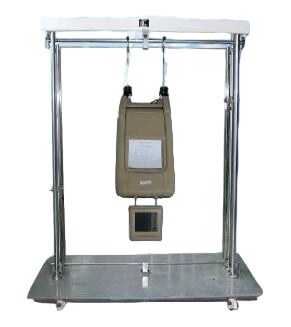
Main parameters:Measuring range: refers to the maximum and minimum range of the center of gravity of
WhatsApp : +86 15601902607
Email : info@qinsun-lab.com

The Car Seat Center of Gravity Measuring Tester is a precision testing instrument used to determine the center of gravity position of automotive seats and seat assemblies. By accurately measuring mass distribution, the system provides reliable data to support seat structural design, safety evaluation, and vehicle-level balance optimization.
The tester is suitable for complete seats, seat frames, and partially assembled seat structures, and is widely applied in R&D verification, quality control, and compliance testing within the automotive seating industry.
(1) Center of gravity measurement of complete automotive seats, including driver seats, front passenger seats, and rear seats.
(2) Testing of manual seats, power-adjustable seats, and seats with memory adjustment systems.
(3) Measurement of seats equipped with integrated functional modules such as airbags, heating systems, ventilation units, and massage components.
(4) Center of gravity determination for seat frames and semi-assembled seat structures during product development and prototype validation.
(5) Comparative analysis of center of gravity distribution for different seat designs, materials, or structural configurations.
(6) Evaluation of center of gravity variation caused by additional trim parts, covers, or accessory modules.
(7) Verification of lightweight seat designs to support vehicle mass reduction and balance optimization.
(8) Quality control inspection of center of gravity consistency during mass production.
(9) Incoming inspection and supplier evaluation of seat assemblies and seat sub-components.
(10) Support testing for vehicle-level mass distribution studies and dynamic performance analysis.
(11) OEM validation testing and third-party laboratory measurement of seat balance characteristics.
(1) GB/T 15084 – Measurement methods for automotive seat center of gravity (if applicable).
(2) ISO 7250 – Basic human body measurements for technological design (reference for mass distribution analysis).
(3) ISO 5353 – Earth-moving machinery — Seat index point (reference methodology for seat positioning and mass distribution).
(4) OEM internal standards and enterprise technical specifications.
Note: Applicable standards may vary depending on regional regulations and specific OEM requirements.
(1) High-precision measurement system for accurate determination of seat center of gravity position.
(2) Adjustable measurement range to accommodate different seat types, sizes, and configurations.
(3) Supports multiple test methods, including drop method and horizontal method, to meet OEM and laboratory requirements.
(4) High load-bearing capacity suitable for standard automotive seat weights.
(5) High angular resolution ensures precise calculation of center of gravity coordinates.
(6) Rigid aluminum alloy frame combined with suspension weighing structure provides excellent stability and repeatability.
(7) Real-time data acquisition and calculation for efficient test evaluation.
(8) Stable mechanical structure with necessary safety protection ensures reliable and secure operation.
| Parameter | Specification |
|---|---|
| Measuring Range | Adjustable, suitable for various automotive seat types |
| Measurement Accuracy | ≤ ±1% (typical, depending on configuration) |
| Test Methods | Drop method, horizontal method, OEM-specified methods |
| Maximum Load Capacity | Suitable for standard automotive seat weights |
| Angular Resolution | High-resolution angle detection |
| Structural Design | Aluminum alloy frame, suspension weighing system |
| Data Acquisition | Real-time measurement and calculation |
| Power Supply | According to laboratory or customer requirements |
| Safety Protection | Mechanical stability design and operational safety protection |
(1) Seat mounting fixtures for different seat structures.
(2) Calibration weights or reference masses.
(3) Angle measurement and leveling tools.
(4) Data acquisition and analysis software.
(5) Power and signal connection cables.
(1) Install the seat or seat assembly securely on the tester mounting platform.
(2) Adjust the fixture and leveling mechanism to ensure correct positioning.
(3) Select the appropriate test method according to the test requirement.
(4) Perform measurement according to the specified procedure.
(5) Record center of gravity coordinates and mass distribution data automatically.
(6) Repeat measurements if required to verify repeatability and accuracy.
(7) Save, export, or print test results for analysis and documentation.
(1) Periodically inspect mechanical components and fastening parts to ensure structural integrity.
(2) Keep sensors, weighing components, and angle measurement devices clean and free of contamination.
(3) Perform regular calibration according to laboratory or OEM requirements.
(4) Check electrical connections and data interfaces for stable operation.
(5) Store the equipment in a dry, clean environment when not in use.
Qinsun Instruments Co., LTD is a professional laboratory testing instrument manufacturer in China,Have been focusing on laboratory instrument R&D more than 30 years and have rich industry experience,Based on international testing standards,We are also the instrument supplier for BV SGS laboratory,We provide one-stop solutions for lab instruments,Free Training and Turn-Key Service,Products exported all over the world,Offer 36 month warranty and are a trustworthy partner.

Company Phone
+86-21-6420 0566
Working hours
Monday to Friday
Mobile phone:
13816217984
Email:
info@qinsun-lab.com