Applicable standards:GB/T 18941-2003 "Test method of foam polymer materials for car seats" : This st
WhatsApp : +86 15601902607
Email : info@qinsun-lab.com

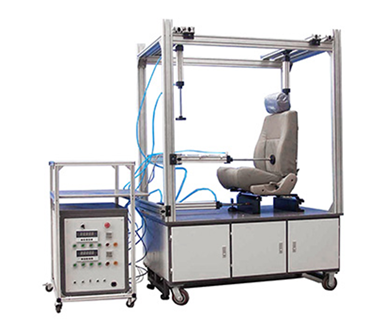
The Car Seat Fatigue Tester is a dedicated durability testing system used to evaluate the long-term fatigue performance of automotive seat foam, cushion assemblies, and liner materials under repeated compression loading.
By simulating continuous seating and load cycles experienced during real vehicle use, the tester assesses changes in mechanical properties, deformation behavior, and structural stability over extended service life.
(1) Fatigue durability testing of automotive seat cushion foam.
(2) Reciprocating compression testing of seat liner and padding materials.
(3) Long-term performance evaluation of complete seat cushion assemblies.
(4) Compression fatigue testing of polyurethane foam used in automotive seating.
(5) Comfort durability verification under repeated seating load conditions.
(6) Comparison testing of different foam formulations, densities, and structures.
(7) R&D validation of newly developed seat foam and cushion materials.
(8) Quality consistency inspection for seat foam during mass production.
(9) Incoming inspection and supplier evaluation of seat foam and liner materials.
(10) OEM internal certification and compliance testing for seat fatigue performance.
(11) Failure analysis and durability improvement testing after material optimization.
(1) GB/T 18941-2003 – Test methods for foam polymer materials used in automotive seats, including reciprocating compression fatigue testing.
(2) ISO 3385 – Flexible cellular polymeric materials – Determination of fatigue by constant-force pounding.
(3) QC/T 56-93 – Automotive industry standard for performance testing of car seat liner materials, including fatigue testing.
(4) ASTM D3574 – Standard test methods for flexible cellular materials (foam fatigue-related methods).
(1) Simulates real seating load conditions through controlled reciprocating compression.
(2) Adjustable impact force to meet different seat and foam test requirements.
(3) Variable compression frequency supports long-term fatigue simulation.
(4) Programmable test cycles allow precise control of fatigue duration.
(5) Configurable compression stroke accommodates different seat structures.
(6) Disc diameter can be customized to match actual seat contact conditions.
(7) Real-time monitoring of load, displacement, and test time ensures accurate evaluation.
(8) Robust mechanical structure designed for continuous long-duration operation.
(9) Integrated safety protection including overload protection and emergency stop.
| Parameter | Specification |
|---|---|
| Loading Impact Force | Adjustable, up to 750 N or higher |
| Reciprocating Compression Frequency | Adjustable, up to 75 cycles/min or more |
| Reciprocating Compression Stroke | Typically 150–180 mm |
| Compression Disc Diameter | Customizable according to seat design |
| Number of Test Cycles | Programmable |
| Display & Control | Real-time monitoring of load, displacement, and time |
| Safety Protection | Overload protection, emergency stop, mechanical safeguards |
(1) Compression discs of different diameters.
(2) Seat foam and cushion mounting fixtures.
(3) Control and data display unit.
(4) Calibration tools for force and displacement.
(5) Safety protection components.
(1) Install the seat foam or cushion sample securely on the test platform.
(2) Select and install the appropriate compression disc.
(3) Set loading force, compression stroke, frequency, and test cycle number.
(4) Start the test; the system performs reciprocating compression automatically.
(5) Monitor load, displacement, and test progress in real time.
(6) Upon completion, stop the test and remove the sample.
(7) Record and analyze test data and fatigue performance results.
(1) Regularly inspect mechanical transmission parts for wear or loosening.
(2) Keep compression discs and fixtures clean and free of debris.
(3) Periodically calibrate force and displacement measurement systems.
(4) Check overload protection and emergency stop functions before operation.
(5) Lubricate moving components according to the maintenance schedule.
(6) Store the equipment in a clean, dry environment when not in use.
Qinsun Instruments Co., LTD is a professional laboratory testing instrument manufacturer in China,Have been focusing on laboratory instrument R&D more than 30 years and have rich industry experience,Based on international testing standards,We are also the instrument supplier for BV SGS laboratory,We provide one-stop solutions for lab instruments,Free Training and Turn-Key Service,Products exported all over the world,Offer 36 month warranty and are a trustworthy partner.

Company Phone
+86-21-6420 0566
Working hours
Monday to Friday
Mobile phone:
13816217984
Email:
info@qinsun-lab.com