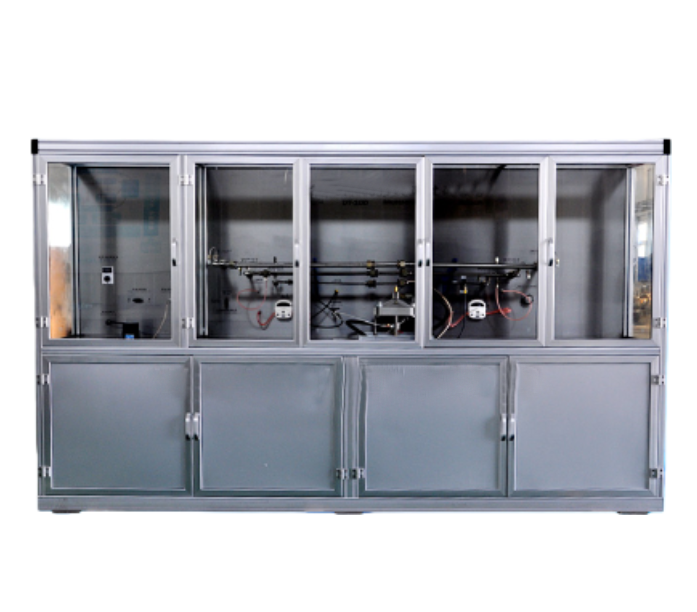
The Hydraulic Multi-Pass Test Bench is a precision filtration testing system designed to evaluate hy
WhatsApp : +86 15601902607
Email : info@qinsun-lab.com

The Hydraulic Multi-Pass Test Bench is a precision filtration testing system designed to evaluate hydraulic filters, oil filters, fuel filters, and other fluid filtration materials. By continuously introducing test contaminants and using online particle counting, the system dynamically measures filtration efficiency, contaminant holding capacity, and pressure drop characteristics under realistic operating conditions. This provides accurate, repeatable data for filter performance analysis, R&D, and quality control.
(1) Hydraulic Filter Testing – Evaluate full-flow hydraulic filters for industrial machinery, construction equipment, and mobile hydraulics.
(2) Engine Oil Filter Assessment – Test efficiency, dirt-holding capacity, and pressure drop of engine oil filters in automotive and heavy-duty applications.
(3) Fuel Filter Evaluation – Assess diesel, gasoline, and alternative fuel filters for filtration precision and contaminant retention.
(4) Filtration Media Development – R&D labs can test new hydraulic or oil filter media formulations.
(5) Industrial Quality Control – Monitor and verify filter performance during manufacturing or incoming inspection.
(6) Training & Demonstration – Educational institutions or technical centers can demonstrate filtration principles and test methods.
(1) GB/T 18853 — Hydraulic filters — Multi-pass method for evaluating filtration performance (China).
(2) ISO 16889 — Hydraulic filters — Multi-pass method for evaluating filtration performance (International).
(3) ISO 4548-12 — Full-flow lubricating oil filters for internal combustion engines, filtration efficiency and contaminant capacity.
(4) ISO/DIS 19438 — Diesel and gasoline fuel filters, filtration efficiency and contaminant capacity by particle counting.
(5) SAE J1858 / ASTM F23 — Supplementary international guidance for multi-pass filter testing.
(1) Fully Automated Control – PLC-based system for automatic operation, monitoring, and data logging.
(2) High Measurement Accuracy – Integrated KZD-3A online particle counter with 32 channels for precise upstream and downstream readings.
(3) Comprehensive Testing – Measures filtration efficiency, contaminant holding capacity, and flow-pressure drop in a single platform.
(4) Precise Thermal Management – Automatic heating and silicone-rubber electric heating with refrigeration cooling for stable oil temperatures.
(5) Robust Construction – Stainless steel pipelines, aluminum frame, and high-quality components ensure durability and contamination-free operation.
(6) Modular Fixture Design – Adaptable for various filter elements, including spin-on and media panels.
(7) Real-Time Data Output – Flow rates, pressure drop, and particle counts displayed and logged continuously.
| Parameter | Specification |
|---|---|
| Test Medium | YH-15 or equivalent hydraulic/oil; customer-specified oils |
| Medium Viscosity | 13.2 mm²/s at 40°C |
| Flow Range | 1 – 100 L/min |
| Flow Sections | 1 L/min (1–10), 2 L/min (10–30), 3 L/min (30–100) |
| Minimum System Pressure | 0.6 MPa |
| Maximum System Pressure | 2.0 MPa |
| Maximum Differential Pressure | 1.6 MPa |
| Differential Pressure Sensor | 0 – 200 kPa |
| Contaminant Injection Flow Rate | 50 – 300 mL/min (standard 250 mL/min) |
| Online Dilution Ratio | 1:10 (sampling flow 20 mL/min) |
| Temperature Control | 40 ± 2 °C |
| Test Oil Tank Volume | 50 L (dual cone design) |
| Contaminant Tank Volume | 40 L |
| Auxiliary Tank Volume | 100 L |
| Particle Counter | KZD-3A (Tianjin), 32 channels |
| Control Mode | Fully automatic programmable |
| Heating Method | Silicone rubber electric heating |
| Cooling Method | Refrigeration unit |
| Frame Material | Aluminum profile with stainless steel panels |
| Pipeline Material | 304 stainless steel |
| Filter Media Fixture | 200 cm² per set |
| Spin-On Filter Fixture | One set |
| Rated Power | 28 kW |
| Power Supply | 3-phase AC 380V / 50Hz |
| Test Bench Dimensions (L×W×H) | 3200 × 1500 × 2000 mm |
| Control Cabinet Dimensions | 800 × 700 × 1800 mm |
| Parameter | Reading Accuracy (±) | Permissible Variation (±) |
|---|---|---|
| Pressure Drop | 5% | – |
| Upstream Contamination | – | 10% |
| Injection Flow Rate | 2% | 5% |
| Test Flow Rate | 2% | 5% |
| Sensor Flow Rate | 1.5% | 3% |
| Temperature | 1°C | 2°C |
| Time | 1 s | – |
| System Volume | 2% | 5% |
(1) Filter media and spin-on filter fixtures.
(2) Contaminant injection system and tanks.
(3) Online particle counter with software for data analysis.
(4) Heating and cooling modules.
(5) User manual and compliance certificates.
(1) Fill the test oil tank with specified oil and install the filter under test.
(2) Set the flow rate, temperature, and contaminant injection parameters via the control system.
(3) Start the test; the system injects dust particles into the oil circuit continuously.
(4) Monitor real-time particle counts upstream and downstream of the filter.
(5) Record pressure drop and efficiency throughout the test cycle.
(6) Automatically generate reports summarizing filtration efficiency, contaminant holding capacity, and flow-pressure characteristics.
(1) Periodically inspect pipelines, fittings, and tank seals for leaks or wear.
(2) Clean contaminant injection system and oil circuits to avoid residue buildup.
(3) Calibrate particle counters and flow sensors regularly.
(4) Replace worn or damaged filter fixtures to maintain test accuracy.
(5) Follow oil handling and disposal guidelines to ensure safety and environmental compliance.
Multi-pass method for evaluating filtration performance of oil filters and fuel filters
Multi-pass method for evaluating filtration performance of a flat sheet filter media (round area of 200 cm2)
Single-pass method for evaluating initial filtration efficiency of fuel filters Particle retention ability and contamination holding capacity
Differential pressure characteristics of the filter
As mentioned, the test bench allows to execute test in accordance with:
ISO16889:2022 Hydraulic fluid power – Filters – Multipass method for evaluating filtration performance of a filter element;
ISO19438:2003 Diesel fuel and petrol filters for internal combustion engines – Filtration efficiency using particle counting and contaminant retention capacity;
ISO4548-12:2017 Methods of test for full-flow lubricating oil filters for internal combustion engines Part 12: Filtration efficiency using particle counting and contaminant retention capacity;
ISO3968:2017 Hydraulic fluid power – Filters – Evaluation of differential pressure versus flow;
There are three different methods of the multipass test to determine the efficiency and dirt-holding capabilities of a hydraulic and lubrication filter. The three types include:
1. ISO 16889 Test
This test is the industry standard for the multipass test. Its primary purpose is to detail the essential aspects of the design and construction of test stands, procedures during testing and the application of contaminants. For example, this test requires that:
Operators choose the steady flow rate and measure it in L/min.
The use of ISO medium dust.
Particle counters must be automatic and correctly calibrated.
Testing completes once the test filter’s differential pressure has been met, and results must be recorded.
The ISO 16889 test is the easiest to operate and is ideal for repeatability and laboratory testing. As a result, this test is the furthest from real-world examples of how filters interact with contaminants in operating environments. The test also utilizes a steady flow rate, so it doesn’t offer a perspective of how fluctuating flow rates can impact filter performance.
2. ISO/CD 23369 Cyclic Flow Test
This test is proposed to replace the ISO 16889 test, as it includes updates and revisions that make it more likely to replicate real-world applications. Some of these updates include the following:
Using cyclic flow rates that alternate every five seconds and are measured in L/min.
The time between automatic particle readings is decreased to every 30 seconds at the operator’s discretion.
The use of ISO fine dust.
Like the ISO 16889 test, this test concludes once the test filter’s differential pressure is met at the maximum test flow rate, and results must be recorded. While this test is a step closer to real-world applications, it’s essential to note that it can miss crucial data during testing due to infrequent particle counts, such as flow transition.
The results from this test are also averaged rather than specific, which can create a misleading picture of a filter’s performance if the test isn’t performed correctly.
3. Cyclic Stabilization Test
The cyclic stabilization test (CST) shares similarities with the ISO/CD 23369 test, which utilizes the same cyclic flow rates, ISO fine dust and changing flow rates every five seconds. What makes the CST different is:
Non-constant contaminant feed utilizing an on-and-off method.
Omitting the first 80% of a filter’s life.
When particle counting starts and the frequency of when counts are taken, either every 30 or 60 seconds.
Because the CST omits the first 80% of a filter’s life and averages the beta ratio, test results may appear better than they are. The test also uses the same flow rate as the ISO/CD 23369, meaning the test filter doesn’t receive 100% of contaminants throughout the entire duration of the test.
While each testing method has some advantages and disadvantages, they can give you a general idea of how a filter can perform in a real-world setting. The beta ratio and multipass test can help you find a filter with the best application efficiency and performance.
1.What is a Hydraulic Multi-Pass Test Bench?
A Hydraulic Multi-Pass Test Bench is a specialized testing setup used to evaluate the performance and efficiency of hydraulic components such as pumps, valves, and accumulators. It allows for the circulation of hydraulic fluid through multiple passes, enabling detailed analysis of how these components perform under various conditions. This kind of test bench can simulate real-world operational conditions, providing manufacturers and engineers with precise data for quality assurance and performance optimization.
2.Why is Multi-Pass Testing important?
Multi-pass testing is crucial because it mimics the actual operational conditions that hydraulic systems face in the field. By performing tests under repeated conditions, engineers can identify potential weaknesses and optimize designs before they reach the market. This thorough testing can lead to improved reliability, efficiency, and longevity of hydraulic components, ultimately saving time and resources in development and maintenance.
3.What components can be tested on a Multi-Pass Test Bench?
A Hydraulic Multi-Pass Test Bench can be used to test a variety of hydraulic components, including pumps, valves, filters, power units, and hoses. Each component can be analyzed for factors such as flow rate, pressure drops, efficiency, and heat generation. This versatility makes the test bench an essential tool for manufacturers looking to ensure their products meet industry standards and customer expectations.
4.How is the testing process conducted?
The testing process on a Hydraulic Multi-Pass Test Bench involves connecting the component to be tested to the bench, where hydraulic fluid is circulated through the system. The setup typically includes measurement instruments to record pressure, flow rates, and temperatures. The component undergoes multiple passes of fluid to simulate different operational scenarios, allowing engineers to gather data and identify performance parameters over time.
5.What are the benefits of using a Hydraulic Multi-Pass Test Bench?
The key benefits of using a Hydraulic Multi-Pass Test Bench include enhanced accuracy in testing, the ability to replicate real-world conditions, and improved reliability of hydraulic components. This testing system helps in diagnosing performance issues early in the development phase, leading to better overall design and manufacturing processes. Additionally, it aids in maintaining compliance with industry standards and regulatory requirements.
6.Can a Hydraulic Multi-Pass Test Bench be customized?
Yes, many manufacturers offer customizable Hydraulic Multi-Pass Test Benches tailored to specific testing needs and requirements. This customization can include adjustments to fluid types, temperature controls, and measurement technologies. Tailored solutions ensure that organizations can effectively test components based on unique operational parameters, enabling precise data analysis and better product development outcomes.
Qinsun Instruments Co., LTD is a professional laboratory testing instrument manufacturer in China,Have been focusing on laboratory instrument R&D more than 30 years and have rich industry experience,Based on international testing standards,We are also the instrument supplier for BV SGS laboratory,We provide one-stop solutions for lab instruments,Free Training and Turn-Key Service,Products exported all over the world,Offer 36 month warranty and are a trustworthy partner.

Company Phone
+86-21-6420 0566
Working hours
Monday to Friday
Mobile phone:
13816217984
Email:
info@qinsun-lab.com