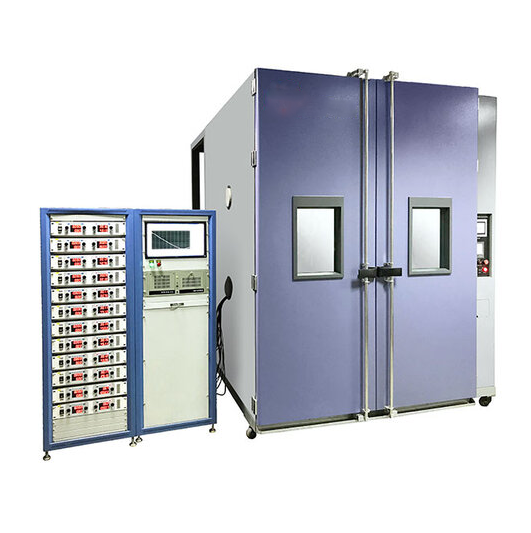
The Damp Freeze and Thermal Cycling Test Chamber is a high-precision environmental simulation device
WhatsApp : +86 15601902607
Email : info@qinsun-lab.com

The Damp Freeze and Thermal Cycling Test Chamber is a high-precision environmental simulation device designed for photovoltaic module testing. By cycling the temperature between -40℃ and 85℃ under controlled humidity conditions, the chamber evaluates PV modules’ electrical performance, mechanical properties, and reliability under combined thermal and damp-freeze stress. It is ideal for laboratory simulation of harsh outdoor environments to verify the environmental durability of photovoltaic modules.
The Damp Freeze and Thermal Cycling Test Chamber is suitable for:
Damp-freeze and temperature cycling performance testing of PV modules
Environmental adaptability evaluation during R&D
Type certification and qualification testing of PV modules
Indoor laboratory simulation of outdoor temperature and humidity cycles
Quality control and factory performance verification of PV modules
Scientific research and environmental durability studies
The chamber complies with the following international standards:
(1) GB/T IEC 61215 – Crystalline Silicon Terrestrial Photovoltaic Modules – Design Qualification and Type Approval
(2) UL 1703 – Safety Standard for Photovoltaic Modules
| Item | Technical Specification |
|---|---|
| Temperature Range | -40~85℃ |
| Temperature Fluctuation | ≤±1℃ |
| Temperature Deviation | ≤±1℃ |
| Temperature Uniformity | ≤±2℃ |
| Heating/Cooling Rate | Compliant with IEC 61215 requirements |
| Humidity Range | 30~98%RH |
| Relative Humidity Deviation | ±3%FS; 85±2%RH; 90±2%RH |
| Humidity Fluctuation | ±2%RH |
| Humidity Uniformity | ≤2%RH |
| Thermal Cycling Performance | Module surface temperature change ≤100℃/h, minimum extreme temperature holding time ≥10 minutes, single test up to 200 cycles or 50 loops |
| Sample Capacity | Up to 12 PV modules |
| Inner Chamber Size | 1.5 × 2.5 × 1.5 m (L×W×H) |
| Outer Chamber Size | 2.5 × 3.0 × 2.5 m (L×W×H) |
| Inner Material | SUS#304 high-temperature resistant mirror stainless steel |
| Outer Material | Anti-rust steel with powder coating |
| Insulation | High-density rigid PU foam + glass wool |
| Control System | Automatic program control; independent heating/humidifying/dehumidifying/cooling |
| Display Panel | Touchscreen, real-time curves of set and actual values |
| Communication Interface | RS-485. supports software data storage, printing, and download |
| Interface Language | English/Chinese switchable |
| Refrigerant | HFC environmentally friendly, auto-switching valve |
| Power Supply | 380V, 50/60Hz |
High precision temperature and humidity control: temperature fluctuation ≤±1℃, humidity fluctuation ≤±2%RH
Simulates extreme thermal cycling and damp-heat conditions compliant with IEC 61215 and UL 1703 standards
Dual-material chamber design with durable SUS304 inner chamber and powder-coated outer chamber for corrosion resistance
Independent control of heating, humidifying, cooling, and dehumidifying for precise energy-efficient regulation
Touchscreen with automatic program calculation displays real-time temperature and humidity curves
Power failure recovery and memory functions improve experiment safety and continuity
RS-485 interface enables online data logging, analysis, and report generation
(1) Damp Freeze and Thermal Cycling Test Chamber Main Unit – inner/outer chamber, control and refrigerant systems
(2) Touchscreen Display and Control Panel – real-time curve monitoring and program control
(3) RS-485 Communication Interface – data storage, printing, and networking
(4) Sample Holder – accommodates up to 12 PV modules
(5) Consumable Refrigerant – HFC environmentally friendly type
(6) Consumable Insulation – PU foam and glass wool
(7) Optional Data Recording and Analysis Software – online logging and visualization
Sample Installation: Fix PV modules evenly on the sample holder.
Program Setting: Set temperature range (-40~85℃), humidity (30~98%RH), cycle count, and holding time.
Start Test: System automatically executes heating, cooling, humidifying, and dehumidifying cycles.
Real-Time Monitoring: Touchscreen displays temperature and humidity curves, program status.
Cycle Completion: Record module temperature, humidity data, and number of cycles.
Sample Removal: Allow modules to cool to room temperature before removal to avoid thermal damage.
Data Analysis and Archiving: Generate experimental reports for PV module performance evaluation and standard compliance.
Ensure power grounding and refrigerant connections are secure
Verify sample holder stability and maintain safe distances from heating/humidifying elements
Regularly inspect refrigerant, water source, and insulation materials for integrity
Periodically calibrate sensors and control systems for accurate temperature and humidity
Clean inner chamber surfaces to prevent condensation residue affecting uniformity
Check touchscreen and RS-485 interface functionality for proper data acquisition
The Damp Freeze and Thermal Cycling Test Chamber provides precise and reliable environmental simulation for photovoltaic modules. Its high-accuracy temperature and humidity control, coupled with thermal cycling and damp-freeze capabilities, supports R&D, type testing, quality assurance, and laboratory studies. The system ensures comprehensive evaluation of PV modules’ electrical and mechanical reliability under harsh outdoor conditions, fulfilling IEC 61215 and UL 1703 requirements.
1. What is the purpose of the Damp Freeze and Thermal Cycling Test Chamber?
The chamber simulates extreme outdoor environments, combining temperature cycles (-40~85℃) and high humidity to evaluate PV module electrical and mechanical performance. It helps verify reliability, encapsulation stability, and long-term durability under damp-freeze and thermal stress conditions.
2. How many PV modules can be tested at once?
The chamber accommodates up to 12 PV modules. The internal sample holder ensures even spacing and stability, allowing simultaneous testing and efficient performance evaluation of multiple modules under identical environmental cycles.
3. How precise is the temperature and humidity control?
Temperature fluctuation is controlled within ±1℃, deviation ≤±1℃, and uniformity ≤±2℃. Humidity fluctuation is ±2%RH, deviation ±3%FS, and uniformity ≤2%RH. This ensures accurate replication of environmental conditions for repeatable and reliable test results.
4. Can the system recover from a power failure?
Yes, the chamber supports power failure recovery and memory functions. It resumes the test cycle automatically upon power restoration, maintaining experiment continuity and preventing damage to PV modules due to sudden temperature or humidity changes.
Qinsun Instruments Co., LTD is a professional laboratory testing instrument manufacturer in China,Have been focusing on laboratory instrument R&D more than 30 years and have rich industry experience,Based on international testing standards,We are also the instrument supplier for BV SGS laboratory,We provide one-stop solutions for lab instruments,Free Training and Turn-Key Service,Products exported all over the world,Offer 36 month warranty and are a trustworthy partner.

Company Phone
+86-21-6420 0566
Working hours
Monday to Friday
Mobile phone:
13816217984
Email:
info@qinsun-lab.com