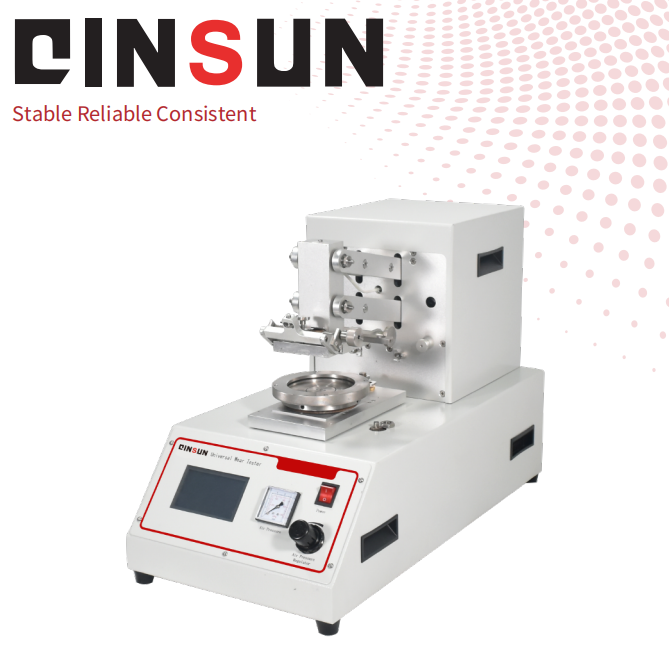
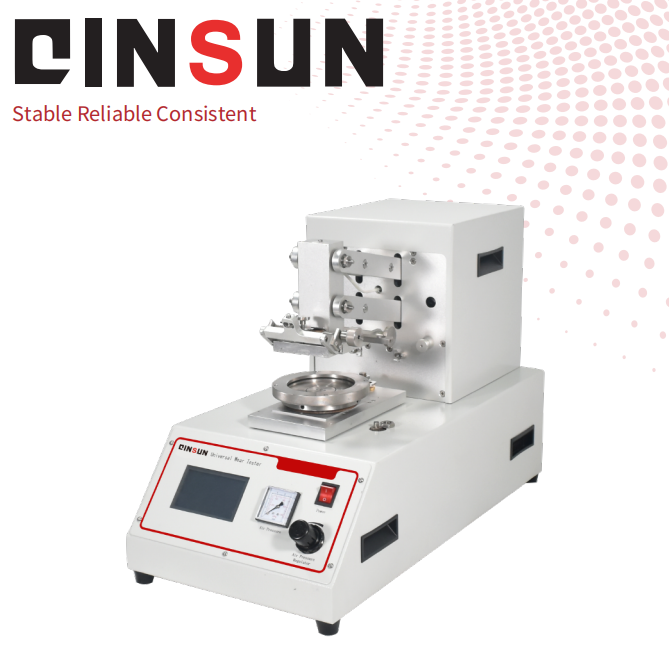
The Universal Wear Tester is used to test wear and abrasion resistance of fabrics for apparel, shoes
WhatsApp : +86 15601902607
Email : info@qinsun-lab.com

The universal wear testing machine features a fully automatic testing mode with automatic counting, automatic stop upon test completion, and a buzzer alert function. The clamp-type sample fixing method allows for quick sample replacement, improving testing efficiency. Its compact design makes it easy to move and offers flexibility to meet various practical application requirements.
Universal Wear Tester (UWT) is used to determines the wear and abrasion resistance of fabric used in clothing, footwear and industrials. Supplied with surface abrasion head (inflated diaphragm method, flex abrasion head, depth abrasion test device, flat abrasion (frosting) and pilling test device as well as necessary weights and initial supply of abrasive. Fitted with built-in timer and mechanical cycle counter.
(1)ASTM Standards: D3514. D3885. D3886 (textile, coating, and plastic wear resistance)
(2)AATCC Standards: 119. 120 (fabric abrasion and pilling resistance)
(3)FTMS Standards: 191/5300/5302 (federal textile durability protocols)
(4)FORD Standards: EFB 15J2. BN 112-01 (automotive interior material testing)
(5)JIS L1096-1999(A)
(6)CNS 12915-1991
Dual Abrasion Heads: Includes surface abrasion head (inflated diaphragm method) and flex abrasion head for diverse testing modes.
Interchangeable Accessories: Compatible with weights, blades, and sample holders to simulate real-world wear scenarios.
Advanced Control System: LCD interface with programmable cycles, stroke length, and speed settings; real-time progress display.
Uniform Testing Conditions: Motor-driven 120 RPM speed and 25mm stroke length guarantee standardized results across operators.
Enhanced Clamping Mechanism: Securely tensions samples to prevent slippage during high-speed reciprocation.
Liquid Immersion Capability: Test samples under wet conditions (water, oil, solvents) to simulate extreme environments.
| Parameter | Specification |
|---|---|
| Rotational Speed | 120 RPM (fixed) |
| Stroke Length | 25 mm (fixed) |
| Test Modes | Flat/curved/edge/fold abrasion, frosting, pilling |
| Sample Compatibility | Fabrics, plastics, leather, rubber, paper, coated materials |
| Power Supply | 220/110V, 50/60Hz |
| Dimensions | 570 (W) × 680 (D) × 400 (H) mm |
| Net Weight | 80 kg |
| Cycle Counter | Mechanical (1–999.999 cycles) |
| Air Injection System | Adjustable pressure for diaphragm inflation |
(1)Standard accessories
Core test components: Standard friction/abrasion media (wool felt/cotton cloth), sample fixing clamps, 500g/1000g standard weights.
Control & auxiliary tools: LCD digital counter, staining/discoloration gray scale cards (complying with GB/AATCC/ISO standards).
Basic accessories: Power cord, user manual, certificate of conformity, cleaning brush.
(2)Optional accessories
Specialized media: Additional friction pads, abrasive wheels (for abrasion tests), small rubber pads.
Functional extensions: Light box (standard light source), pre-tension adjustment fixtures, vacuum dryer.
Calibration & auxiliary tools: Precision calibration weights, calibration fabrics, liner sandpaper.
1. Preparation Phase
Equipment and Accessory Inspection
Ensure the instrument's power connection is secure, and all components (fixtures, abrasives, weights, diaphragms, etc.) are intact and clean, free from oil stains or debris.
Prepare test samples (cut to standard dimensions) and prepare tools such as sample mounting wrenches.
2. Sample and Abrasive Installation
Sample Mounting
Use the sample mounting wrench to open the fixture, place the diaphragm and sample into the fixture, and tighten the fixture knob to secure the sample.
Abrasive and Weight Installation
Fix the abrasive to the upper fixture, and then install the corresponding weight (select according to the test load requirements).
3. Parameter Settings
Power On and Interface Access
Turn on the instrument's power switch and access the operation display screen interface.
Setting Test Parameters
Set the number of test cycles (such as the number of friction cycles required by the standard);
Adjust the air pressure value (the sample will expand to a preset height with the air pressure, adapting to flat grinding/curved grinding and other test modes).
4. Starting the Test
Adjusting the Contact Position
Lower the upper fixture to ensure close contact between the abrasive and the sample surface.
Starting the Test
Press the "Start" button, and the instrument enters the automatic friction mode (the abrasive and the sample continuously rub against each other).
The test status can be monitored through the display screen during the test.
5. Test Completion and Subsequent Operations
Automatic Shutdown
When the sample is worn through or the set number of cycles is reached, the instrument automatically stops and beeps.
Sample Processing and Analysis
Turn off the instrument's power, remove the sample, check the degree of wear, and record the data (such as wear area, weight change, etc.).
Cleaning and Maintenance
Clean up any remaining debris inside the instrument and keep the equipment clean for future use.
1.What is the Universal Wear Tester (UWT) used for?
The UWT is used to evaluate the wear resistance and friction performance of textiles, coatings, and other materials under controlled conditions, simulating real-world usage.
2.Which materials can be tested with this machine?
It can test fabrics, leather, coated textiles, plastic films, and other materials that require abrasion or friction resistance assessment.
3.How does the UWT operate?
The tester applies a controlled load while moving the specimen against a standard abrasive surface or counter material, measuring wear and friction over a set number of cycles.
4.Can the testing parameters be adjusted?
Yes, the UWT allows adjustment of load, speed, stroke length, and number of cycles to meet different testing standards and research requirements.
5.What standards does the UWT comply with?
It is designed to meet international standards such as ASTM D4966. ISO 12947. and related textile and material wear testing guidelines.
Similar products : Abrasion Testing Machine
Qinsun Instruments Co., LTD is a professional laboratory testing instrument manufacturer in China,Have been focusing on laboratory instrument R&D more than 30 years and have rich industry experience,Based on international testing standards,We are also the instrument supplier for BV SGS laboratory,We provide one-stop solutions for lab instruments,Free Training and Turn-Key Service,Products exported all over the world,Offer 36 month warranty and are a trustworthy partner.

Company Phone
+86-21-6420 0566
Working hours
Monday to Friday
Mobile phone:
13816217984
Email:
info@qinsun-lab.com