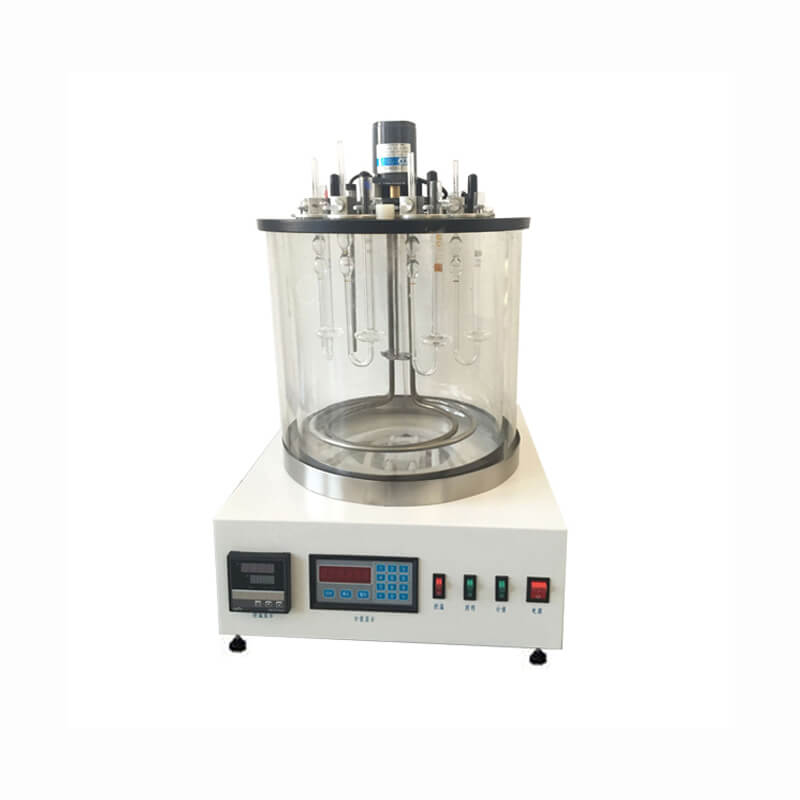
Measures kinematic viscosity of petroleum products using capillary viscometers in a temperature-cont
WhatsApp : +86 15601902607
Email : info@qinsun-lab.com

The determination of kinematic viscosity is performed by measuring the time it takes for a defined volume of a liquid to flow through a calibrated glass capillary viscometer under gravity at a precisely controlled constant temperature. The kinematic viscosity is then calculated by multiplying the measured flow time by the calibration constant of the viscometer.
A typical Petroleum Products Kinematic Viscosity Tester consists of a highly stable temperature-controlled bath (usually a liquid bath like glass filled with a transparent fluid) capable of maintaining the test temperature with high accuracy and uniformity. Capillary viscometers are mounted vertically in holders within this bath. Once the sample reaches the test temperature, it is drawn into the viscometer bulb, and the time it takes to flow between two designated marks is measured.
Automated versions of these testers can handle multiple samples simultaneously, automatically fill the viscometer, detect the fluid menisci using optical or thermal sensors to measure flow time, clean and dry the viscometer, and calculate and report the results. The accuracy of the temperature control and the flow time measurement are critical for obtaining reliable kinematic viscosity values, as viscosity is highly dependent on temperature. Different types and sizes of calibrated capillary viscometers are used to cover a wide range of viscosity values.
Determining the kinematic viscosity of fuels, lubricants, hydraulic fluids, and other petroleum-based products.
Quality control to ensure products meet specified viscosity grades (e.g., SAE grades for engine oils, ISO VG grades for industrial oils).
Research and development of new petroleum products and formulations.
Monitoring the condition of in-service oils (e.g., detecting fuel dilution or oxidation).
Characterizing the flow behavior of petroleum fluids at specific temperatures.
ASTM D445:Standard Test Method for Kinematic Viscosity of Transparent and Opaque Liquids (and Calculation of Dynamic Viscosity)
ISO 3104:2023 Petroleum products — Transparent and opaque liquids — Determination of kinematic viscosity and calculation of dynamic viscosity
IP 71: Section 2 Glass capillary kinematic viscometers - Specifications and operating instructions
Provides accurate and reliable measurement of kinematic viscosity according to international standards.
Essential for quality control, product specification, and trade of petroleum products.
Helps predict how petroleum fluids will flow and perform in various temperature conditions.
Covers a wide range of viscosity values by using different calibrated capillary viscometers.
Temperature-controlled bath ensures tests are performed under precise and repeatable thermal conditions.
Automated versions increase throughput, improve accuracy, and reduce operator involvement.
Widely accepted and standardized test method.
| No. | Parameter Description | Specification |
|---|---|---|
| 1 | Working Power Supply | AC (220±10%)V, 50Hz±5% |
| 2 | Heating Power | 1600W |
| 3 | Stirring Motor | Power: 6W; Rotation Speed: 1200r/min |
| 4 | Measurement Range | Room Temperature ~ 100℃ |
| 5 | Temperature Control Accuracy | ±0.1℃ |
| 6 | Constant Temperature Bath | Capacity: 20L; Form: Double-cylinder (inner & outer) |
| 7 | Sample Loading Quantity | Number of Capillaries Inserted Simultaneously: 4 pcs |
| 8 | Operating Environment | Ambient Temperature: -10℃ ~ +35℃; Relative Humidity: < 85% |
| 9 | Temperature Sensor | Industrial Grade; 分度号 (分度 Number): Pt100 |
| 10 | Overall Power Consumption | ≤1800W |
| 11 | Capillary Viscometer | Properties, Specifications and Quantity: Subject to Business Agreement |
| 12 | Overall Dimensions | 530×400×670mm (L×W×H, including bath, etc.) |
1. STD-Kinematic Viscosity Tester (including inner and outer glass cylinders, stirring device, rubber rings, etc.): 1 unit
2. Capillary Viscometer (including Pinton capillary, Campion countercurrent capillary, and standard Ubbelohde capillary): 1 set (7 pieces in total, inner diameters of 0.6. 0.8. 1.0. 1.2. 1.5. 2.0. and 2.5 mm respectively)
3. Rod-type Mercury Thermometer (including 0~50℃ and 50~100℃, both with a graduation of 0.1°C): 1 piece each
4. Plumb bob: 1 piece
5. Sensor: 1 piece
6. Bakelite cap: 4 pieces
7. Capillary clamp: 4 pieces
8. Silicone stopper (#3): 2 pieces
9. 10A fuse (medium 6x30): 4 pieces
10. Round glass: 1 piece Item 11. Thermometer retaining ring (#1): 4 pieces
12. Wired timer button: 1 piece
13. Ear syringe: 1 piece
14. Instruction manual: 1 copy
15. Product certificate: 1 copy
16. Product warranty card: 1 copy
1. Preliminary Preparation
Instrument and Environmental Checks: Level the instrument (confirmed by using a spirit level), check the thermostatic bath level, and ensure that the power supply, stirring motor, and other components are functioning properly. The environment should be free from significant vibration and airflow interference, with the temperature maintained between -10℃ and 35℃ and relative humidity <85%.
Sample Preparation: Filter the petroleum product to be tested to remove impurities. If it contains moisture, dehydrate it. Volatile/oxidizable samples should be transferred quickly in a sealed container.
Viscometer Selection and Cleaning: Select a capillary viscometer with a matching inner diameter based on the sample viscosity (ensuring a flow time of 200~1000 seconds). Clean the viscometer with a solvent (such as petroleum ether). If there is dirt, wash it sequentially with chromic acid cleaning solution, distilled water, and ethanol, then dry it by blowing it off.
2. Instrument Settings
Turn on the power, set the target temperature of the thermostatic bath (e.g., 40℃, 100℃), start the heating and stirring functions, and wait for the temperature to stabilize to ±0.1℃ (temperature control accuracy) and maintain this temperature for at least 10 minutes.
If parameter adjustments are required (such as capillary constant, number of tests), set and save via the control panel.
3. Sample Loading and Temperature Control
Inject the prepared sample into the capillary viscometer, avoiding air bubbles; fix the viscometer on the stand and immerse it in a constant temperature bath (ensuring the expansion section is more than half submerged), and allow it to equilibrate for 15-30 minutes.
4. Viscosity Measurement
Use a rubber bulb/negative pressure device to draw the sample above the upper mark of the viscometer's timing bulb. After releasing the pressure, start the timer when the liquid level reaches the upper mark and stop when it reaches the lower mark.
Repeat the measurement at least 4 times, ensuring that the relative deviation of each flow time from the average is ≤0.5% (at 15-100℃).
5. Data Processing and Cleaning
The instrument automatically calculates the kinematic viscosity (formula: kinematic viscosity = capillary constant × average flow time); if dynamic viscosity is required, it can be further calculated in conjunction with the sample density.
After the measurement is completed, clean the viscometer with solvent for future use; save the test data (such as time, viscosity value), which can be printed out.
6. Finishing Steps
Turn off the instrument power, clean the test equipment, and record the test information (sample number, temperature, results, etc.).
Qinsun Instruments Co., LTD is a professional laboratory testing instrument manufacturer in China,Have been focusing on laboratory instrument R&D more than 30 years and have rich industry experience,Based on international testing standards,We are also the instrument supplier for BV SGS laboratory,We provide one-stop solutions for lab instruments,Free Training and Turn-Key Service,Products exported all over the world,Offer 36 month warranty and are a trustworthy partner.

Company Phone
+86-21-6420 0566
Working hours
Monday to Friday
Mobile phone:
13816217984
Email:
info@qinsun-lab.com