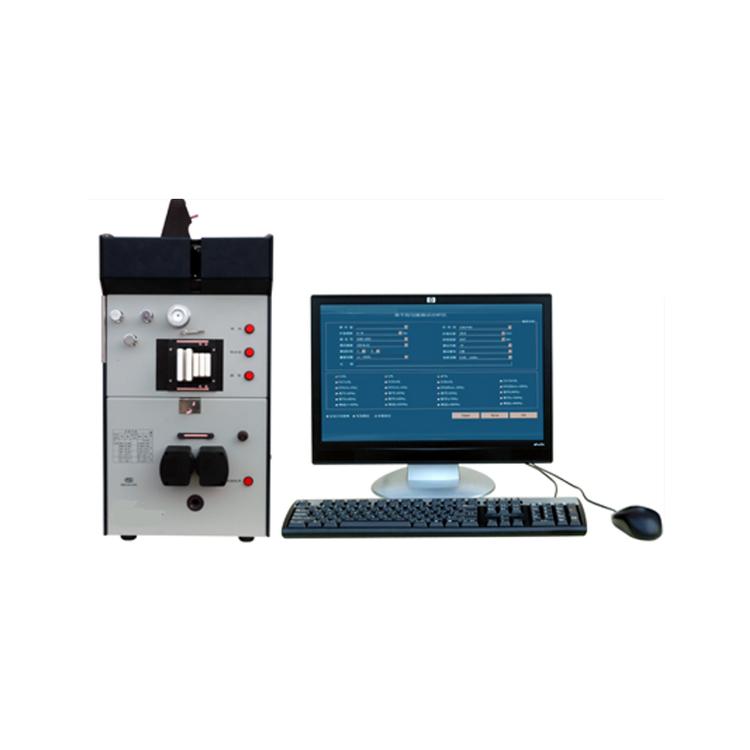
Measures the mass variation of textile sliver, roving, and yarn using capacitance sensors for qualit
WhatsApp : +86 15601902607
Email : info@qinsun-lab.com

The Strip Evenness Tester is a high-performance textile laboratory instrument designed to analyze the density and uniformity of fine yarn, roving, and sliver. It provides precise detection of unevenness in cotton, wool, hemp, chemical fiber short fibers, and blended yarns. This instrument enables detailed analysis of the causes of unevenness, offering valuable insights for quality control and production optimization.
The Strip Evenness Tester is suitable for:
(1) Cotton Industry: Testing yarn, roving, and sliver for CV%, U%, thick/thin places, and neps.
(2) Wool Processing: Evaluating short fiber uniformity in wool and blended yarns.
(3) Chemical Fiber Production: Monitoring the consistency of synthetic fibers, including polyester, nylon, and viscose.
(4) Textile Laboratories: Quality control of spun, blended, or pure fiber yarns.
(5) Extended Applications: Can also be applied to research in fiber blending optimization, automated production line monitoring, and textile defect analysis.
(6)Specific products tested include: cotton yarn, wool yarn, hemp yarn, polyester yarn, viscose yarn, blended fiber yarns, roving, and slivers.
The Strip Evenness Tester aligns with common textile testing standards, including:
(1) ISO 2060:1995 – Textiles – Determination of linear density of yarns (Tex system)
(2) ISO 1833-1:2020 – Textiles – Quantitative chemical analysis of fiber mixtures
(3) ASTM D1425 – Standard Test Method for Evenness of Yarn
(4) GB/T 3811-2010 – Testing of fiber and yarn uniformity
(1) High Precision Measurement: Sensitive capacitance sensors detect minute mass variations in textile strands.
(2) Wide Material Range: Supports cotton, wool, hemp, synthetic, and blended yarns.
(3) Comprehensive Analysis: Provides CV%, U%, imperfections, spectrograms, vari-length curves, and linear density distribution.
(4) High-Speed Testing: Capable of up to 800 m/min for rapid production monitoring.
(5) Automated Operation: Features automatic yarn feeding, zero adjustment, and defect alarms.
(6) Expert Analysis Software: Integrated software for root cause diagnosis and corrective action suggestions.
(7) User-Friendly Interface: Windows-based graphical interface for intuitive operation and visualization.
(8) Data Management: Stores, replays, and prints test data for long-term analysis.
| Parameter | Specification |
|---|---|
| Capacitor Detection Slots | 4 |
| Test Range | 4 tex – 80 ktex |
| Test Speed | 8, 25, 50, 100, 200, 400, 800 m/min |
| Test Time | 10 sec – 20 min, adjustable |
| CV%, U% Value Range | 0.2% – 100% |
| Variation-Length Curve | Cutting length: 1 cm – 1000 m |
| Defects Output | Three types
simultaneously: - Details: -30%, -40%, -50%, -60% - Coarse section: +35%, +50%, +70%, +100% - Cotton knot: +140%, +200%, +280%, +400% |
| Spectral Diagram | 170 channels, wavelength range 1 cm – 2000 m |
| Linear Density Frequency Distribution | -100% – +100%, +100% – +400% |
| DR% Values | DR(1m, +5%), DR(1m, -5%), DR(20cm, +35%), DR(20cm, -30%) |
| Number of Batch Measurements | ≤20 |
| Power Supply | AC 220V ±10%, 50Hz ±5Hz |
| Power Consumption | ≤400 VA |
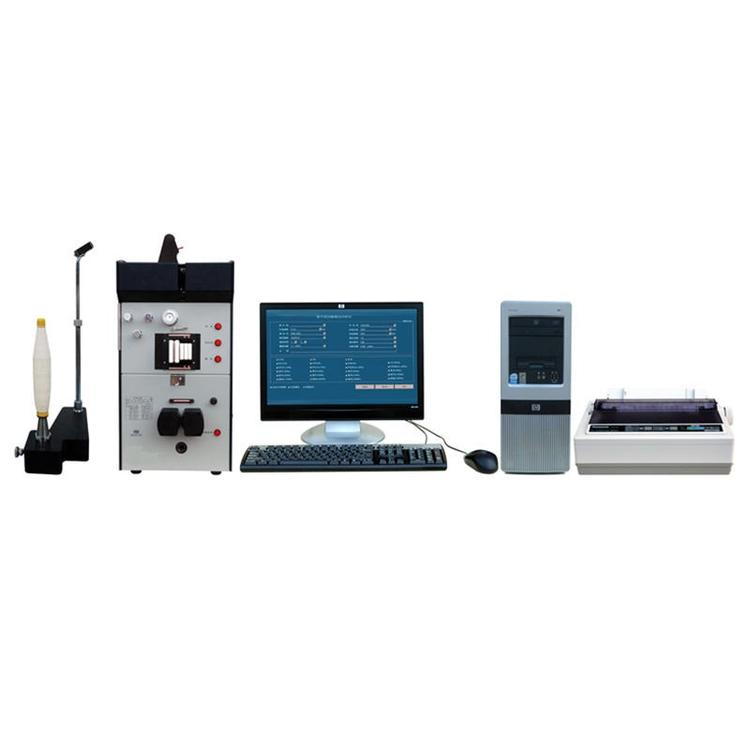
(1) Main testing unit – 1 set
(2) Sample holders – 4 pcs
(3) Calibration weights – 1 set
(4) Power cable – 1 pcs
(5) User manual – 1 set
(6) Software CD – 1 pcs
(7) Certificate of Quality – 1 set
(1) Mount the yarn, roving, or sliver sample into the detection slots.
(2) Set the test speed, time, and desired output parameters on the interface.
(3) Start the measurement; the capacitance sensors detect density variations along the sample.
(4) Observe the real-time graphical outputs, including CV%, U%, and variation-length curves.
(5) The system automatically calculates defects, spectral distribution, and DR% values.
(6) Save or print the test results for analysis and record-keeping.
(1) Clean sensor slots and sample holders after each test.
(2) Periodically check calibration using standard reference yarns.
(3) Lubricate moving parts according to the manufacturer’s instructions.
(4) Store the instrument in a dry, dust-free environment to prevent sensor degradation.
(5) Perform software updates and backups regularly to maintain data integrity.
1. What is the primary purpose of this tester?
It measures the uniformity and evenness of strip-shaped materials, detecting thickness variations, defects, or inconsistencies along the length.
2. Which materials can be tested using this device?
The tester is suitable for metal strips, plastic films, rubber strips, textiles, and other continuous strip materials.
3. How does the tester operate?
It uses precision sensors or micrometers to scan the strip along its length and width, recording variations in thickness or surface evenness.
4. Which standards does this tester comply with?
It supports international and industry standards for material thickness and evenness testing, including ASTM, ISO, and GB/T protocols.
5. Who typically uses this equipment?
Material manufacturers, quality control laboratories, and R&D teams use it to ensure product consistency, optimize production processes, and maintain quality standards.
Qinsun Instruments Co., LTD is a professional laboratory testing instrument manufacturer in China,Have been focusing on laboratory instrument R&D more than 30 years and have rich industry experience,Based on international testing standards,We are also the instrument supplier for BV SGS laboratory,We provide one-stop solutions for lab instruments,Free Training and Turn-Key Service,Products exported all over the world,Offer 36 month warranty and are a trustworthy partner.

Company Phone
+86-21-6420 0566
Working hours
Monday to Friday
Mobile phone:
13816217984
Email:
info@qinsun-lab.com