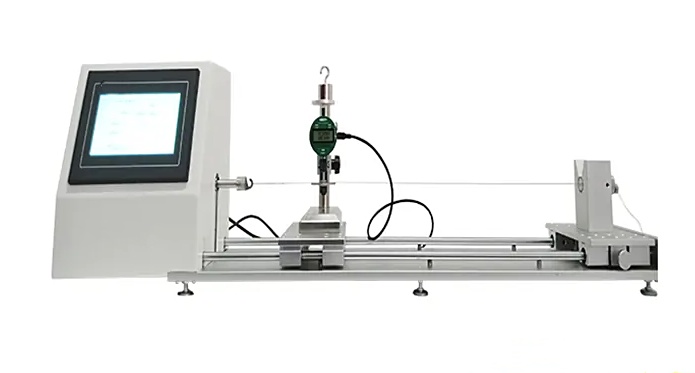
The Medical Suture Thread Diameter Tester is a specialized testing equipment used for measuring the
WhatsApp : +86 15601902607
Email : info@qinsun-lab.com

The Medical Suture Thread Diameter Tester is a specialized testing equipment used for measuring the diameter or linear diameter of medical suture threads.
Quality Control: The medical suture thread diameter tester plays a crucial role in the quality control of medical devices. By accurately measuring the diameter of suture threads, it ensures that products meet relevant medical standards and specification requirements, thereby improving the quality and safety of medical devices. Manufacturer Inspection: During the production process, manufacturers need to conduct strict quality inspections on each batch of suture threads. The thread diameter tester can monitor the changes in thread diameter in real - time, promptly detect and correct production deviations, and improve production efficiency and product quality. Third - Party Inspection: Independent third - party testing laboratories are responsible for conducting random quality inspections and verifications on suture threads sold in the market. The high - precision data provided by the thread diameter tester can serve as a reliable basis for test reports, ensuring the safety and effectiveness of products during use. Product R & D: In the process of developing new suture thread products, R & D personnel need to repeatedly verify and adjust product specifications. The thread diameter tester can provide accurate thread diameter measurement data, helping R & D personnel optimize the design and improve product performance.
The medical suture thread diameter tester needs to comply with relevant medical industry standards, such as YY 1116 - 2020Absorbable Surgical Suture and YY 0167 - 2020 Non - absorbable Surgical Suture. These standards specify in detail the requirements for the technical parameters, testing methods, and measurement accuracy of the suture thread diameter tester, ensuring the accuracy and reliability of measurement results.
1. Compliance
Execution Standards: Designed and manufactured according to the wire diameter testing clauses in YY1116-2020 "Absorbable Surgical Sutures" and YY0167-2020 "Non-absorbable Surgical Sutures".
Allows for measurement at multiple positions, including 1/4. 1/2. and 3/4 of the length; for multi-strand sutures with specifications greater than metric 2. the suture can be rotated 90° for measurement without disassembly.
2. Stability
Uses a grating displacement sensor instead of a micrometer, providing accuracy to one ten-thousandth and excellent stability.
3. Convenience
Manual sample loading, electric tensioning, and multi-point automatic measurement.
To address the issue of changing weights for each specification, it innovatively uses a high-precision force sensor to automatically set the tension force, making operation simple.
Equipped with quick mechanical buttons for testing and stopping, allowing for one-button testing and pausing.
4. Intelligence
A 7-inch color touch screen combined with intelligent data processing functions provides users with a comfortable and smooth operating experience.
Touch screen operation: Nominal specification, test load, printing, testing, left movement, right movement, time, calibration.
| Serial No. | Parameter Item | Parameter Details |
|---|---|---|
| 1 | Minimum Division Value | Not exceeding 0.002mm (some high-precision devices can reach 0.001mm), ensuring precise suture thread diameter measurement |
| 2 | Base Diameter | Usually greater than 50mm, providing stable basic support for measurement |
| 3 | Pressing Plate Diameter | 12.70mm±0.02mm, used to apply pressure to the suture thread for diameter measurement |
| 4 | Presser Foot Load | Varies by suture thread specifications:- For specifications > nominal size 0.4 (or 8-0): 210g±3g- For specifications ≤ the above size: ≤60g |
| 5 | Calibration Difference and Parallelism Difference | Not greater than 0.005mm (between pressing plate surface and base), ensuring measurement accuracy |
One main unit, one certificate of conformity, accompanying fixtures, one instruction manual, and one roll of printing paper.
1. Preparation Before Operation
Equipment and Environment Check:
Connect the power supply (suitable for wide voltage range), start the equipment and confirm that the operating interface is functioning correctly; place the equipment in a standard testing environment of **22±2℃ and 50±5% humidity**, ensuring the workbench is stable and vibration-free.
Sample Preparation:
Select suture samples that meet the standards of "YY 1116-2020 Absorbable Surgical Sutures" and "YY 0167-2020 Non-absorbable Surgical Sutures," cut them to a length of 10-15cm, ensuring the sutures are clean, untwisted, and undamaged.
Equipment Pre-check:
Confirm the condition of the components, including the press plate diameter (12.70mm±0.02mm) and base diameter (≥50mm), ensuring there is no wear or deformation.
2. Equipment Calibration (Ensuring Measurement Accuracy)
Baseline Calibration:
In the unloaded state, verify the "calibration difference and parallelism difference between the press plate surface and the base," ensuring the error is ≤0.005mm; calibrate the minimum division value (typically ≤0.002mm, high-precision models ≤0.001mm) using the equipment's built-in calibration program.
Press Foot Load Calibration:
Set the press foot load according to the suture specifications:
Suture specifications > nominal 0.4 (or 8-0): Calibration load is 210g±3g;
Specifications ≤ nominal 0.4 (or 8-0): Calibration load ≤60g.
3. Sample Installation
Place the suture naturally in the center of the base, ensuring the suture is not stretched or twisted; adjust the position of the press plate so that it is aligned with the area of the suture to be measured, avoiding contact between the suture and other parts of the equipment.
4. Parameter Settings
Select the corresponding standard (YY 1116-2020/YY 0167-2020) through the operating interface and set:
Measurement mode (single measurement/multi-position average measurement);
Press foot load matching the sample specifications;
Minimum division value (select 0.001mm/0.002mm accuracy as needed). 5. Test Execution
After confirming the parameters are correct, start the test; the device automatically drives the pressure plate to apply the set load to the suture, and simultaneously collects diameter data.
It is recommended to measure 3-5 different positions on a single suture to obtain multiple data sets to improve result stability.
6. Data Processing and Application
The device automatically calculates the average measurement value and displays the individual data sets and the average;
A report is generated containing "sample information, measurement data, calibration records, and compliance with standards," which is used for:
Quality control: verifying whether the suture diameter meets medical standards;
Production testing: real-time monitoring of diameter deviations in batch products;
Third-party inspection: providing high-precision data for compliance verification of products in the market.
7. Post-Test Maintenance
Turn off the device power, and clean any remaining suture fibers from the base and pressure plate surface;
Record the device usage status, and regularly re-examine the pressure plate wear and sensor accuracy to ensure the long-term stable operation of the equipment.
1. What is the primary function of the Medical Suture Line Diameter Tester?
The Medical Suture Line Diameter Tester is a specialized testing instrument used to measure the diameter or linear diameter of medical suture threads. By providing precise diameter measurement data, the tester helps ensure that suture threads meet the dimensional requirements defined in relevant medical standards. Accurate diameter control is essential for maintaining product consistency, ensuring safe clinical use, and supporting reliable quality control throughout manufacturing, inspection, and research processes.
2. In which scenarios is the Medical Suture Line Diameter Tester commonly used?
The tester is widely used in quality control, manufacturer inspection, third-party inspection, and product research and development. In manufacturing, it enables real-time monitoring of diameter changes to detect production deviations. In third-party laboratories, it provides high-precision measurement data as a reliable basis for inspection reports. During R&D, it supports repeated verification and optimization of suture specifications, helping improve product performance and safety.
3. Which standards does the Medical Suture Line Diameter Tester comply with?
The tester is designed to comply with YY 1116-2020 Absorbable Surgical Sutures and YY 0167-2020 Non-absorbable Surgical Sutures. These standards specify the technical parameters, testing methods, and measurement accuracy requirements for suture thread diameter testing, ensuring that the measurement results are accurate, reliable, and suitable for medical device quality evaluation.
4. What features ensure measurement accuracy and stability?
The tester uses a grating displacement sensor instead of a traditional micrometer, achieving accuracy to one ten-thousandth and providing excellent stability. Calibration difference and parallelism difference between the pressing plate surface and the base are controlled within 0.005 mm. In addition, high-precision force sensors automatically set the tension force, ensuring consistent loading and reliable diameter measurements across different suture specifications.
5. How does the tester support efficient and user-friendly operation?
The instrument supports manual sample loading combined with electric tensioning and multi-point automatic measurement. It is equipped with quick mechanical buttons for one-button testing and pausing, reducing operational complexity. A 7-inch color touch screen integrates intelligent data processing functions, allowing users to easily set nominal specifications, test load, calibration, printing, and measurement positions through a clear and intuitive interface.
Qinsun Instruments Co., LTD is a professional laboratory testing instrument manufacturer in China,Have been focusing on laboratory instrument R&D more than 30 years and have rich industry experience,Based on international testing standards,We are also the instrument supplier for BV SGS laboratory,We provide one-stop solutions for lab instruments,Free Training and Turn-Key Service,Products exported all over the world,Offer 36 month warranty and are a trustworthy partner.

Company Phone
+86-21-6420 0566
Working hours
Monday to Friday
Mobile phone:
13816217984
Email:
info@qinsun-lab.com