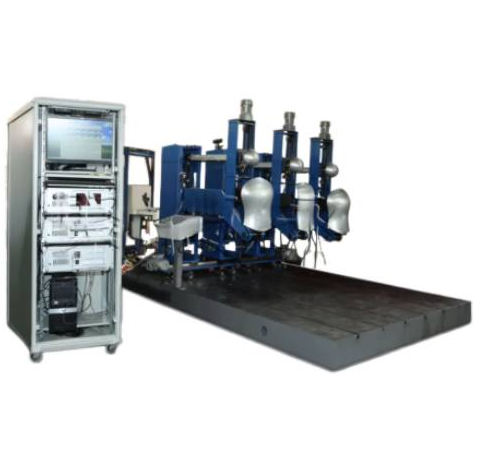
Applicable standards:GB 11550-2009 "Automobile seat headrest strength requirements and test methods"
WhatsApp : +86 15601902607
Email : info@qinsun-lab.com

The Automobile Headrest Strength Tester is a dedicated testing system used to evaluate the static strength and load-bearing performance of automotive seat headrests under specified loading conditions.
By applying controlled static forces and accurately measuring displacement and deformation, the tester verifies whether headrests comply with national and international safety regulations.
It is widely used in automotive OEM validation, component supplier quality control, certification testing, and seat system R&D.
(1) Static strength testing of automotive seat headrests.
(2) Load-bearing capacity verification of headrest structures under forward and backward forces.
(3) Displacement and deformation measurement of headrests under sustained static loads.
(4) Compliance testing for regulatory approval and type certification.
(5) Quality control inspection during mass production of seat headrests.
(6) Comparative strength testing of different headrest designs and materials.
(7) Structural optimization and design validation during headrest development.
(8) OEM internal standard testing for headrest safety performance.
(1) GB 11550-2009 – Automobile seat headrest strength requirements and test methods.
(2) GB 15083-2006 – Automobile seats, seat fixtures, and headrest strength requirements and test methods.
(3) ECE R17 – Strength and safety requirements for vehicle seats and head restraints.
(4) ECE R21 – Interior fittings safety requirements related to head impact protection.
(5) FMVSS 202 / FMVSS 207 – U.S. Federal Motor Vehicle Safety Standards for head restraint strength and seating systems.
(6) OEM technical specifications and internal validation standards.
(1) Dedicated design for static strength testing of automotive headrests.
(2) High load capacity suitable for simulating real-world static loading conditions.
(3) High-accuracy load and displacement measurement ensures reliable and repeatable results.
(4) Adjustable test speed to accommodate different test standards and headrest designs.
(5) Supports both manual operation and computer-controlled automatic testing.
(6) Stable support fixtures ensure secure mounting of seats and headrests during testing.
(7) Real-time data acquisition for load, displacement, and test status monitoring.
(8) Robust mechanical structure designed for long-term stable operation.
(9) Integrated safety protection including overload protection and emergency stop.
| Parameter | Specification |
|---|---|
| Load Capacity | ≥ 500 kg |
| Load Accuracy | ±1% |
| Displacement Range | 300–400 mm |
| Displacement Accuracy | ±1% |
| Test Speed | Adjustable, 10–30 times/min |
| Control Mode | Manual and computer-controlled automatic |
| Test Components | Load device, displacement sensor, support fixture, data acquisition system |
| Safety Protection | Overload protection, emergency stop, mechanical safeguards |
(1) Adjustable mounting fixtures for different seat and headrest types.
(2) High-precision load cells for extended load ranges.
(3) Displacement sensors and data acquisition modules.
(4) Professional test control and analysis software.
(5) Protective covers and safety guards.
(6) Calibration tools for load and displacement systems.
(1) Secure the automotive seat and headrest onto the test bench using appropriate fixtures.
(2) Connect load and displacement sensors and perform system zero calibration.
(3) Set test parameters including load value, displacement range, and test speed.
(4) Start the test; the system applies static load according to the programmed conditions.
(5) Monitor load and displacement data in real time during the test.
(6) Complete the test and gradually release the applied load.
(7) Save, analyze, and export test data and curves for reporting and evaluation.
(1) Regularly inspect mechanical structures, fixtures, and load devices for wear or deformation.
(2) Periodically calibrate load cells and displacement sensors to maintain measurement accuracy.
(3) Keep electrical components, sensors, and control systems clean and dry.
(4) Check safety protection devices and emergency stop functions before operation.
(5) Lubricate moving mechanical components according to the maintenance schedule.
(6) Store the equipment in a clean, stable environment when not in use.
Qinsun Instruments Co., LTD is a professional laboratory testing instrument manufacturer in China,Have been focusing on laboratory instrument R&D more than 30 years and have rich industry experience,Based on international testing standards,We are also the instrument supplier for BV SGS laboratory,We provide one-stop solutions for lab instruments,Free Training and Turn-Key Service,Products exported all over the world,Offer 36 month warranty and are a trustworthy partner.

Company Phone
+86-21-6420 0566
Working hours
Monday to Friday
Mobile phone:
13816217984
Email:
info@qinsun-lab.com