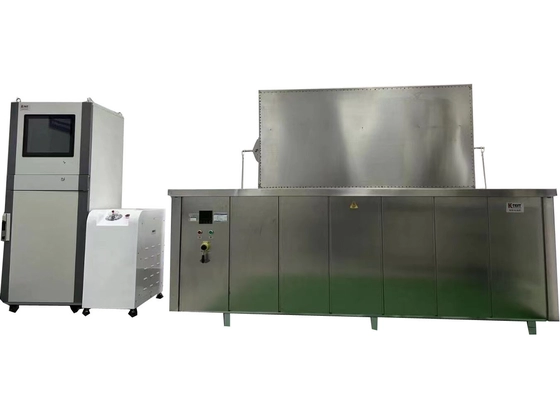
Product Introduction:The machine is used for the determination of pressure time and instantaneous bu
WhatsApp : +86 15601902607
Email : info@qinsun-lab.com

The Plastic Pipe Hydrostatic Pressure Burst Tester utilizes an international airless pressure control system. Its core is a dual-CPU control system (computer and instrument) with the same pressure control method as used in Denmark. It employs differential pressure control technology to independently control each test circuit, ensuring mutual independence and no interference. It can simultaneously perform various tests with different pressures and durations. It is suitable for long-term hydrostatic pressure tests, instantaneous burst tests, and thermal stability 8760 tests on various materials and pipe diameters, including PVC, PE, and PP-R.
The Plastic Pipe Hydrostatic Pressure Burst Tester is suitable for hydrostatic pressure burst testing of PVC, PE, aluminum-plastic composite pipes, and other similar materials. Based on the fundamental principles of material mechanics and fluid mechanics, it simulates the pressure conditions that pipes may experience in real-world applications by applying gradually increasing pressure to the inside of the pipe, thereby evaluating the pressure resistance and safety performance of the pipe. It features both computer and manual control, and is equipped with a constant temperature water tank for automatic temperature control. This testing machine fully complies with relevant national standards and can be customized according to specific requirements. During the test, pressure changes, test time, and other data can be monitored in real-time through the data display interface on the LCD screen. Simultaneously, the deformation of the pipe and any other abnormal conditions should be closely observed.
ISO 1167: For thermoplastics pipe systems under constant internal pressure
ASTM D 1598: Standard test method for time-to-failure of plastic pipe under constant internal pressure
ASTM D 1599: Standard test method for resistance to short-time hydraulic pressure of plastic pipe
ASTM F1335:Standard Specification for Pressure-Rated Composite Pipe and Fittings for Elevated Temperature Service
ISO9080:Plastics piping and ducting systems - Determination of the long-term hydrostatic strength of thermoplastics materials in pipe form by extrapolation
Smart Software Suite:
Multi-user environment with role-based access control.
Wireless remote operation via mobile/tablet.
Sample database with barcode scanning and batch import/export.
Customizable report templates (ISO/ASTM compliant).
Precision Engineering:
Stainless steel test chamber with anti-corrosion coating.
Dual-circuit hydraulic system for rapid pressure stabilization.
Self-diagnostics for fault alerts and maintenance reminders.
Ergonomic Design:
7-inch touchscreen with multi-language support (English, Spanish, German, Chinese).
Adjustable stand height and mobile caster base for lab mobility.
| Parameter | Specification |
|---|---|
| Pressure Range | 0–50 MPa (customizable up to 100 MPa) |
| Testing Stations | 45 (expandable to 60) |
| Pump Type | Variable Frequency Drive (VFD) |
| Power Supply | 220V/50Hz or 110V/60Hz (CE/UL certified) |
| Control System | PLC + HMI Touchscreen |
| Data Interface | Ethernet (TCP/IP), USB 2.0. Wi-Fi |
| Operating Environment | 5–40°C, ≤85% RH (non-condensing) |
| Dimensions (L×W×H) | 950mm × 850mm × 1800mm |
| Weight | 450 kg (net) |
Multi-specification pipe sample fixture, high-precision pressure sensor, multi-size sample sealing components, TCP/IP data connection cable, high-precision temperature sensor, spare sealing gaskets, sample size measuring tools, operating manual + calibration certificate.
1. Pre-test Preparation
Check the equipment power supply (matching the equipment voltage requirements) and the supply of test medium (usually deionized water), and confirm that there are no leaks in the equipment piping;
Calibrate the pressure sensor and temperature sensor (refer to the equipment calibration certificate, or verify using standard calibration equipment);
Connect the TCP/IP data connection cable to ensure normal communication between the equipment and the laboratory network (if remote monitoring/data synchronization is required).
2. Sample Preparation
Cut plastic pipe samples according to ASTM D1598 standard requirements (usually the length is 5-10 times the pipe diameter, and defects at the ends of the pipe must be removed);
Measure the pipe diameter and average wall thickness of the sample using a vernier caliper and wall thickness gauge, and record the basic parameters of the sample.
3. Sample Installation
Select the corresponding specifications of clamps and sealing components according to the sample pipe diameter;
Connect both ends of the sample to the sealing components and fix them in the clamps of the test chamber, ensuring that there is no medium leakage at the sealing parts (low-pressure medium can be pre-injected to check the sealing performance).
4. Test Parameter Settings
Select the test standard (e.g., "ASTM D1598") through the equipment's microprocessor controller;
Set the test parameters: target hydrostatic pressure, test medium temperature, and maximum test duration (or select "burst test mode");
Enable the "real-time data synchronization" function to ensure that test data can be transmitted to the laboratory network.
5. Starting the Test
Start the equipment's medium injection and pressurization program. The equipment will automatically inject the medium into the sample and pressurize it to the set value;
During the test, monitor the pressure, temperature, and sample status in real time through the controller interface or network terminal.
6. Test Monitoring and Termination
If the sample bursts, the equipment automatically records the burst pressure and failure time, and the test terminates;
If the sample does not fail after the set duration, the equipment records the pressure holding time and final pressure, and the test is stopped manually.
7. Post-test Processing
Slowly release the pressure in the test chamber and remove the tested sample (record the sample failure mode, such as burst location and crack morphology);
Clean the test chamber and piping, and drain the residual medium;
Export the test data (local storage + network backup) and generate a test report.
1. What is this product?
A testing device that measures the pressure resistance and burst strength of plastic pipes under hydrostatic load.
2. What is this product used for?
To evaluate pipe durability, leak resistance, and maximum operating pressure.
3. How does this product work?
The pipe is filled with water, pressure is gradually increased, and the machine records the burst pressure and failure point.
4. Why is this product important?
It ensures pipe safety, quality control, and compliance with standards, preventing leaks or catastrophic failures.
5. Which industries is this product suitable for?
Plumbing & water supply
Gas pipelines
Industrial fluid transport
Construction & civil engineering
Pipe manufacturing & quality testing laboratories
Qinsun Instruments Co., LTD is a professional laboratory testing instrument manufacturer in China,Have been focusing on laboratory instrument R&D more than 30 years and have rich industry experience,Based on international testing standards,We are also the instrument supplier for BV SGS laboratory,We provide one-stop solutions for lab instruments,Free Training and Turn-Key Service,Products exported all over the world,Offer 36 month warranty and are a trustworthy partner.

Company Phone
+86-21-6420 0566
Working hours
Monday to Friday
Mobile phone:
13816217984
Email:
info@qinsun-lab.com